
Related Downloads
Additional
Delivery
- We considered policy and guidance available for COPFS staff on the citation process and whether they were aware of these instructions and resources. Citation of witnesses is a process undertaken by different COPFS units and specialist areas, but we found there is limited central guidance and consistency of practice.
- There is little guidance for COPFS legal staff that focuses solely on the citation of witnesses. Guidance for prosecutors on whether to initiate a prosecution and the option of court proceedings is contained in many documents, but the principal source of guidance is the Prosecution Code,[66] with practical guidance in the COPFS Case Marking Instructions (CMIs).
- The CMIs emphasise the importance of only citing essential witnesses, with the police reporting officer only cited if necessary. We heard that prosecutors mainly cite police officers, who may not otherwise be required, to bring any physical evidence to court (referred to as ‘productions’), or to confirm if a civilian witness gave a statement and then to confirm the detail of that statement. The CMIs specifically state that the reporting officer should not be cited simply to bring productions to court, and that local arrangements should be made for this, though practice varies across COPFS. The guidance also states that there may be a need to cite police witnesses where it is clear a civilian witness is likely to be uncooperative in court, but again practice varies. It would be preferable if COPFS had a clear policy for citing police officers in summary cases when a witness is likely to be reluctant.
- The CMIs also provide guidance on citing children and vulnerable adults. As noted at paragraph 187, COPFS staff within the National Initial Case Processing Unit (NICP) tend to be aware of their obligations in terms of the United Nations Convention on the Rights of the Child (UNCRC). The final section of guidance in the CMIs advises staff of the need to decide which witnesses may require to be cited by way of personal service. We found that staff involved in case marking tended to be unaware that this was an option.
- In our interviews with COPFS staff, it was evident that while most understood the need to reduce unnecessary citation, none of those we spoke to referred to the guidance in the CMIs. COPFS should ensure that all staff responsible for deciding which witnesses to cite are aware of this guidance and follow it in practice. While the choice of which witnesses require to be cited is often subjective, case markers need to follow the principles and guidance from the CMIs.
- To support its administrative staff in the citation process, COPFS has developed detailed guidance and business rules contained within the Local Court Business Process Handbook (the Handbook) largely developed by the local court business transformation team over several years in an attempt to provide desk instructions for staff and ensure consistency of approach. This includes guidance on the different stages of the citation process and the various actions to take in respect of each type of witness. It includes topics such as:
- automated and manual citing
- rules for citation by witness type and personal service of citation by the police
- dealing with excusal requests from witnesses
- countermanding witnesses (cancelling the witnesses’ attendance at court)
- witness citation process maps.
- To provide practical guidance, the instructions include screenshots from COPFS systems, showing the actions staff should perform in processing citations in summary, and sheriff and jury cases.
- The rationale behind the production of the Handbook is commendable. However, we found gaps in sections where matters had not been adequately considered and areas of divergence in the business rules between summary, and sheriff and jury procedure when there was no apparent reason for variance. These will be considered throughout this report. It is important that such areas are addressed to ensure consistent practice for witnesses, and that staff are fully aware of all the steps they must take in the citation process.
- We were advised that the Handbook is still being developed, and that refinement of processes and updating this guidance is a rolling process. The sheriff and jury guidance was only added to the Handbook in late 2024. Much of the ‘service delivery’ section of the Handbook remains under construction. While up-to-date national guidance requires proper consideration, it is a matter of concern that some years after the Handbook was launched, key sections of essential staff guidance remain absent.
- When any new guidance on processes is published, it is important that COPFS staff are aware and adhere to these national processes. To achieve this there must be awareness raising and training. Handbook guidance updates are issued to local business managers and published on the COPFS intranet. We found this to be ineffective in practice. We established that many COPFS administrative staff involved in the citation process were unaware of either the publication of the sheriff and jury process section of the Handbook, or even existence of the Handbook. This has resulted in inconsistent practices in offices across COPFS. By way of example, we found offices routinely issuing personal citations in sheriff and jury cases, unaware that the Handbook instructs postal citation for most witnesses in the first instance. We also learned of staff using out-of-date guidance.
- We understand that COPFS intends to move away from business rules to standard operating procedures, but unless the issues we have identified in respect of the Handbook are addressed there will continue to be inconsistency of practice across COPFS.
- It is necessary to carry out quality assurance by compliance checking, to ensure consistency of practice. Currently, offices often follow their own established individual processes. Inconsistency is compounded by staff movement. COPFS must consider how to ensure effective compliance with national business rules on citations.
Recommendation 7
COPFS should:
(a) ensure that guidance on all parts of the citation process in summary, and sheriff and jury cases, are connected and reflect business rules in full;
(b) introduce an effective way of communicating changes to policy and guidance in the Local Court Business Process Handbook to staff; and
(c) ensure that all relevant staff are actively following the Local Court Business Process Handbook. Regular effective national compliance monitoring must take place.
- In addition to local court offices, COPFS has a number of specialist units that are also responsible for citation of witnesses and we heard that they try as far as possible to follow citation guidance for local court. We learned that a working group was attempting to align the processes that impact witnesses across the specialist units, and that citation of witnesses is part of this work. COPFS case management systems were designed before the move to specialist units, which has exacerbated divergence of practice.
- While the work of specialist units is not the focus of this inspection, given the volume of citations issued by them, we observe that there remains a need for specialist unit guidance in respect of citation of witnesses, to take account of the additional challenges these units face.
- A key document in the citation process is the ‘Lord Advocate’s guidelines to chief constables on the citation of witnesses’ (LAGs).[67] These instructions to Police Scotland set out procedures to be followed in the citation of witnesses for attendance at court. They refer to the personal service of citations on witnesses by police officers and provide basic guidance to the police on effective service and completion of the execution of service. During interviews with COPFS staff we found no awareness of the LAGs and their content.
- The LAGs explain that it is desirable for witness citations to be served on the witness well in advance of the trial and the execution of service completed properly. If the citation cannot be served, the LAGs explain how this should be recorded and notified to COPFS. The LAGs, however, do not reflect current operational practice in COPFS or Police Scotland, with a requirement that the Procurator Fiscal be contacted ‘immediately’ by telephone if a witness citation cannot be achieved. This aspect of the LAGs is outdated and is unachievable given the volume of citations. Police Scotland internal guidance is slightly more nuanced than that in the LAGs in that it states that the Procurator Fiscal should be notified by telephone/email of non-service of citations as soon as possible.
- The LAGs reflect a paper-based system with a requirement for police officers to complete the paper execution of service when service has been successful, or where it has been unsuccessful to record any attempts made on the back of the citation and return the document to the Procurator Fiscal. This does not take account of police officers, in practice, emailing COPFS or using the LDD to digitally record the service of citations on witnesses, as discussed at paragraph 497 below.
- It is evident that the LAGs need revising and updating, not least because of the removal of intermediate diets in summary cases. Given COPFS’s ongoing commitment to increase digitalisation (as set out in in strategic and business plans and published reviews) and the recommendations for increased use of electronic systems that follow in this report, any revision to the LAGs must take account of such recommendations or changes once implemented.
Recommendation 8
COPFS should review and update the ‘Lord Advocate’s guidelines to chief constables on the citation of witnesses’ and this should include the consequence of the removal of intermediate diets and the use by police officers of the Legal Document Database. Both COPFS and Police Scotland should ensure that staff are aware of the guidelines and their content.
- It is beyond the remit of this inspection to consider the broad topic of children as witnesses, but we note that COPFS has taken significant steps to reduce both the unnecessary citation of children and the trauma that could be caused by giving evidence. While COPFS has also updated many existing policies to take account of the UNCRC, there are areas of the citation process where UNCRC considerations appear to have been overlooked. COPFS is in the process of considering the business rules about the citation of children in the Handbook through a UNCRC lens.
- We heard that legal staff deciding whether to cite child witnesses were familiar with the appropriate procedures and policies to be applied. We also heard from prosecutors of an increased and improved level of recording decisions on citing child witnesses by NICP staff. Such increased recording serves to emphasise the importance of only citing children when it is necessary and proportionate.
- During the inspection we identified an issue with the child witness citation document itself and the personal service of this document on children by police officers. This is discussed at paragraph 289.
- There are two core documents that provide national guidance and instruction for police officers and members of police staff on the management and administration of citations and service of legal documents, and on the attendance at court to provide evidence:
- Police Scotland Citations (Police Officers and Staff) National Guidance (2022)
- Police Scotland Service of Legal Documents National Guidance (2024).
- We found that this guidance has been kept relatively up-to-date and seeks to support those working on the citation of witnesses, both in terms of the service of legal documents, and the citations of police officers and staff to court. However, in their current form, we do not consider these guidance documents to be comprehensive enough in their detail and they do not provide sufficient guidance on practical scenarios faced by officers serving legal documents.
- Court standby is not mentioned within the Police Scotland Citations National Guidance. However, for summary court appearances there is a 2013 ‘Police Witness Summary Court Standby Protocol (Memorandum of Understanding)’ (MoU) between Police Scotland, COPFS and SCTS. It states that the aim of using a standby scheme is to allow police officers to use any waiting time that they have before court productively, to ensure efficiency and effectiveness. There was a lack of awareness among staff of the MoU.
- The MoU sets out the standby time of 30 minutes within which an officer should be normally expected to arrive at court after being advised to attend, and it also states that police witnesses should remain available within the station at their point of contact. While in the station they should first prepare for court, and thereafter can undertake office work, but can also be deployed operationally, if they are still able to get to the court within the agreed time period. As described later in this report, however, we did not always find compliance with this MoU, finding instead that in some cases officers are being deployed to incidents without having sufficient time to prepare for the day of court (see paragraph 481).
- The COPFS website[68] contains insufficient information about citation. There is no information for witnesses about what to expect when they are cited, including how/when they will receive a citation. Aside from very brief descriptions of the citation as a form of letter and a warning that witnesses are required by law to attend court, there is very little assistance for witnesses on the citation process. Respondents to our survey were not specifically asked to comment on the COPFS website, however a desire for more information on the court process once a citation was received was a recurring theme.
“The whole process is poorly explained and it’s hard to get information about citation.”
Public survey respondent
- The theme of insufficient information echoes what IPS learned in a recent inspection[69] that 13% of all contact received by the COPFS National Enquiry Point related to citation. It is likely that a more informative website could reduce some of this demand. Given the strategic commitment to digitalise and modernise the work of COPFS and to improve communication with customers it is disappointing that there is such lack of information on the citation process on the COPFS website. We are aware that similar observations were recently made in the COPFS Sexual Offences Review.[70]
- We also examined the information available on the Police Scotland website regarding the citation process. We found that there is currently no guidance available to inform the public about how citations are issued or served. While the website does include information for witnesses that signposts users to external agencies and resources, it lacks specific content explaining the citation process itself. This represents a missed opportunity to improve public understanding and transparency about a key aspect of the criminal justice system.
Recommendation 9
COPFS and Police Scotland should provide information on the citation process on their websites.
- One of the COPFS strategic aims is to build ‘knowledge and skills, ensuring competence and striving for excellence’.[71] This is supported in its business plan, which sets out that staff should be ‘skilled and resilient’ and ‘provided adequate training’.
- We found that there is no specific training on citations, as it is integrated into many different aspects of the work of COPFS. We learned that training for administrative staff involved in the processing of citations in local offices is either peer-to-peer or on-the-job, with no formal course or structure to ensure consistency of practice. The inherent risk in any such training is that errors in practice are perpetuated.
- This absence of specific training on citation of witnesses may go some way to explain the processing failures that were evident in our case review. A common theme through the case examples that follow is a lack of appreciation by staff of the whole citation process – particularly given that more than one unit or organisation is involved. A risk with increased specialisation is that staff working in one area do not appreciate how their role should fit with others. Citation is a complex process that cuts across the work of many different roles and teams in COPFS, from those issuing citations to those preparing courts. While the Handbook explains processes, it tends to do so in isolation and without consideration of the wider criminal justice system.
- It is apparent that there is currently a gap in responsibility for training. While the local court transformation team is responsible for the creation of new processes, it is not responsible for ensuring that such processes are embedded by training or quality assessment. Given the high turnover of staff across local courts, it is disappointing that COPFS does not have central training for administrative staff on such an essential element of their role. We note that there was a COPFS strategic aim in 2024 for case management training to be delivered to new and existing staff to ensure consistency of practice; however, this commitment is absent from the current local court business plan.
- As part of our review of COPFS training resources, we considered materials on the COPFS Local Court Business Process Hub[72] (the Hub) where guidance videos, training sessions and recordings of seminars have been uploaded by the local court transformation team. There is a training video that covers the use of the three main case management systems and how they interact with other systems. The video contains some citation-related content as part of an introductory overview to systems. The video is an aid for staff rather than job-specific training. We note that, since this video was uploaded in June 2024, the number of views has been low. As with the Handbook, the Hub contains some training materials that have no content.
Recommendation 10
COPFS should develop training on the citation of witnesses for administrative staff, to ensure consistency of practice. All relevant staff should undertake this training as soon as practicable.
- We considered Police Scotland training on the delivery of citations and the completion of SPRs. The current training on the citation process is insufficient in terms of content, timing and frequency. This particularly relates to SPRs, but also to service of citations, evidential requirements for trials, and court attendance to give evidence.
- Citation related training is mainly provided when officers attend the Scottish Police College (SPC) prior to becoming operational probationers. This is in the form of a PowerPoint presentation. While this input is generally well put together, it is theoretical and there is no opportunity to carry out any practical application until officers reach an operational environment. Officers learn how to serve citations and other legal documents while on the job, under the supervision of their tutor. On-the-job or peer-to-peer/tutor learning is important to consolidate training, but it requires quality assurance. During our fieldwork, we heard that some newer officers do not know the process for serving citations, which can lead to errors such as handing over a citation without obtaining the execution of service, or not uploading updates to the LDD.
- Officers are also provided with training on completion of SPRs while at the SPC and given basic scenarios to allow them to complete mock reports. Given their main training is on the job under their tutor constable many staff felt that face-to-face training would be more effective. Many officers did not think the training was sufficient and felt that the standard of reports had reduced. There was also little evidence to suggest that fully-trained operational officers were being supported with continuous or updated training on to how to write SPRs. We were told that the introduction of the new SPR will allow more focus on training in the completion of SPRs. Some officers did not realise that a potential consequence of insufficient information in the SPR could be more police officers being cited for court.
- In our fieldwork, SCM was welcomed by most of the police officers and staff, who recognised that frontloading the work prevented time and effort further in the process. Many told us they had already experienced a reduction in the number of times they were cited to court. While SCM cases do not require additional information to be submitted, the information is required at an earlier stage, particularly for domestic abuse cases. We were told this could be challenging and could lead to officers staying on after the end of their shift, to complete their cases, reducing their rest and recovery time between shifts.
- Embedding SCM requires adequate training and support for police officers. We heard from some officers that SCM had been rolled out in their division without sufficient awareness, and without training, leading to lack of understanding about its purpose and requirements. In another division, we were informed that uptake of training on SCM had been poor, so it had been made mandatory for supervisors.
- In addition to SCM other new innovations have been introduced in a relatively short period of time. These include the introduction of body-worn video[73] (BWV) and DESC, both of which are used when relevant to provide information for cases. These are intended to assist officers and while most officers recognised the longer-term benefits they did feel that there was too much change within a short timeframe.
Recommendation 11
Police Scotland should ensure that training in all elements of the citation process is up-to-date, delivered and refreshed at appropriate times, and in the most suitable format.
- A key aspect of witness engagement is openness with witnesses about the consequences of providing information and statements to the police – including the possibility of being cited to give evidence in court. We heard that:
- some witnesses felt there was a lack of explanation at the time of providing statements to police that they may be required to give evidence in court
- on occasion, victims and witnesses were informed by the police that they would not be required as witnesses but were later called to give evidence.
- Focus group interviews with police officers and advocacy workers highlighted mixed practices on this issue. Some officers reported that they consistently ensure witnesses are made aware of the potential consequences of providing a statement to the police, including the possibility of being required to attend court. Others believed this should be self-evident and did not consider it necessary to explicitly communicate this. Some felt that the priority was to gather information about a crime or incident from a witness and that telling witnesses they could be cited to court could impede willingness to give a statement. However, citation servers said that witnesses were often angry or frustrated if served a citation without having been advised by a police officer that this might happen. From the evidence obtained, it is our view that transparency is key.
- In England and Wales, we heard that it is the practice for officers to ask witnesses if they are willing to attend court and that they record this response on the witness statement; the witness is therefore aware of this possibility. This approach offers greater transparency.
- At first point of contact with victims and witnesses, police officers are required to ask for contact details and other information. With digitalisation of the citation process in mind, it is important that police officers obtain mobile numbers and email addresses from witnesses where available.[74] There has been a significant improvement in officers obtaining mobile numbers from witnesses and including them in SPRs, however, this is not the case with email addresses of witnesses. Similarly, COPFS will need to ensure that Specialist Reporting Agencies (SRAs) who report cases for consideration by prosecutors also include witness email addresses and mobile numbers in their SPRs.
- In order for the most suitable trial date for a witness to be correctly scheduled, it is vital that police officers obtain details of witness unavailability when taking their statements. This is not the current practice. This is further discussed at paragraph 258.
- One method of making the citation process more trauma-informed for witnesses is to tailor the process to their preferred method of citation and for this information to be gathered at first contact by police officers. This is an area that may be considered in the future as digitalisation of the process develops.
Recommendation 12
Police Scotland and COPFS should consider a method whereby witnesses who are giving statements to police officers are also advised that they may be required to give evidence in court.
- When Police Scotland investigates a potential crime under the law of Scotland and considers that there is sufficiency of evidence, they can report the accused person to COPFS by submitting an SPR.[75]
- An SPR is an important document in the criminal justice process – it is used by a prosecutor to decide if there is a legal sufficiency to prosecute the accused. In the context of citations, SPRs need to contain adequate information to enable the marking depute to cite the necessary witnesses to prove the case.
- Police Scotland officers are provided with guidance on how to complete police reports and statements.[76] This guidance has been formulated in conjunction with COPFS to ensure that it meets the needs of prosecutors. As referenced at paragraph 203, officers are given training on SPRs while at the SPC.
- Despite this, we found evidence of a lack of understanding by some officers about why the provision of certain information was required by COPFS, and of the urgency for doing so. Some officers also had a lack of knowledge regarding the potential requirement to give evidence in court, for example, when they had noted a statement or seized a production. During our case review, we saw repeated examples of inadequate information about seizure of productions within SPRs, which often led to additional citation of police witnesses or requests for further information. These indicate a lack of awareness of evidential requirements and processes by some officers.
- We also found that human error can, at times, result in the inaccurate recording of witnesses’ addresses in SPRs. In our case review, in a small number of cases, although officers had correctly recorded the witnesses’ details (including addresses), this information was not accurately replicated in the SPR. While the Police Scotland IT system allows for the smooth transfer of information, it requires officers to carry out the correct procedures to do so and, in some cases, it seems that errors by officers in following the guidance led to errors further in the process, such as citations going to the wrong addresses.
Recommendation 13
Police Scotland should ensure that the Standard Prosecution Report contains information regarding: witness availability and contact details (including email addresses and phone numbers); and details about which police officers seized productions.
- Quality assurance of SPRs is vital. It has always been part of the Police Scotland quality assurance process that first-line supervisors (usually police sergeants) check SPRs before they are submitted to COPFS. This enables supervisors to review officers’ performance by assessing the quality of the SPR and their work rate. There is also currently a second layer of quality assurance in the form of Case Managements Units (CMUs). CMUs are staffed by Police Scotland Criminal Justice Services Division (CJSD) and situated in each of the local policing divisions. CMU staff have extensive knowledge and experience of checking SPRs and ensure they meet the necessary quality and standards prior to being submitted to COPFS. The CMUs work closely with COPFS staff, with the aim of reducing common errors and ensuring evidential standards are met.
- We understand that Police Scotland has now significantly reduced the number of officers working in the CMUs, resulting in a move towards direct submission of SPRs to COPFS by local policing divisions. At the time of writing direct reporting was live in 7 of the 13 local policing divisions. This leaves quality assurance to first-line supervisors only. Officers expressed concern about this change in process, which will place additional pressure on already-stretched first-line supervisors. We heard concern that this will lead to a reduction in the standard of SPRs although we were told that divisions are going to closely monitor the transition away from CMUs. We would encourage Police Scotland to actively manage any additional workloads on first-line supervisors to ensure they have sufficient capacity and support to carry out any extra functions.
- In some courts and COPFS offices, there is a co-located police officer who acts as local liaison between COPFS and Police Scotland. Liaison officers often help overcome defects in the citation process such as highlighting unanswered police excusals and providing police availability for sheriff and jury trials. Throughout our inspection, we heard how liaison officers improved communication between COPFS and Police Scotland. One member of COPFS staff described a court-based liaison officer as ‘pivotal’ in the sheriff and jury process. Differing changes at local and national divisional level has led to disparity in liaison officer provision across the country. We understand that the liaison officer is subject to review and observe that should this be phased out it could negatively impact the citation process.
- We found that police officers and staff were sometimes slow to reply to requests for information from COPFS, resulting in frustration from COPFS staff that information was not always forthcoming in a timely manner. This was also noted in our case review. COPFS case markers advised that such issues led to delays in progressing cases, whether on the day of a custody appearance or for considerable periods of time if an accused was not in custody.
- We learned of inadequate governance of how requests are sent and received between COPFS and Police Scotland. These were sometimes sent directly to the police via email or by phone call, rather than through the National Case Management IT system. This recently introduced system is linked to other Police Scotland systems, and enables Police Scotland to better monitor workloads. It also enables the work to be overseen by supervisors. It is important that requests from COPFS to police officers go through this system, as direct emails or calls are not recorded or auditable, and supervisors are not aware of any such direct requests. Following the conclusion of our fieldwork we were advised that COPFS and Police Scotland have entered into a protocol[77] that may address some of these issues.
- There should be a closer working relationship between COPFS and Police Scotland at an operational level to ensure better understanding of why information is required, and any potential barriers to obtaining that information. Staff from both organisations need to follow agreed protocols for requesting and responding. There should also be clear routes for escalation, should either organisation fail to get a response to queries or requests.
- Police Scotland, in conjunction with COPFS, has created guidance[78] for staff to ensure that only appropriate witnesses are included in the witness section of the SPR. This guidance, which has been revised on a number of occasions, seeks to avoid unnecessary court attendance for officers and staff who do not have any key evidential role in the incident. However, we heard concerns expressed by COPFS staff that the interpretation of the guidance by some officers was too wide and that some police witnesses were inappropriately being recorded as a ‘non-witness’ and not included on the witness list in the SPR. We also heard that prosecutors had to ask the police for witnesses to be added to witness lists, which took additional time. Some police officers were also not aware of the guidance.
Areas for development
- Police Scotland should review and actively manage the workloads of first-line supervisors in relation to additional functions created by the removal of case management units, to ensure they have sufficient capacity and support.
- Police Scotland and COPFS should regularly review their joint ‘Guidance for Reducing Unnecessary Police Witnesses in Standard Prosecution Reports’, and ensure that staff are kept up-to-date.
- Some respondents to our police survey and participants in focus groups believed that COPFS staff simply instructed that all witnesses be cited. It is important to dispel that myth.
- In deciding which witnesses are needed to give evidence, there is a tension between citing witnesses to create a legal sufficiency of evidence and citing witnesses to prove a case beyond reasonable doubt. We found that in summary cases marked[79] by staff in the NICP unit of COPFS there tended to be considered and balanced choices over which witnesses required to be cited. In our review of cases, we found some limited evidence of overciting police witnesses. It is important to acknowledge that the choice of witnesses to be cited is subjective. In our review of 20 cases submitted by Police Scotland, there were 149 people described as witnesses and 79% of them were cited. Of the police officers listed as witnesses, COPFS instructed only 68% to be cited.
- Decisions on which witnesses to cite by COPFS in summary cases tend to be informed by a combination of the information provided by the police in SPRs, witness statements, and where available digital evidence[80] and BWV evidence.
- When cases are submitted to COPFS by Police Scotland or an SRA they are marked by COPFS deputes either for prosecution, no proceedings or alternatives to prosecution.[81] Cases can be submitted with an accused in custody, and those cases require to be marked on the same day. Cases in which the accused is not in custody are known as ‘report’ cases and COPFS has a target to take a decision on these cases within 28 days of receipt. Cases can also be submitted when an accused is released on an ‘undertaking’[82] by Police Scotland.
- Summary cases, except for some undertakings, are marked for court and have citation decisions made by legal staff in the NICP team. Decisions to initiate sheriff and jury proceedings are usually made by legal staff within local sheriff and jury units.
- Police Scotland can release an arrested person on police bail to attend court at a later date, provided the accused person signs an undertaking to attend. Undertaking reports, when received by COPFS, are often marked for proceedings by local court deputes, whose experience as prosecutors can vary significantly. Given the differing experience profile of local court deputes, it is important that COPFS assures itself on the quality of case marking and related citation decisions.
- We found an absence of effective quality assurance despite functionality in case marking systems that allow for this. Other than for trainee deputes,[83] routine dip sampling or other mechanisms that consider the quality of case marking and citation decisions within NICP, were notably absent. We heard that some managerial staff used the complaint signing process as a form of quality assurance but in terms of citation choices there was no effective review.
- This issue of inadequate internal quality assessment of citation decisions was, we found, compounded by inadequate feedback mechanisms between those who prosecute in court (local court) and those predominantly taking citation decisions (NICP). It is possible for local court deputes to provide feedback to the individual who made a marking or citation decision (or through their line managers), but this is rarely done, showing a notable absence of a culture of service improvement. We were advised that time pressure in preparing future work was often a barrier to providing feedback or learning.
- We were also told that lack of time is an impediment to NICP staff providing feedback to Police Scotland about the quality of SPRs, despite them having concerns over a perceived decline in quality of SPRs and the time taken to respond to specific case-related queries. COPFS should ensure that there are adequate mechanisms for identifying areas of weakness in SPRs and feed this back to Police Scotland so that these issues can be addressed.
- We learned that, with the advent of SCM, the time taken to mark domestic abuse cases for court proceedings has increased substantially, as case markers are now required to consider both SPRs and other key evidence, such as witness statements and video evidence, at the marking stage. Some NICP staff expressed concern that this was leading to backlogs in the marking of report cases, but the overwhelming perception was that frontloading consideration of such key evidence led to better marking and citation decisions. This is encouraging, given the findings in the IPS inspection on the prosecution of domestic abuse case at sheriff summary level,[84] where it was noted that the submission of key evidence (which was still being piloted at the marking stage), had led to better decisions.
Recommendation 14
COPFS should introduce and maintain effective and formal quality assessment for the citation process and citation decisions, ensuring that any failures identified are reported to those with managerial oversight.
- In sheriff and jury cases, the decision on which witnesses are to be cited is taken by local court deputes after a trial date has been set at a procedural hearing called a first diet. We observed that sheriff and jury prosecutors tended to provide clear instruction on which witnesses required to be cited to attend the trial. There was, however, an understandable caution in comparison with summary cases, potentially due to the gravity of the charges, which led to additional witnesses being cited who, ultimately, may not have been required.
- As a matter of law, it is the duty of the prosecutor and an accused’s defence solicitor to identify evidence and take all reasonable steps to secure the agreement of such evidence. That evidence should be recorded in a joint minute of agreement and the witnesses who would have given that evidence at court are no longer required. This can also be achieved by Crown or defence serving on the other a statement of uncontroversial evidence (SOUE) which, if unchallenged, has the same effect. Despite this duty being incumbent on both prosecution and defence, the burden disproportionately falls upon prosecutors including the requirement to draft the joint minute of agreement. Agreement of evidence is an essential element in reducing the number of witnesses cited when a case is scheduled for trial.
- We found that in both summary and solemn cases evidence was often agreed late in the process and, regrettably for witnesses, sometimes on the day of the trial. Our case review showed multiple examples of cases in which witness evidence should have been agreed or having been agreed in principle not being entered into a joint minute. We also noted inconsistency where agreement of evidence was recorded in COPFS systems and when it was agreed: we observed records of evidence being agreed in principle in undated pre-intermediate diet minutes, court minutes sheets[85] and case minute sheet notes.[86]
Case study
In one sheriff and jury case we reviewed, forensic evidence that the defence had indicated could be agreed was recorded in a COPFS court minute. Despite this, several forensic scientists were cited repeatedly (the trial was adjourned numerous times). On one occasion, the trial was adjourned specifically because a scientist was unavailable. Had the initial indication of agreement of this evidence been identifiable, these witnesses would not have been cited at all and at least one adjournment would not have been needed.
- Judicial practice notes governing both SCM[87] and sheriff and jury[88] emphasise the importance of agreement of evidence before a trial is fixed. We heard that this process is often frustrated, due to matters beyond the control of COPFS. For the process to be effective, judicial management of agreement of evidence is required. However, we learned through interview and as part of our case review that some trials are fixed before evidence is fully agreed. Consequently, witnesses who are not needed are often cited to court. We heard of a culture in which defence solicitors will indicate a general willingness to agree evidence or indicate to the court that consideration will be given to evidence being agreed but then fail to revert to COPFS. It is not the role of this inspection to consider the role of the judiciary or defence, but COPFS does not operate in a vacuum. The prevention of unnecessary citation of police officers, doctors, experts and members of the public will only be possible if the judiciary, COPFS and defence work together to ensure that the principles of the practice notes are given effect and trials are not assigned until evidence is agreed.
- Under SCM, evidence that is capable of agreement should be agreed prior to the trial being assigned at a case management hearing. Our review of SCM cases found no reduction in witnesses being cited after case management hearings, even when evidence should have been agreed. We noted marking deputes routinely identifying areas of evidence that could be agreed (for example, interviews, injuries and photographs). Unfortunately, no link was made between this evidence and specific witnesses who would no longer be required if the evidence were agreed. We heard concerns that the extra work in linking specific witnesses to agreeable evidence at the case marking stage would be onerous for already-stretched NICP staff. However, not doing so at the marking stage increases the possibility of more witnesses being cited and leads to double handling of work, as another prosecutor has to assess which witness evidence is capable of agreement at a later stage.
- We learned of functionality in COPFS case marking systems that allows case markers to flag witness evidence as capable of agreement, but also heard differing views on when this should be used and what the consequence of this use is. Practice varied, with some case markers not using it at all. Our case review also showed examples of such varied practice, and COPFS should provide staff with guidance on how this should be used.
- In sheriff and jury cases, as with summary, we heard concerns from some prosecutors of a lack of judicial support in securing agreement of evidence at first diets. We also noted in the small sample of sheriff and jury cases reviewed an absence of a SOUE served along with the indictment. SOUEs are useful in indicating to the defence at an early stage what evidence the Crown is seeking to agree, helping to focus on agreement of evidence at a first diet. The use of SOUEs should be the norm in sheriff and jury cases, although we also understand that SOUEs are routinely challenged by the defence, sometimes without any explanation, which can cause delays in evidence being agreed.
- The current sheriff and jury practice note requires the Crown to produce and lodge a draft joint minute of evidence prior to the first diet, with a view to judicial scrutiny and the minute being signed at the first diet. This reflects the reality that if the Crown does not actively seek to agree evidence, it tends not to happen. To prevent unnecessary citation of witnesses, it is important that sheriff and jury prosecutors conducting first diets adhere to this paragraph of the practice note and, of equal importance, that the defence actively engages in agreeing evidence.
Recommendation 15
COPFS should:
(a) issue guidance on where discussions between the Crown and defence, and final decisions about agreement of evidence, should be recorded in the case management system to provide a consistent and identifiable record;
(b) issue guidance for case markers and local court staff on appropriate use and consequence of the ‘agree evidence’ facility in the case management system; and
(c) implement instructions and measures for prosecutors to link evidence capable of agreement, and specific witnesses, at the marking stage.
- The legal framework and processes for sheriff and jury cases were significantly reformed by the Criminal Justice (Scotland) Act 2016, which came into effect in 2017 (the 2017 reforms).
- One aim of the 2017 reforms was to reduce the number of witnesses unnecessarily cited and countermanded. Prior to 2017, each case was indicted to a trial sitting, of usually a fortnight, with a first diet normally a fortnight ahead of each sitting. Witnesses were cited after the indictment was issued and before the first diet. A negative of this system for witnesses was that because a significant number of accused pled guilty, or evidence was agreed at the first diet many witnesses were cited unnecessarily. Those witnesses who still had to attend the trial would often not know when they would be required over the course of the fortnight sitting.
- Since 2017, the accused is indicted to a first diet only and it is at a first diet that a trial is assigned by the court. The benefit of this is that citations are only issued after the accused has confirmed a plea of not guilty and agreement of evidence is considered. Instead of trials being allocated to fortnight ‘sittings’, it was intended that each trial be allocated to a specific date with a four-day ‘floating’ period in which the case must call in court rather than being one of a large number of trials to call at any time within a fortnight.
- We learned that, in at least one area of Scotland, fortnight long sheriff and jury sittings have returned, something that COPFS staff reported as having caused some distress to witnesses (including police witnesses). We also noted that, in some areas, the focus on allocating trials to specific days had been changed (from the initial 2017 intention) and that cases were always being allocated to the Monday of each week, rather than giving consideration to how long the trial would likely last and then assigning to a specific day. In one office reviewed, we learned that trials tended to be cited to either a Monday or a Wednesday which was closer to the 2017 reform model. The downside for witnesses in courts that only cite to Mondays, or fortnight ‘sittings’, is increased time in a state of limbo.
- In sheriff and jury cases, we noted significant variations in the time between first diet and trial across the four areas reviewed (varying from a few weeks to many months). While having a trial as soon as possible is clearly desirable, there needs to be sufficient time to cite witnesses and to allow them to make arrangements to attend. This is acknowledged in a 2023 memorandum of understanding between SCTS and COPFS on the allocation of sheriff and jury business, which states that there ‘should generally be a period of at least 4 weeks between First Diet and Trial Diet where possible’. Trials assigned with less than eight weeks to cite witnesses, inevitably mean:
- personal citation (with resource implications for Police Scotland)
- witnesses (who might otherwise have responded to a letter or email) having police officers attend at their homes
- limited time for witnesses to plan attendance.
COPFS should liaise with SCTS to ensure that trials being assigned less than four weeks from the first diet are kept to a minimum. We found no such formal agreement for summary cases and observe that the same issues apply and should be monitored by COPFS and SCTS.
- In our public survey, 78% of respondents stated that they were not asked about their availability to attend trial. Fixing a date for trial that will please every witness is not always possible. To avoid excusal requests, countermands, churn and re-citation of witnesses there should be adequate mechanisms in place to avoid fixing a trial when it is obvious that it cannot proceed on the assigned date. The current processes for collecting witness availability differ in summary, and sheriff and jury procedure.
- Witness availability is complicated in solemn procedure. Many witnesses, including police officers, are not aware that they may be required to attend court on more than one day and to be available for several days not just the date that appears on their citation.
- The 2017 reforms require that Crown and defence advise the court that they are ready for trial so that it can be assigned in the expectation that no further court input will be necessary, unless circumstances change. This is summarised in the sheriff and jury practice note, which states that the first diet is intended to be the endpoint of preparation, rather than the starting point. It is therefore crucial that the court has as much information as possible before assigning the trial.
- In consequence of the 2017 reforms, COPFS created a system for checking witness availability ahead of the first diet. The initial version of this system involved:
- letters to all witnesses who may be cited, asking for their periods of unavailability
- text reminders asking the witness to return the availability form
- attempts to call those who did not reply
- assessment of whether they were likely to be cited
- Police Scotland officers tasked with checking with essential witnesses who did not respond.
This system was managed by the COPFS witness engagement team (WET), which has since been subsumed by the witness management team (WMT).
- We found that the sheriff and jury witness engagement process has become ineffective, with many COPFS offices not using the system at all and some sheriff and jury deputes entirely unaware of the process. This is aggravated by an absence of guidance on COPFS systems on the witness engagement process. In the IPS previous inspection of sheriff solemn cases in 2019,[89] we found prosecutors to be generally unaware of the role and work of WET and this does not appear to have changed.
- We learned that, due to resource issues, some telephone calls from WET staff to witnesses, to check on availability, do not take place until a few days before the first diet. As a result, this information does not reach the court prior to the first diet.
- A consequence of the failure of the WET process was shown in our case review, where we found written records[90] submitted prior to the first diet without necessary details about witness unavailability. In some COPFS offices, staff had taken on this time-consuming role and were telephoning witnesses to check availability. The cases we reviewed predated the most recent sheriff and jury practice note. This practice note is clear that the written record should be completed ‘fully, unambiguously and in detail’.
Recommendation 16
COPFS should ensure all prosecutors engaged in the conduct of sheriff and jury business are aware of the content of the Sheriff Court Solemn Procedure Criminal Courts Practice No 1 of 2024 and are adequately trained on the contents to ensure compliance. Existing sheriff and jury prosecutors should undertake this training within six months of the publication of this inspection report, and prosecutors transferring to sheriff and jury teams should undertake relevant training within a month of their transfer.
- In some COPFS offices, information on police witness unavailability was provided by an embedded police liaison officer before each first diet. The police witness scheduler application, which is currently being piloted in some offices, could reduce the need for this work. For further discussion of the police witness scheduler application see paragraph 262.
- As part of a drive to offer digital solutions to witnesses, COPFS completed national rollout of an online Witness Gateway in November 2024. This allows witnesses to update their contact details, receive notifications about cases and, for some, view their statements and provide availability for trial. While such innovation is to be welcomed, there remain issues over access and uptake of the Witness Gateway (for further discussion of the Witness Gateway see paragraph 518).
- Presently, COPFS offers a service for sheriff and jury witnesses through WET, where witnesses can fill in and post a reply form or telephone COPFS, and a parallel digital gateway service. We have found that there are significant issues with both. Of equal importance is that many local offices are not using the information ingathered through either mechanism, and trials are assigned to dates when witnesses have advised COPFS they cannot attend.
Recommendation 17
COPFS should:
(a) ensure that the processes legislated for in the 2017 sheriff and jury reforms are given effect;
(b) publish guidance for staff on the witness engagement process;
(c) ensure that there are sufficient resources within the witness engagement team to give effect to this process;
(d) monitor that staff in COPFS local offices are following the witness engagement process; and
(e) monitor that written records are being completed with witness unavailability.
- COPFS does not have a system for capturing civilian or professional witness unavailability in summary cases. We learned that Police Scotland does not routinely ask about periods of unavailability when a statement is taken. While SPRs contain a section on witness unavailability, this is mostly used to report periods of police witness unavailability. In our review of cases, we also found inconsistent use of the police unavailability section of the SPR. In some, the periods of leave for multiple officers were so extensive that identifying a date for trial that did not clash would be impossible. In others, there was information on availability for some officers, but not all. By the time of trial, leave dates were often out-of-date, particularly if trials were adjourned. In our case review, we also found examples of cases being assigned to a trial when witnesses were not available. Due to unclear or incomplete COPFS court minutes, it is unknown if suitable dates could not be found, or no consideration was given to scheduling.
- The reply forms sent to civilian and professional witnesses with their postal citation (further explained at paragraph 274) contain a section asking them to identify any dates within the next six months when they are unavailable. COPFS does not have an adequate system to record this information and bring it to the attention of prosecutors. The consequence of this is that adjourned trials can be assigned for dates on which a witness has advised that they are unable to attend.
- The current SCM practice note states that the Crown and defence are expected to address the court on dates to avoid for trial. The SCM model mirrors sheriff and jury practice by front loading, with no further court hearings between the first calling and the trial. However, our inspection found significant weakness in the ability of COPFS to manage issues arising between these dates. This is more fully explored in paragraph 352 and highlights the need for COPFS to have robust systems to manage cases between court diets, and identify when witnesses are unable to attend trial.
- In addition to police periods of unavailability contained in the SPR, it is often the case that when excusal requests are submitted by police officers they also take the opportunity to update their periods of unavailability. Unfortunately, there is currently no system within COPFS for capturing this updated information and adjourned trials will usually be assigned with no regard to this information.
- To reduce the number of police officers cited to court while on periods of leave, rest days, nightshift and back shift, Police Scotland developed a colour coded scheduling system over ten years ago. This was a paper-based system. The purpose was to allow sheriff court clerks to view the colour coded dates when assigning trials, to reduce the impact on Police Scotland. This paper-based system was not successful, and Police Scotland and COPFS have now developed a digital application that is being piloted in Aberdeen, Dundee and Ayrshire. This digital version, which has the advantage of being more up-to-date than the paper-based version, was designed to be used live in court and to draw information from police systems. However, while there was a memorandum of understanding for the paper-based scheduler, there is not yet one in place for the electronic version.
- We learned that, despite the police witness scheduler application being a live digital application, it is not being used in the pilot areas to display the information to sheriff court clerks at the point of trial assignation. Given the volume of cases in a summary court, we heard concerns over the ability of SCTS sheriff court clerks to consider this information. Recognising this, and to try and realise some of the benefits of the application, COPFS staff in pilot areas are currently importing screenshots from the application and trying to identify suitable trial dates. This is an expensive and labour-intensive process and prevents the information presented to the court as being live.
- Despite significant effort by Police Scotland to provide accurate witness unavailability dates, there is a widespread perception amongst police officers that scheduling trials on suitable dates is a low priority. As a result, disruption to officers’ personal and professional lives is frequent and could be avoided if there were more effective processes in place to take account of witness availability. This is discussed further at paragraph 75.
Case study
We came across an example of the difficulties experienced where police witnesses do not adopt a consistent approach to providing their availability. In an SPR submitted in March 2024, one of the officers listed ten separate periods of unavailability spanning the following 12 months. These periods ranged from single days to a few days at a time, but none exceeded five days. Typically, when officers take leave, it is expected to be for longer durations within an allocated annual leave period. When these short absences are combined with the officer’s annual leave, the overall number of unavailable dates increases significantly, limiting their availability for court. In the same case, another officer listed eight periods of unavailability extending through to the end of March 2025, just four months beyond the trial date. We examined the availability of the remaining police witnesses in the case. There was a notable variation, with some officers providing clear blocks of annual leave (typically weeks), while others, like the examples above, indicated unavailability for isolated single days. In total, we identified 13 police officers associated with this case who collectively submitted 49 periods of unavailability to attend court.
- In the police survey, 80% of respondents whose role it was to complete SPRs said that they included their non-availability dates every time they completed an SPR. However, 83% of those whose role included completing SPRs felt that these dates were never or rarely taken into consideration when trials were set.
- During our inspection, we heard a view that the police witness scheduler application places police witnesses at an advantage over other witnesses (including victims of crime) in trial scheduling. An integrated digital system that takes account of all witness availability ingathered by Police Scotland and COPFS, that feeds into an automated SCTS trial scheduling system, appears overdue. As part of our inspection, we met with criminal justice partners in Northern Ireland and they have successfully managed to implement such a process (as described in paragraph 559). Such a system will have cost implications that will need to be considered by the Scottish Government in allocation of budgets to the relevant criminal justice bodies, but any initial outlays required to implement such a system will be offset by a more efficient citation system.
- Until such a system is developed it is vital that information about periods of unavailability for all witnesses are captured and used by those scheduling sheriff court trials. Additional information on the availability of witnesses will require a more considered approach to trial scheduling by SCTS. It is a requirement of judicial practice notes governing summary and solemn procedure for witness availability to be provided to the court. More considered court scheduling would provide benefits to wider society, since journey times of cases would be reduced for accused and witnesses if suitable attendance dates were identified from the outset. This would result in fewer witnesses seeking excusals, greater availability of police resources and more effective use of court time.
Recommendation 18
To improve court scheduling:
(a) the Scottish Government, COPFS, Police Scotland and SCTS should develop an integrated digital trial scheduling solution that takes account of all witness availability;
(b) until such a digital solution in (a) is realised, COPFS and Police Scotland should (i) work with SCTS to realise the benefits of the current police witness scheduler application and
(ii) ensure that information is continuously gathered on all witness availability and is provided to SCTS in a manner that allows effective trial scheduling at both first trial assignation and adjourned trials.
- Reluctant witnesses can cause difficulties for the successful commencement of a trial if they do not attend court, which will have a knock-on effect on those witnesses who do attend. For a witness who is considered unlikely to attend a sheriff and jury trial without being compelled, it is open to COPFS to cite them to attend a first diet court to check compliance.[91] We heard that this practice was not common, with such witnesses, and witnesses who had not engaged with the citation process, instead being cited to the first day of a sitting or floating period for a ’witness check’. On the first day of a jury sitting witnesses rarely give evidence. COPFS staff told us that dealing with witnesses cited for the purposes of such a check was stressful, and that they were routinely faced with witnesses who were upset, having been told they had to attend court, only to be sent away.
- If a witness is cited to a first diet but does not attend, a warrant can be obtained for their apprehension. This affords time to invite the witness to attend at court again, or to be arrested ahead of the trial if necessary. However, seeking a warrant on the first day of the sitting for a non-attending witness, as currently happens, is often too late to ensure that the witness is traced and the trial can begin. Once the witness is before the court they will usually be admitted to bail or ordained (ordered by the court) to attend at the trial, or remanded in custody, with the question of potential punishment continued until the trial has concluded.
- To seek a warrant for a witness who does not attend a first diet when cited, COPFS requires an execution of service from Police Scotland for that witness, i.e. proof that the witness knew that they required to attend court. It is often the case that an execution of service will not be available on the day of the first diet. To make this process effective, COPFS and Police Scotland should work together to implement systems that ensure that, when witnesses are cited to a first diet, the execution of service is returned as a priority and is available.
Recommendation 19
COPFS should:
(a) ensure that staff engaged in sheriff and jury case preparation identify reluctant witnesses, attempt to engage them in the justice process and then, if necessary, cite such witnesses to first diets where appropriate; and
(b) work with Police Scotland to ensure that effective processes are in place for the issue and return of executions of service for witnesses cited to attend first diets.
- Sheriffs have the power to transfer trials between courts within a sheriffdom to ensure efficient use of court time. We heard that transfer of jury trials is problematic. While there is benefit to witnesses in having a trial dealt with, rather than adjourned, it is evident that processes for COPFS and SCTS staff need to be improved, not least to take account of the impact on witnesses.
- By and large, witnesses in criminal prosecutions tend to be local to the sheriff court to which they are cited. To expect witnesses to travel significant additional distances at short notice could have adverse impacts upon them. There appears to be no mechanism to check with witnesses about such impacts, nor consideration of whether this will affect the quality of evidence. Neither is there consideration of the potential impact on the accused. The sheriff and jury practice note is silent on these issues, but it is clear that last-minute movement of cases from one court to another has the potential be contrary to trauma-informed principles.
- We heard that there were significant practical difficulties in managing the transfer of cases between COPFS offices and courts, with blurred lines of responsibility and an absence of internal COPFS guidance. We also found there to be insufficient practical guidance on how to transfer cases and how any witness-related issues should be addressed by COPFS and SCTS.
Recommendation 20
COPFS should:
(a) work with SCTS to agree an effective national process on the transfer of sheriff and jury cases; and
(b) produce guidance for staff on the transfer of sheriff and jury cases between sheriff courts.
- The formal citation document that COPFS sends as part of the citation pack includes:
- a covering letter
- a reply form that must be returned to the procurator fiscal, along with a prepaid envelope (for postal citations only)
- an expenses claim form
- an information sheet about the options for travelling to the court, and services available at the court
- information on what to do if the witness needs the citation to be translated into a different language.
- For postal citations, the covering letter contains further information for witnesses including:
- the date, time and court the witness should attend
- instruction on returning the reply form
- a warning that, if they fail to return the form, the police will attend to serve a citation
- advice that a defence solicitor may be in touch
- advice on contacting COPFS if they have particular special, cultural or religious needs
- details of the COPFS web address to access more information.
The letter includes a sentiment that witnesses’ attendance is much appreciated and contributes to the effective administration of justice.
- Providing details of the COPFS website in the letter is a move away from providing paper information leaflets. COPFS staff felt this was unhelpful, as witnesses no longer had instant access and would be less likely to access the information.
- The content of citations and the forms that witnesses must return to COPFS in summary, and sheriff and jury cases, are set by legislation.[92] The form for electronic citation is only available in summary proceedings.
- The citation contains a warning – written in bold and upper case:
“IF YOU DO NOT ATTEND COURT WITHOUT A LAWFUL EXCUSE THE COURT MAY ORDER THAT YOU ARE APPREHENDED AND PUNISHED”
This means that, for many victims and witnesses, their first contact from COPFS about attending court contains a threat of arrest. While witnesses must be given fair notice that a warrant may be granted for their arrest (should they fail to attend court after they have been cited), this is not a trauma-informed approach.
- We considered the approach by other jurisdictions within the UK. Notice letters tend to be sent advising of the trial date, and that attendance is required, with the more formal legal documentation kept for those who are unwilling to attend. We discuss and commend this approach later in the report at paragraph 575.
- There has been a recognition of a more trauma-informed approach for citation documentation with justice partners.[93] Working together, postal and personal citations in solemn proceedings were revised to contain more accessible language and more information to support and assist witnesses.[94] During our inspection, we found that COPFS was not using these new forms, but was using the former style – although this appears to have been an oversight. As local offices issue on-demand citations direct to the police for personal service, it would be prudent for COPFS to undertake an audit, to check that all staff are using the correct form of citation style.
- It was unclear during our inspection why only the solemn proceedings forms were amended to have more accessible language for witnesses and why this was not extended to the form of citations used in summary proceedings. These would benefit from similar revision.
- The citation was considered easy to understand by 86% of civilian witnesses and 98% of professional witnesses who responded to our public survey. Issues highlighted were:
- Lack of information – witnesses would like a summary of the offence[95] or details of the charge included. We learned that 12% of victims and witnesses and 16% of professionals were not sure what incident the citation related to. Many were unaware that that they might need to wait for several hours at court or might not be required to give evidence if the case were adjourned or the accused pled guilty
- More user friendly – witnesses felt the citation should be easy to read and jargon-free
- Additional information on the process – many would like practical guidance on the process of attending court, requesting an excusal, and a note of frequently asked questions
- Additional information for professional witnesses – doctors would like to be informed of the patient’s name as the accused’s name will, in most cases, mean nothing to them. This would enable them to recall the case and prepare for court. There is the facility in COPFS systems (for non-automated citations) for a reference number or a note to be put in the citation with information that may assist professional witnesses, but this has to be in accordance with data protection legislation. In other jurisdictions, this information is provided to professionals – see paragraph 563 below.
Recommendation 21
COPFS should:
(a) use the correct form of witness citation in solemn proceedings – as prescribed in Act of Adjournal (Criminal Procedure Rules 1996 Amendment) (Witness Citations in Solemn Proceedings) 2023/276;
(b) audit and ensure that local procurator fiscal offices who may issue ‘on-demand’ citations are using the correct form of witness citations; and
(c) work with the Scottish Government and justice partners to ensure that all witness citations are considered and revised where necessary to ensure that they are trauma-informed and use accessible language.
- The citation sent to sheriff and jury witnesses requires them to attend on a certain day and ‘at any postponed dates’. The covering letter informs witnesses the case is likely to last more than one day and is one of a number of trials to call. It advises that the witness may be required to attend court on the days following this date to give or complete their evidence. We found from our interviews with witnesses, including police officers, that despite the wording many witnesses do not understand that they are cited for more than one day and that they may have to make themselves available to attend for a period of between 7-14 days.
- Most sheriff and jury witnesses are cited to the first day of a sitting. This is the one day of the sitting that witnesses may not be required to give evidence, as it is the day the jury is balloted.
Police survey respondents
“Witnesses do not understand the period they could be cited for… they often ask, ‘Is it going ahead this time'?”
“You really feel for the witnesses, they think they are helping the police, but they get really messed about.”
- To ensure efficient use of court time, it is common practice for witnesses in at least two sheriff and jury trials to attend court on any given day. The prosecutor will intend to start one trial, and the others will be back-up trials should the priority trial not commence. To ensure witness attendance COPFS administrative staff have to telephone all the witnesses. They told us that this is not a task they enjoy, as they have to inform witnesses that they are required to attend court to give their evidence, in the knowledge that there is a high chance they will be sent away to attend at a later date. Witnesses, in the mistaken belief that they are only required for the date on their citation, may have made practical arrangements for just one day in respect of their work commitments, travel, childcare, etc. This process often leads to witnesses being unhappy and unsettled, given the lack of certainty.
- While the form of citation is prescribed by legislation, the accompanying letter sent by COPFS to witnesses is not, so there is opportunity for COPFS to provide clarity on what to expect. Ideally, this should be reflected in the citation, for consistency. It would also be of value for this key information to be put on the COPFS website.
Recommendation 22
COPFS should ensure that correspondence included with the witness citation in sheriff and jury cases states how many days the witness may need to be available to attend court.
- As summary citations to witnesses are issued via an automated process called ‘autociting' (explained at paragraph 296) and the majority of citations are printed centrally within the National Print Unit (NPU), there is limited scope to tailor them to particular witness needs. COPFS should be alerted by Police Scotland if a witness’s main language is not English and if they require an interpreter for a trial. COPFS has a process to ensure that such witnesses have an interpreter available when they give evidence at the trial. There is, however, no process or guidance to COPFS staff to proactively issue citations in a language other than English, even when informed of the need for one. Instead, the onus lies with the witness to contact COPFS if they require the citation translated into another language. As mentioned above at paragraph 274, there are instructions on this in the citation package for a witness.
- We found that COPFS is unable to obtain data from its systems regarding the number of witnesses who have requested the translation of a citation. We understand that it would be possible for a witness to be moved from autocite to manual citation in order that a translated citation could be obtained in advance of one being issued, but in staff interviews we were not informed who would do this. COPFS systems should be automated to issue translated citations when required. This would shift the onus from the witness and move towards a more inclusive approach by COPFS, rather than sending out information that the witness is unlikely to understand.
Recommendation 23
COPFS should review how citations are issued to witnesses who do not use English as a first language when they have been notified of this by Police Scotland.
- When a child witness citation is printed by the NPU, it is addressed to the child – not their parent or guardian. When these citation envelopes are passed to Police Scotland to be personally served, the officers are usually unaware that it is a citation for a child. Even when officers open the envelope to extract the execution of service to complete, it will still not be immediately clear that the citation is for a child. The covering letter is addressed to the parent or guardian, but this is alongside a number of other documents within the envelope. If police officers are unaware that they are serving a citation on a child, they are unable to comply with the Lord Advocate’s guidelines to Chief Constables on the citation of witnesses, which states:
“Where the witness is a child, aged under 18 years, consideration should be given to the impact of the attendance of uniformed officers, and the delivery of a citation, in causing unnecessary trauma or distress to the child.”
Recommendation 24
COPFS should review how child witness citations issued for personal service are prepared, to ensure that police officers are aware that they are serving a citation on a child and allow compliance with the relevant Lord Advocate’s Guidelines.
- Most citations are printed at the COPFS NPU and issued to witnesses by second-class post in the first instance. When postal replies are returned, they are scanned into an automated system and filtered into email trays for staff in the WMT to action if necessary. The work of the WMT is discussed at paragraph 363. The scanned-in reply form is then available for staff in COPFS offices to download and, if necessary, produce to a sheriff as evidence that the witness has been cited. The physical reply form is retained for one month within NPU and then destroyed.
- The NPU is responsible for printing and dispatching all hard copy citations that are delivered by Police Scotland to witnesses. They are sent in various bundle sizes, usually by mail, to designated police stations and buildings across the country. Some police offices were able to take advantage of a secure legal mail service, but not all.
- One occasion when Police Scotland require to serve citations in person is when a postal citation has failed. Failure is assessed as no-reply from the witness within 28 days of issue of the citation, or a citation that has been returned indicating that the witness does not live at the address on the citation.
- When a citation is served personally, the execution is completed by the police officer and returned to the NPU, and also scanned in for the WMT to action. As with postal executions of service, these are retained for one month and the digital version is available for download to evidence proof of service if required.
- Personal citations for police service should be issued in accordance with COPFS business rules. We note that these business rules for summary cases were written prior to SCM being introduced, and they should be reviewed to ensure that the timescales remain appropriate.
COPFS process for issue of summary citations
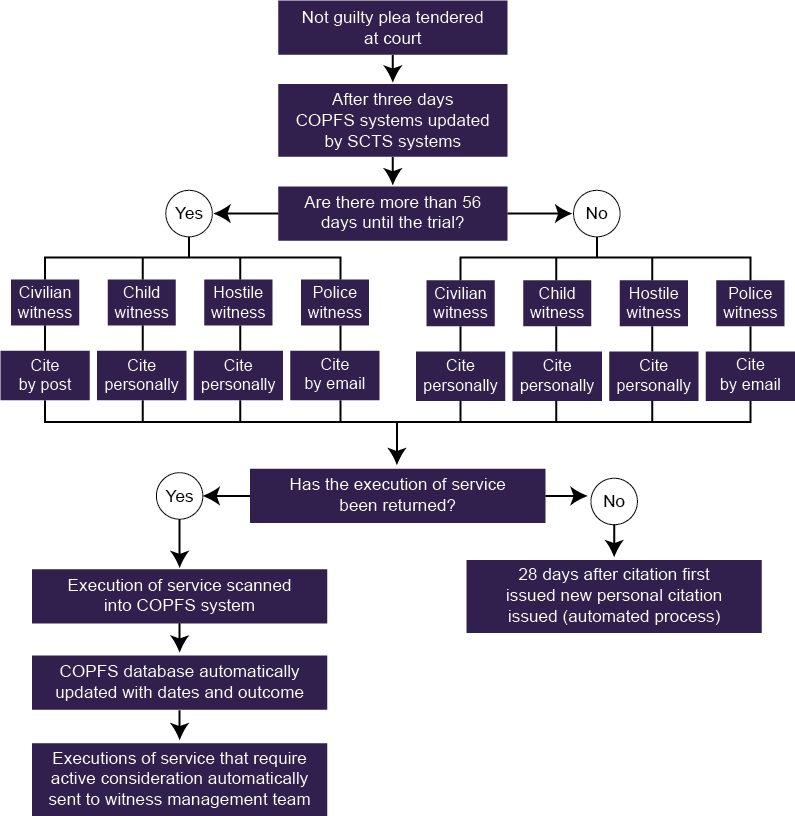
- In our case review, we found that citations tended to be issued promptly and well in advance of the trial.
- In summary cases ‘autocite’ relies upon data on assigned trials being transmitted from SCTS systems to COPFS overnight. In most cases, three days after the trial diet is assigned, an automated instruction is sent to the NPU and citations are posted to witnesses or to the local police office for personal service on the witness, where appropriate. Police officers who will be witnesses are cited automatically by email through autocite. The autocite system in summary cases defaults to postal citation other than in accordance with business rules previously described at paragraph 5.
- We heard that, due to a technical issue, police officers in legacy force areas could not be cited by email when autocite was introduced, for example, a police officer based in Lothian could not be cited by email if a case had been reported to a procurator fiscal’s office outwith Lothian. We were advised that this has been remedied, but some COPFS guidance on the autocite process needs to be updated to reflect this.
- Autocite does not trigger if the trial is less than 14 days away, in which case, COPFS staff require to use ‘on-demand’ citation for personal service. On-demand citations are discussed at paragraph 326. To prevent witnesses being cited too far in advance of the trial, the autocite system will not issue citations if there is more than 20 weeks until the trial. In such cases, the system will automatically wait until 20 weeks before the trial and then the instruction for the citation will be sent to the NPU for print and issue.
- We found that, in most cases, autocite works well. The process is timesaving and provides consistency of approach. However, it does not always work well if trials are ‘part-heard’ and we heard that it was difficult for COPFS to override the autocite function.
- In summary cases when evidence does not conclude in one day, the trial will be ‘part-heard’ and a further date will be fixed for the conclusion of evidence. It is anticipated that SCM will lead to more part-heard trials. The autocite facility cannot differentiate between a part-heard trial and an adjourned trial. Unless COPFS staff manually deselect witnesses who have already given evidence, the system will, after three days, reissue citations to them, so that witnesses who had already given evidence may be cited again unnecessarily. During the most recent IPS inspection, on how COPFS responds to enquiries through National Enquiry Point, there were calls from witnesses confused as to why they had been cited again when they had already given evidence.
- We heard that cases were not always processed within three days by COPFS administrative staff. It is apparent that case processing after court is an early indicator of resource issues in COPFS offices, but this is viewed as a lower priority than preparation for cases yet to call. This requires to be addressed by COPFS.
Recommendation 25
COPFS should develop a process to ensure that autocite is not applied for witnesses whose evidence has concluded in summary trials that are part-heard.
- In August 2024, COPFS staff carried out an assessment of personal citations issued in summary proceedings. Of the 4,914 personal citations issued during this period, 524 appeared to be contrary to business rules on personal citation (explained at paragraph 5). Despite the process being automated, we are aware that when administrative staff process cases after court, they must complete a checklist in the case management system for each case and that this can lead to override of the automated function. It is unknown if this is a contributory factor in additional personal citations being generated.
- As a result of the extra personal citations issued contrary to business rules, an instruction was issued to local court business managers to remind staff not to override the automated system. Training or reminders to COPFS deputes on the cost and impact of instructing unnecessary personal citation would also be beneficial. In the interim, as already set out, COPFS should investigate why personal citations are being issued contrary to business rules.
COPFS process for issue of sheriff and jury citations
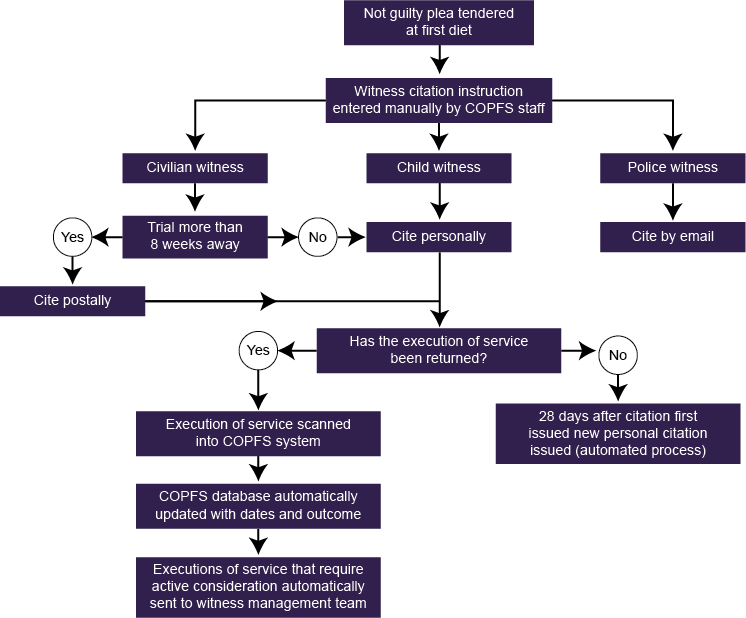
- In sheriff and jury cases there is no autocite facility and an instruction for citations to be issued requires manual input from COPFS administrative staff. Despite the lack of an automated process, we found that citations tended to be issued promptly after the first diet. Final decisions on which witnesses require to be cited cannot be made until after the first diet and, given the number of variables in a sheriff and jury trial ‘sitting’, there would be inherent risks in automated citing in sheriff and jury cases. The lower volume of citations in sheriff and jury cases allows for more tailored consideration of how witnesses should be cited, in comparison with summary citation.
- However, the lack of an automated process in sheriff and jury cases does create inconsistency in the type of citation issued. We learned that, in some areas, staff believed that all citations in sheriff and jury cases require to be issued for personal service. This meant that thousands of citations were issued each month for personal service by police officers when there was adequate time for postal citation. This has significant cost and resource implications for Police Scotland and the likelihood of increased stress for victims and witnesses caused by uniformed officers attending at home addresses unnecessarily.
- Before November 2024, there was no central guidance available to COPFS staff on the issue of sheriff and jury citations. We found there was a lack of awareness of the Handbook, which contains the guidance, among operational staff.
- In the month of November 2023, out of 2,729 sheriff and jury citations issued, 46% (1250) were personal citations in the first instance with more than eight weeks until the trial diet.[96] Seven months after the guidance was issued, in June 2025, out of 2,229 citations issued, only 14% (319) citations were issued personally with more than eight weeks until trial. Postal citations accounted for 4% of all sheriff and jury citations in November 2023 and 29% in June 2025.
- As previously described, in summary cases, autocite stops citations being issued when there are more than 20 weeks until the trial, to prevent witnesses losing or forgetting about citations. We found in our case review, examples of citations in sheriff and jury cases being issued in excess of 20 weeks. It would be preferable for summary, and sheriff and jury processes to match.
- Another discrete issue we identified relates to ‘roll-up’ or ‘conjoined’ cases. The most common example of conjoined cases is when an accused person is alleged to have breached bail conditions after a trial has been set for the case for which they are on bail. When this happens it is common practice for the court to fix the same trial date for the breach of bail allegation as the trial date already fixed for the original offence. Cases are conjoined for efficiency and to prevent witnesses giving evidence twice. As the witnesses will often be the same for both cases this can result in two sets of citations being issued for the same witnesses to attend the same court on the same date – one citation for the original case and a further citation for the breach of bail case. Two sets of citations create the risk of confusion, miscommunication and inefficiency which require to be addressed by COPFS, examples include:
- confusion for witnesses who may have already received their first citation and then receive a second citation
- miscommunication if information from a witness is recorded in only one of the two cases
- inefficiency with either postal or police personal service costs and time duplicated
- inefficiency and risk of confusion with any countermand processes duplicated.
Recommendation 26
COPFS should investigate why sheriff court citations are issued for personal service other than in accordance with business rules and ensure that remedial action is taken where necessary.
- In the police survey, when asked how effectively respondents thought the whole citation process is managed, 67% said ‘not at all effectively’ 32% said ‘moderately effectively’, and just 1% said ‘very effectively’.
- Once Police Scotland receives citations, either from the NPU by second-class post or DX (an end-to-end courier service), the citations are then administered by police staff or, on some occasions, police officers. They ensure that the details of the citations are recorded on the LDD. Officers said that the citations were usually received two to three months ahead of the trial, which allowed adequate delivery time, but those received with less time put pressure on police officers. When the NPU send citations to central police hubs to send on to local police stations for service this creates a delay.
- Police Scotland also receives ‘on-demand’ citations from COPFS. These usually have short timescales for service and are received by email, hand delivered to the police station or collected by officers from local COPFS offices. These have to be added to the LDD manually and allocated for service. We found that, in most divisions visited, short notice citations were dealt with by dedicated officers, due to the short timescales involved.
- As already discussed, the approach to service of citation varies across Police Scotland. Prior to Police Scotland becoming a single force, most forces used legal document servers, who were mainly police staff members with a dedicated role to serve legal documents including citations. The document server role ended in 2013 and the function of serving citations fell to police officers. Many of those interviewed felt strongly that a return to dedicated document servers would improve the process and reduce the burden on police officers. One officer gave the example of how the delivery of citations in their division was manageable, but only because it was allocated to a specific person and done as their full-time job.
- In some remote locations, we found a lack of clear ownership or accountability for the service of individual citations. Citations are typically allocated to a police station or officer in charge of a station, rather than to a specific officer. As a result, whichever officer happens to be on duty or covering that area will attempt to serve the citation when they are able. While this approach reflects a pragmatic response to the challenges of resourcing remote areas, it raises concerns regarding accountability. It falls short of best practice and undermines the ability to ensure transparency and accountability in citation service.
- We found from our case reviews and dip-sampling of cases on the LDD, that there were better enquiry updates and a more consistent approach in the divisions that utilised light duty or modified officers to deliver citations. One of the main reasons for the lack of consistency with operational officers is that they were trying to deliver citations while carrying out other duties. In our fieldwork, many police officers said that they did not feel that response officers were best placed to deliver citations, due to the reactive and often time-critical nature of their response activities. We determined during our inspection that serving citations was seen as a lower priority than other tasks by operational officers.
- We noted evidence that some witnesses simply cannot be traced, and therefore citations are not served. In such cases, it is essential that Police Scotland maintains a defensible position through robust record keeping of all attempts made to trace and serve those individuals. We were told in our focus groups with police officers that they do not always record every delivery attempt due to time constraints.
- We learned from our survey that the majority of witnesses preferred police officers who were not wearing uniform attending at their home to serve citations. This was also evident from our discussions with advocacy workers working with victims of crime.
- While we understand that plain clothed officers serving citations can enable a more trauma-informed experience for victims and witnesses, some concerns were raised about the safety of modified duty officers delivering citations in an area that they may have previously policed, while not carrying personal protective equipment (PPE). In one particular case, a modified duty officer who was working alone and not in uniform, did not carry a police radio, because of not wanting to be recognised as a police officer, and so was potentially vulnerable should an adverse incident have occurred.
- Some officers who were regularly involved in serving citations told us about their frustrations with a paper-based process. This included officers leaving calling cards with their email address, resulting in email correspondence, despite the officer being unable to email the actual citation. Repeated attendances to serve personal citations was another source of frustration.
- Officers reported that witnesses often directed frustration at them when they attended at the home, in the belief that any delays or repeated citation were the fault of the police.
- The remote nature of many locations, combined with limited policing resources, frequently hampers timely delivery of citations. We found that different divisions took different approaches to citation in rural areas. This included interrogating different systems to check or establish witnesses’ addresses, making initial engagement with witnesses by telephone, or text messaging either to check availability or to give them the option to attend a police station to pick up the citation. We were told by some officers that establishing early contact was the key to success, with most witnesses engaging.
- We heard accounts of officers travelling considerable distances to serve a single citation in rural areas. This practice is unsustainable and is not environmentally friendly, nor does it align with the expectations of a modern police service operating in a digital age, where communities are accustomed to more efficient and technology-driven solutions.
- Once a citation has been delivered by the police, they return the paper execution of service part of the citation back to their police station. How long it takes for an execution of service to return to the police station depends on whether the citation has been delivered by a response officer, a police officer or staff in a dedicated citations delivery role. We found that there is no consistent approach to what happens next in the process. Executions of service are usually collected in one place in the police station, in a box, where they await being sent back to the NPU in batches. The frequency with which batches of executions of service are sent back to the NPU varies, but usually only once or twice a week. The current process creates a delay of up to a week between delivery of the citation and its being received by the NPU for scanning. If the executions of service are sent back to the NPU by Royal Mail, which is the case for some batches, then the time taken can be even longer.
- This process is not only time consuming; sending the documentation in batches takes up resource and there is also room for error with a paper-based system. Alternatively, Police Scotland could scan and email the execution of service to COPFS. This process would be more cost effective, reducing the potential for error and enhancing environmental sustainability, and COPFS would be notified of citation delivery very quickly. Given that we learned that the executions of service are only retained by the NPU for a month – having a recorded scanned copy would be preferable, since it would afford an improved audit trail.
- As previously explained, Police Scotland witnesses are cited by email through a single national case management IT system. This system is linked to other systems, including Police Scotland’s SCoPE system. Officers and their immediate supervisors receive an email notification advising that they have been cited to attend court. The SCoPE system records the date officers are required to attend court; this allows the officer and Police Scotland’s HR department to keep track of the case and also affords Police Scotland oversight of how many officers have been cited for each court every day. This enables Police Scotland to make operational resourcing decisions if required.
- If a citation needs to be issued urgently, COPFS staff have the facility to issue on-demand citations. Such citations arise most often in summary cases where an accused is remanded in custody (requiring a trial to commence within 40 days) or other circumstances where there is insufficient time for the citation to be printed centrally and posted to the police. On-demand citations can be generated in the local COPFS office and emailed to the appropriate police station/officer for service.
- We learned that COPFS has an automated system to help identify cases where there is less than 14 days to the trial and witnesses have not been issued with citations through autocite. To create an on-demand citation, COPFS staff require to generate the document, save it to their own computer and then email the document as an attachment to Police Scotland for service on the witness – or arrange for officers to uplift the physical copy citation to serve.
- COPFS guidance about ‘on-demand’ citations in summary cases states that they should be printed and issued to the police for service. We heard that COPFS email these as attachments, which is in accordance with their sheriff and jury guidance instead. The guidance for sheriff and jury, and summary on-demand citations differs. In summary cases, the execution return date is two days before the trial, but there is no prescribed period in sheriff and jury guidance. Guidance is limited on how on-demand executions of service should be returned to COPFS – only that local practice should be used. Given the urgency in such cases, COPFS and Police Scotland should have clear mechanisms to ensure their effective management. We heard that return of the executions of service in such cases is often after the trial has passed and that executions of service are returned to the NPU, rather than the local issuing office.
- We also learned that there is a risk of two citations being served on witnesses, leading to likely confusion and duplication of effort by both COPFS and Police Scotland. This can occur when there is doubt about whether an original citation has been served and, rather than taking steps to investigate, Police Scotland will request that a new on-demand citation is issued for urgent service.
- When on-demand citations are issued to Police Scotland, they have to be manually added to their LDD system for management (for further discussion of this system see paragraph 497). When police officers record their attempts to serve these urgent citations on the LDD system, this information does not transfer to COPFS systems and COPFS staff will be unaware of service attempts.
- As COPFS staff email on-demand citations to Police Scotland from their own email addresses, there is a risk of an insufficient audit trail if they do not upload a copy of this to COPFS case management systems.
- COPFS cannot currently quantify the number of on-demand citations issued; however, we heard from Police Scotland staff that they are common. By necessity, such citations are urgent and require immediate resource allocation by Police Scotland. COPFS must therefore ensure that such requests are necessary and appropriate.
Recommendation 27
COPFS should:
(a) investigate why on-demand citations are issued and take steps to minimise their use;
(b) take steps to quantify and monitor the number of on-demand citations issued; and
(c) work with Police Scotland to ensure that information regarding on-demand citations is recorded on the Legal Document Database/Legal Document Exchange systems.
- As part of our review of cases, we found inconsistency in where key information on the citation process was recorded by COPFS.
- In summary cases, electronic case minute sheet notes in the case management system are the main store of information. These were often undated or unsigned, which led to difficulty understanding whether an entry related to the current citation cycle or a previous one. An absence of signatures also created the potential for a lack of ownership of citation-related issues and a lack of clarity over whether entries were for information only or requiring action.
- Our case review was conducted with access to COPFS case management systems, yet understanding the citation position at any given time remained problematic. Prosecutors do not have access to the full range of COPFS systems while in court and the information available to them is contained on an iPad; this will be a snapshot from the point at which the information was downloaded.
- In conducting courts, prosecutors require to be able to address the sheriff on the citation history and current position. We heard from one member of the judiciary that prosecutors were not always fully aware of the citation position while in court. The lack of a single document containing all information about witness citation makes the role of the prosecutor more onerous than it should be. Currently, it may not be immediately clear to prosecutors whether all of the witnesses have been cited or not (to assist the court to determine if the case is ready to proceed to trial).
- The witness citation status report is a useful tool to inform COPFS deputes of citation status and efforts by Police Scotland to serve citations. This is created from information supplied by the LDD. In our case review we found that, in some cases, a copy of the report was uploaded to the case management system, but this was inconsistent. In some other cases, a summary of what was perceived to be the citation position was recorded on a case minute sheet note by administrative staff. Guidance on when this information should be captured and uploaded to COPFS management systems is absent.
- In sheriff and jury cases our ability to review the management of the citation position was also challenging, due to the absence of information in COPFS case management systems. We learned that, in some areas, staff use spreadsheets or other documents to maintain a record of issues, including citation and excusal, and that these are stored separately from COPFS case management systems. As with summary cases, there was inconsistent uploading of the witness citation case report.
- A simplified, consistent and central record of witness citation is required. With the advent of SCM this is of particular importance, given the removal of intermediate diets. To prevent unnecessary adjournments at trial due to citation failure, COPFS staff must be able to efficiently identify difficulties with citation to allow for remedial action where appropriate.
- In January 2025, COPFS published guidance for sheriff and jury administrative staff about maintaining a full electronic record of all court minutes, case instructions and correspondence (including emails and memos from Police Scotland) in the case management system. The witness contact record has been a concern in IPS previous inspections[97] and remains so. Our case review found several examples of key information provided by witnesses stored in this repository that did not make its way to court prosecutors. We learned that some COPFS teams/units that feed into the citation process, such as the WMT, WET and NEP routinely record important information in the witness contact record. This is an area of COPFS systems seldom accessed by other COPFS staff despite a reminder having been issued that this should be checked on every occasion when dealing with a case. To comply with the guidance and to ensure there is a full record, it would be preferable for the WET and WMT to also upload emails into the case record that they send to local offices, until a centralised record is created. During our inspection, we learned that COPFS has established a working group to attempt to solve the issue of a lack of central contact record.
- It is clear that COPFS staff do not routinely telephone witnesses when there is ambiguity over citation status, to check if they have been cited and are able to attend the trial. COPFS staff place great importance on obtaining an execution of service of citation which, in most cases, would allow a witness warrant[98] to be sought, to ensure a witness attends court. While there was some evidence of COPFS sheriff and jury prosecutors telephoning witnesses ahead of and during a ‘jury sitting’, this was not the norm. It is apparent that this would be a more efficient use of resources than always asking Police Scotland to make such enquiries. It would also align with enhanced witness engagement and a trauma-informed approach. Our case review highlighted that Police Scotland is now making concerted efforts to provide telephone numbers for witnesses and, for the sake of efficiency, COPFS must be prepared to use them.
- We also noted inconsistent communication between COPFS and Police Scotland when information was needed about whether witnesses had been cited personally. In some offices, COPFS staff felt that there were good relations with local police, but that was not universal. In one office the relationship was so poor that some COPFS staff advised that they no longer asked the police for this information since they would either receive no response, or the police would advise that there had been insufficient time to serve citations. Reducing the number of personal citations issued, along with increased, consistent and accurate electronic recording of the citation position on the LDD/LDX system, would go some way to overcoming these communications issues.
Recommendation 28
COPFS should:
(a) introduce and monitor the use of a single document in which all citation records and information are recorded; and
(b) ensure that staff consistently carry out checks on the citation position and record the citation status for each witness in COPFS case management systems.
- The pilot of SCM, which began in September 2022, was underpinned by judicial practice notes. The national rollout of SCM has now been completed; however, the latest practice note makes significant changes to the working model of summary business and court practice that are worthy of comment.
- A fundamental element of summary procedure since 1980 has been the intermediate diet. Intermediate diets were introduced due to a concern over late guilty pleas and wasted court time. Accordingly, summary citation processes were designed with the intermediate diet in mind. The latest SCM practice note has the effect of removing the intermediate diet in almost all sheriff summary cases. Intermediate diets will not be assigned unless necessary and there is no guidance available to sheriffs on when such a diet is necessary.
- The main purpose of an intermediate diet is to allow the court to ascertain whether a case is ready to proceed to trial. The Crown and defence are expected to advise the court whether witnesses have been cited or not. When an accused pleads not guilty, an intermediate diet and trial dates are set by SCTS. Intermediate diet are two to four weeks before the trial date. The volume of summary business does not always permit COPFS to consider issues arising between court diets, including citation issues. Preparation tends to focus in the week ahead of intermediate diets.
- There is an absence of guidance for COPFS staff on how the removal of intermediate diets should be addressed, with COPFS offices responding on an individual basis. Citation issues such as reluctant witnesses, witnesses changing address, becoming unwell or requiring medical appointments, are commonplace and will often be unknown at the time citations are issued, despite the best efforts of Police Scotland and COPFS to frontload cases. It is against this background and experience of sheriff and jury procedure in which there is also no intermediate checking stage, that such internal systems must be designed.
- The removal of the citation review process necessitated by intermediate diets creates a significant risk in summary procedure of citation failure or related key information not being adequately identified and managed. We found evidence of this risk manifested in the sheriff and jury cases we reviewed – cases with no clear ownership and the real potential for important issues not to be addressed. This is relevant, as SCM mirrors sheriff and jury cases, with no court calling between assignation of trial and trial. This risk is illustrated in the following case study.
Case study
In one sheriff and jury case reviewed, there was information provided that established an accused person could not have committed one of several offences on an indictment. This information was contained in a police memo that was not seen by COPFS staff until the day of the trial – despite it having been in COPFS systems for a matter of months. As a consequence, witnesses were cited who should not have been and those witnesses, including the victim of a crime, attended court only to be advised of the error. There were other serious charges on the indictment and the case resolved at the trial in a plea of guilty to some of the remaining charges.
- We learned of one SCM office where intermediate diet preparation has been replaced by reviewing of cases by legal staff. A depute engaged in these checks advised us that staff attempted to look at ‘as many of these as possible’ in the time allocated. While a form of review is welcomed, it is a matter of concern that there is already an apparent reduction in the importance of case reviews and isolated, individual local practices rather than standard. In intermediate diets, every case would have been subject to review, including whether witnesses had been cited.
- In one office in our case review, checks on the citation position by administrative staff were carried out a week before the trial, However, we found no evidence that citation issues were brought to the attention of legal staff. In Dundee, there has been an increase in applications to adjourn trials by way of joint application with the defence,[99] which is evidence of active management of summary cases, with administrative staff tracking the applications and replies from the court. Without such checks there is a risk of trials being administratively adjourned and witnesses who have been cited not being countermanded. It is imperative that, when such administrative adjournments are granted, Police Scotland citation staff are informed immediately.
- Administrative adjournments can be a slow process and this needs to be taken into account, so that witnesses can be countermanded timeously. There is an absence of guidance on when such applications are appropriate and COPFS should address this.
- Issues discussed in respect of such adjournments in summary procedure are mirrored in sheriff and jury procedure, governed by section 75A of the Criminal Procedure (Scotland) Act 1995.
- In our small sample of reviewed cases, we found evidence of inadequate management of cases between witness citations being issued and sheriff and jury trials. It was common for there to be no active consideration of trials for several months at a time, which was acknowledged by operational COPFS staff. Aside from creating the risk of citation failure, leading to cases being adjourned or discontinued, it also tends to lead to last minute attempts to remedy situations that could otherwise have been prevented.
- As with SCM, COPFS does not specify when the citation position should be reviewed in sheriff and jury cases, and practice varied on how this was managed. In one area, we heard that administrative staff used a spreadsheet, which recorded the witness position around six weeks prior to the trial, but this was not stored in the COPFS case management system. In another office, the citation position was not reviewed until one week before the trial. As already observed in summary cases, a central citation record, along with a consistent national approach, would assist. It is apparent that in many sheriff and jury cases the review and management of citations is inadequate, with key information not being sought or actioned until too close to the trial diet. The consequence of such failure demand means an additional burden on COPFS staff; this is often then shared with Police Scotland officers who are required to attempt to cite essential witnesses in serious cases at short notice.
Case study
In one sheriff and jury case we reviewed, there were two civilian witnesses to an incident involving a knife. A witness engagement letter was returned indicating that one witness had changed address. There was a note in the witness contact record of COPFS systems that this information had been emailed to the local procurator fiscal’s office by WET, but there was no record of the email. COPFS systems were amended to reflect the address of the witness as ‘unknown’. No further action was taken until the citations were generated six months later, whereupon a postal citation for the witness was generated with ‘address unknown’. Fortunately, staff at the NPU prevented this from being posted and alerted the WMT, who requested the reporting officer obtain an up-to-date address for the witness. There was no record of an attempt to telephone the witness by WMT. The reporting officer provided a response quickly, with an updated address but the same telephone number that WMT already held. No action was taken in respect of this new address for four and a half months. Six days before the trial, an on-demand citation was issued to Police Scotland in an attempt to remedy the situation. The citation was returned, unserved, to COPFS after the trial sitting had concluded. As a direct result of the non-attendance of the witness, a plea to a significantly reduced set of charges was accepted by the prosecutor. Further negative consequences included lost time for four witnesses (including three police officers being cited for court) and the added cost of attempts to urgently serve the citation.
- A change or incorrect address being identified once citations have been issued is common. We have already noted that there are numerous areas within COPFS systems for information to be recorded, including a new address. Updated witness addresses in VIA minute sheets are one area in which this can arise. COPFS staff should be mindful that witnesses require to be cited at their current address and that a failure to properly record/share that information can lead to citations being issued for incorrect addresses, with Police Scotland wasting time and resource attempting to serve citations at out-of-date addresses.
Recommendation 29
COPFS should implement and monitor a process to ensure that when witnesses change address, citations are issued to the correct address and Police Scotland staff serving citations are notified of the new address.
- We found that return dates on witness citations issued for personal service caused confusion for COPFS and Police Scotland. There is a longstanding agreement between both organisations called ‘Witness Citation Target Agreement’ in which it is agreed that COPFS will print a target service date on each citation issued for personal citation. This was to allow for more effective monitoring of performance and to give the police more time to serve citations. It is unclear whether these objectives have been met.
- Despite this return date, we heard from both COPFS and Police Scotland that there is an expectation that attempts at personal citation should continue until the trial. While the return by date may allow for prioritisation of service by Police Scotland, there is scope for confusion about the purpose of the return date among officers serving citations. We heard from staff in the WMT that they routinely dealt with personal citations that had been returned to them, unserved, before the trial, with no indication of why they had been returned. Police Scotland can receive citations from COPFS with return by dates that have already passed. While the agreement between COPFS and Police Scotland related to summary cases, we note that sheriff and jury citations also contain such return by dates.
- As part of our review of cases, we considered COPFS case management systems and noted that one electronic record on the system is called ‘execution date’. We learned that the dates recorded in this record are not the date on which the citation was executed (served) but rather, the date on which the returned execution of service is scanned into COPFS systems. This is misleading. The difference in dates can be due to postal delays or delays in returning the execution of service by Police Scotland in personal service cases. It is unlikely that prosecutors will always understand the potential for such delays, with the potential risk of courts being incorrectly advised about when citations were actually served on witnesses
Recommendation 30
COPFS should:
(a) review the use of ‘return by’ dates printed on personal citations and ensure that the purpose of the date is understood by both COPFS and Police Scotland; and
(b) review the use of the term ‘execution date’ in COPFS case management systems.
- When essential witnesses are not cited or it is unclear if they have been, COPFS should decide if the purpose and timing of a citation review by a prosecutor before a trial is to:
- allow for further work to attempt to remedy citation failure before a trial; or
- end the citation process and assess how the case should proceed – by way of a motion for adjournment or discontinuation.
- The first approach allows Police Scotland to continue efforts to cite witnesses until the trial. Experience suggests that some witnesses who have not returned their citation postal reply will attend court on the date of the trial and, further, that many witnesses will be personally served in the days before a trial. This model maximises the time available for service of citations.
- A benefit of the second approach would be increased certainty that the cases set for trial will likely proceed, whether with fewer witnesses or an acceptance that charges may be reduced. To work on this basis would require a cultural shift and clear communication with Police Scotland and the judiciary that the review date is the endpoint for citation efforts.
Recommendation 31
COPFS should issue guidance in sheriff court cases on how and when citation status should be reviewed.
- In the current sheriff and jury citation model, witnesses are usually cited for the start of sittings. In the week prior to the sitting, the prosecutor provides a running order of the cases to COPFS administrative staff. The working day before the trial, administrative staff attempt to contact all witnesses in the sitting and advise them what day they should attend. COPFS staff tend to email the police resource deployment units (RDUs) or local liaison officer for police witnesses, and telephone civilian and professional witnesses. We found that civilian witnesses were often advised not to attend on the date stated in their citation and that they would be contacted once a date was known. This was particularly problematic in the area where fortnight ‘sittings’ had been re-instated. If they cannot be contacted by phone, in some areas Police Scotland will make efforts to contact the witness and if this unsuccessful, the witness is left to attend court needlessly. This current process is highly inefficient. We note that, if scheduling of sheriff and jury trials were restored to the 2017 reforms model, then the need for this rescheduling should be greatly reduced.
- Police witnesses are re-scheduled as necessary during a sitting by contact between COPFS administrative staff and the RDUs of Police Scotland. We heard that if this information is provided late in the afternoon there can be an issue reaching police officers who are no longer on duty.
- The COPFS WMT is integral to the citation process. The WMT deals with returned unserved citations and executions of service that need to be considered due to issues such as unavailability, incomplete executions of service and confusion over the status of the citation. Since creation of the WMT around three years ago, it has subsumed the Witness Engagement Team (WET), and all staff now carry out the functions of both teams. We were advised that, at the time of inspection, there were seven full time equivalent staff and a section manager.
- Prior to the creation of the WMT, local COPFS offices or specialist units dealt with returned citations and executions of service that required further action. Despite this large burden of work being removed from local offices in COPFS, we found limited knowledge in the organisation of the existence or role of the WMT. The WMT has multiple citation roles which are often blurred and overlap with responsibilities of the local offices.
- There is guidance on management of returned citation mailboxes on the COPFS intranet that needs updating, as it was written for local court and not WMT staff. We learned that updated guidance has been created but awaits final authorisation. Publication of such updated guidance for WMT staff could raise awareness of the role of WMT across COPFS and provide consistency of approach within WMT, particularly communication processes with local offices.
- When physical executions of service and unserved citations are returned to the NPU by Royal Mail or Police Scotland they are scanned, and a barcode identifies the relevant case and updates COPFS systems that the document has been returned. This optical scanning system identifies the issue with the returned document and filters it to one of six email folders for WMT staff to consider. These folders are:
- late replies
- will not attend
- not served
- status unclear
- was served (extra info)
- will attend (extra info).
- It is not currently possible for WMT staff to prioritise work in order of the date of the impending trial due to the manner in which information is stored on email folders. To limit the risk caused by this, we were advised that staff work from the oldest email to the newest. Staff reported that they had experienced opening emails to find that the trial the citation or execution of service related to had passed. This has clear implications for both customer service and the efficient conduct of trials.
- The majority of the WMT’s work is responding to emails in the ‘will not attend tray’. This includes witnesses who have advised they are unable to attend and citations that have been returned as unserved. We heard that this tray could have up to a three-week backlog. An internal three-day target for emails in each tray to be processed was often missed. WMT is now also required to deal with undelivered letters sent to witnesses, inviting them to access the online witness gateway. Such additional work inhibits the ability of WMT staff to respond to citation related replies timeously.
- WMT guidance is inadequate on how urgent issues should be communicated to local offices. To be effective, such guidance must align with processes in local offices to review cases, otherwise important information can be missed.
- In some circumstances WMT staff are required to telephone witnesses to give advice, or to seek information when a citation is returned. We found that there was no guidance for WMT staff on call handling and no method for WMT managers to monitor the quality of such calls. This is concerning, given the potentially difficult or sensitive nature of some of these calls. There was also a lack of monitoring to ensure that calls were actually being made, rather than a default to letters being issued.
- We found weakness in communication between WMT and local offices. In summary cases, WMT staff tended to record information about a specific citation in the minute sheet note in the case management system. We also noted in our case review that WMT adds digital ‘sticky notes’ to the scanned-in PDF of the returned document in the case management system. As noted previously (paragraph 333), in the absence of a central COPFS record for citation issues this is a useful tool to record information – but only if staff in local offices are reviewing it. WMT staff are often aware of a lack of response from local offices to issues previously communicated, but have no process for escalation, so will simply add a supplementary note when this occurs. This is part of a wider issue – local offices are unaware of new correspondence/notes on electronic case files, and cases are not looked at by local court staff until preparing them for court.
- A common example of inaction by local offices relates to citations returned where a witness has moved address. When this happens, WMT staff update the witness’s address on COPFS systems to ‘address unknown’ and send a memo to Police Scotland requesting an updated address for the witness. We found many examples of new addresses being provided to COPFS by Police Scotland, but no subsequent action by COPFS staff to update the address in the system. Thereafter, citations are issued with ‘address unknown’ and passed to the Royal Mail. Some of these citations are identified by staff at the NPU prior to being posted, but not all. We questioned whether COPFS IT systems could be adapted to alert staff when an instruction is issued to print an ‘address unknown’ citation, but were advised this would be problematic. Despite the perceived difficulties, it is apparent that a consistent naming convention among staff, together with an IT script-based solution, could identify and eliminate such citations.
- We also heard from WMT staff who had noticed citations being issued or re-issued when COPFS had previously been alerted that a witness had died. We learned that an attempt had been made in one office to address this, with Police Scotland agreeing to advise of witnesses who had died by sending an email to a specific local management inbox. Given the sensitivity of this issue, COPFS staff should follow a single, national process.
- COPFS case systems already have an inbuilt facility to prevent citations being issued when a witness has died, so staff are either unaware of this or are using the system incorrectly. It is also possible that – since information such as the death of a witness may be recorded in a number of different places in the case management system – such information is often missed. Current guidance on this is outdated, but correct use of COPFS case management systems and guidance is essential, so that witnesses’ families are not further distressed by re-issued citations for their deceased loved ones.
- We also heard from WMT staff that VIA staff often learned of new addresses for witnesses given their specific contact role. However, WMT staff experienced inconsistent updating of addresses on COPFS systems by VIA staff. We also found examples of this in our case review, with staff across COPFS failing to consider the citation process and either not updating addresses, nor appreciating that a new citation would be needed or cancelled when a new address was obtained. This situation has the potential to be exacerbated with enhanced victim engagement (EVE) in SCM, which will lead to more information obtained from victims needing to be properly recorded. It is imperative that when COPFS staff contact a witness who may or has been cited, that they confirm the witness’s current address and review the citation position if that address has changed.
- In sheriff and jury cases, WMT staff will add an electronic case note and email the local office with the relevant information. Given the number of documents in sheriff and jury cases, the risk of a case note being missed by local sheriff and jury units is high. We learned that emails from the WMT alerting sheriff and jury units about issues with citation are not uploaded by WMT staff to the case management system. Similarly, we found no evidence to show that emails that had been sent were being uploaded by local offices. This prevents an effective audit trail.
- A potential benefit of a centralised WMT is the ability to identify common areas of failure in citation across offices or nationally. Staff told us about issues concerning the service of citation on doctors, and problems with addresses (for example, incomplete flat numbers or postcodes). We found there to be inadequate communication between WMT, Police Scotland and local COPFS offices and units on these issues with a view to service improvement and learning. Given their overview, a WMT focused on service improvement and engaged with other units in COPFS and Police Scotland should be a useful tool in solving such issues and improving the overall citation process.
Recommendation 32
COPFS should:
(a) ensure that guidance for the witness management team staff is published internally;
(b) implement systems that allow the witness management team to prioritise work by trial date and monitor implementation of this;
(c) create processes to ensure effective information sharing between the witness management team and local offices;
(d) ensure that the witness management team is sufficiently resourced to be able to respond efficiently and timeously to returned citations and executions of service;
(e) prevent citations being printed and issued where there is no known address;
(f) prevent citations being issued to witnesses who have died; and
(g) implement a service improvement process arising from any systemic issues identified by the witness management team.
- When COPFS has a mobile telephone number for adult witnesses it will send text messages at key stages to encourage responses to a citation or attendance at court. This is an automated process. Shortly before the citation is printed, witnesses are sent a text from COPFS advising them that they will receive a citation. An open-source internet search reveals that this text can cause confusion for some, with online posts enquiring if this text is a scam. This is unsurprising, as we could not find any evidence that witnesses were advised that they might receive text messages from COPFS. As discussed at paragraph 193 and at recommendation 9, COPFS should provide information on its website about the citation process, including when and how COPFS will communicate with witnesses about attending court. This should include information about COPFS text reminders and should include the telephone number used to send the text to provide reassurance that the message is from COPFS.
- Ten days after the citation is issued, if the reply form has not been received by COPFS, a further text is sent to the witness asking them to complete and return the form as soon as possible or to telephone the COPFS National Enquiry Point.
- A further text message is sent four days before the trial date, stating that the witness must attend court and giving the National Enquiry Point telephone number again. The automated system draws information from COPFS case management systems. This means that any backlogs or errors in processing within COPFS can lead to witnesses receiving text messages instructing them to attend court when they may not be needed.
Case study
A witness received a text message stating that she must attend court four days later as a witness. She was in possession of two postal citations for different dates for the same case. One citation was a trial date in four days and the other for a date some months in the future. Due to backlogs in case processing, a countermand had not been issued for the trial in four days. That trial had been adjourned 11 days prior to the witness receiving the text reminder. The witness correctly concluded that her attendance would only be required for the later date, but became concerned when she received the text stating that she must attend court for the earlier trial. The witness attended at the sheriff court to make enquiry before being directed to the procurator fiscal’s office, where staff confirmed to the witness that she would only be required for the later trial. This example illustrates the danger in having systems for citation, countermand and text reminder that work independently of each other.
- As we learned, there is a particular issue regarding the citation of doctors. Doctors are often cited to court to give evidence about injuries or treatment, or an opinion about causes of injury. The most recent sheriff and jury practice note emphasises that Crown and defence will be expected to be able to address the court on agreeing medical evidence. Despite such an emphasis on agreeing this evidence, doctors are often cited in sheriff and jury cases.
- The nature of medical training is such that many resident doctors move from one hospital to another, within the UK and abroad, and will often have moved by the time a citation is issued. Our case review showed that significant police resources are often used in locating doctors. Police officers must ensure that the full contact details for doctors are taken when the statement is given, including their email address, home address, mobile telephone number and full work address (including any future work addresses). However, these issues could be avoided if medical staff and other professional witnesses were cited by email.
- As with medical evidence, the most recent sheriff and jury practice note expects Crown and defence to address the court on agreement of forensic evidence. Two forensic scientists prepare a joint forensic science report which is the basis of their evidence. It is not always possible to agree forensic evidence, and we noted that there is inconsistency in how forensic scientists are cited. COPFS guidance states that such witnesses ‘are usually’ cited by personal service. Our case review found evidence of both postal and personal citation, with personal service being used more often. However, personal citation of forensic scientists is a wasteful and inappropriate use of police resources in most cases. For instance, we learned that, in some locations, one member of staff at a laboratory will sign to accept the citations for numerous colleagues across multiple cases. This defeats the fundamental purpose of personal service of a citation.
- In the West of Scotland, Forensic Services Operational Support team are responsible for the receipt, recording, and distribution of citations for forensic witnesses and will liaise with any local COPFS offices where necessary. In other areas, the Forensic Services Operational Support team will simply distribute the citations and these processes fall to the scientists themselves, which is inefficient and takes them away from their scientific work. In our focus group with forensic scientists, we were told that some can spend several hours a week trying to determine if cases are going ahead, which has an impact upon their workload.
- SPA Forensic Services advised that in the West of Scotland there exists a long standing automatic standby arrangement with COPFS for forensic witnesses. The effect of this is that a cited forensic witness will not attend court unless they are contacted by COPFS staff. We learned that on occasion this arrangement can result in forensic scientists not always attending court when it was necessary for them to do so, not always submitting excusal requests and therefore impacting on case progression. In our focus group with forensic scientists, we were told that in the East of Scotland, which does not have any such standby arrangement, forensic witnesses can spend several hours a week trying to determine if they require to attend court and if their cases are still proceeding to trial, which has an impact upon their workload. We found that a lack of reference to this standby arrangement in COPFS guidance and prosecutors in the West of Scotland made no mention of it in our interviews. We heard that some prosecutors gave effect to this standby arrangement but COPFS guidance to staff requires to be updated to reflect any such arrangement to ensure consistency of approach. We question why there is not a single consistent national approach.
- Due to the number of citations received, forensic scientists can be cited to multiple courts on the same day with no internal COPFS or SPA Forensic Services process identifying this. The consequence is that the forensic scientist will not know which court to attend without proactive steps on their part.
- We heard that many forensic scientists do not complete the availability letter in sheriff and jury cases, due to the number of times they are cited against the limited number of times in which they give evidence. This was supported by our case review: in one case, a trial had to be part-heard because the forensic scientist did not attend due to maternity leave absence; and, in another, an excusal request was not received until the sheriff and jury sitting had commenced – despite the citation being served some months previously. This approach clearly needs to change and improve.
- The Witness Gateway may be a method to improve knowledge of citation dates for forensic scientists, but it will not address the fundamental issue that of those cited, only a small percentage are required to attend court and a smaller percentage yet give evidence. COPFS should do more to reduce the number of forensic scientists cited. However, when forensic scientists are cited, there should be consistent and national approaches to their citation, standby arrangements and provision of evidence by remote means. Email citation should be the initial method of citation.
Recommendation 33
COPFS should cite professional witnesses by email and ensure that there are consistent and effective national standby arrangements for these witnesses.
Recommendation 34
The Scottish Police Authority Forensic Services should develop a consistent national approach and administrative process to manage court witness citations issued to forensic scientists.
- Civilian, police and professional witnesses seek excusal from attending court for a variety of reasons. Our surveys sought to understand these reasons.
- Witnesses will first become aware of the trial date that has been fixed by the court through receipt or service of the citation.[100] It may be that the trial date scheduled by the court is not suitable for the witness to attend. This could be for a number of reasons including:
- the police did not take a note of witness availability when they took a statement
- the witness was not asked by COPFS to provide their availability
- the witness did not provide COPFS with their availability
- the availability of the witness was not taken into account when the court set the trial date
- the circumstances of the witness changed.
- Any witness seeking an excusal has to submit a formal written request to the Procurator Fiscal. The circumstances should be considered by a prosecutor with reference to the prosecution case and a decision reached whether the witness can be excused from attending court or not. It is important to note that, in sheriff and jury proceedings, Crown witnesses must be made available to the defence if they have stated at the first diet that they require a Crown witness as part of their defence case. Such witnesses, once cited, can only be excused from attending court with both Crown and defence consent.
- The number of requests received by COPFS from witnesses seeking excusal from their witness citation is linked directly to witness availability and court scheduling. If witness availability is not proactively ingathered by COPFS and Police Scotland, and is not taken into account by SCTS when scheduling trials, then the number of witnesses seeking excusals will naturally increase. This is a further example of failure demand in the system. Excusal requests cause:
- lost time in the submission of excusal requests by witnesses
- increased work for COPFS in processing witness excusal requests
- anxious waits for witnesses to hear from the prosecutor whether they are excused from attendance at the trial
- trials adjourned and the journey time of cases for victims, witnesses and accused persons extended
- churn of cases in the justice system.
- A prosecutor has to balance many matters when considering an excusal request. These include the reason for the excusal, the procedural history of the case, whether the prosecution can prove the case or a particular charge without that witness, or whether the prosecutor should seek an adjournment of the case to enable the witness to attend at a later date. An excusal is not automatic and can be refused by the prosecutor. If an excusal is refused, the witness remains under legal citation and is obliged to attend court.
- Excusal requests from civilian and professional witnesses can be received by the prosecutor in a number of ways (including phone, letter and email). Excusal requests are also submitted to different departments across COPFS, but all require to be considered by a prosecutor. Written communication will be scanned by COPFS office or NPU staff and imported into the case on the case management system, together with any supporting documentation from the witness evidencing their lack of availability on the date of the trial. The limitations of the COPFS case management system means that it will highlight that a new document has been received, but not the nature of the document.
- For postal citations, civilian and professional witnesses can complete the postal reply form describing any difficulty they have in attending court for trial. This could relate to such matters as a pre-booked holiday, a hospital appointment or another commitment or difficulty. Along with the form, they must submit evidence, such as a copy of the holiday booking confirmation, and return it all to COPFS in a pre-paid envelope.
- Professional witnesses told us of prosecutors requesting evidence of a holiday booking and many viewed this as questioning their professionalism and duty to the court. This was reflected in our survey where one witness stated the following.
Public survey respondent
“As a Professional witness when receiving multiple citations, we would never get any annual leave if the annual leave is not respected. To have this challenged isn't good practice”.
- While we appreciate such frustrations, it may be that the court (rather than the prosecutor) will insist on such vouching if the case has to be adjourned due to the non-availability of the witness. The Handbook should be clear to COPFS staff when vouching should be sought.
- The citation pack for witnesses (sent by post or served by police officers) does not provide full guidance to civilian and professional witnesses on the excusal process and what action they should take if they have another commitment on the date of the trial and are unable to attend. There is only brief information on the postal reply form. In our public survey, only 40% of victims and witnesses who had received a citation knew how to request an excusal. For professional witnesses, this increased to 70% , likely due to knowledge of the court process.
- Witnesses often phone COPFS through NEP with excusal related questions. In the IPS inspection report on NEP, we noted in the audit that witnesses contacting COPFS via phone or email with either citation related enquiries or excusal from court requests is common, and that much of that demand could be reduced by providing better information on the excusal process on the COPFS website.[101] In that inspection, we audited 200 enquiries[102] and found that 13% related to citation and 14% to witness availability or excusal. NEP operators will usually advise witnesses to submit an excusal request to COPFS in writing (by email or letter). This information, along with general guidance about what to expect if cited as a witness, should be clearly set out on the COPFS website to assist witnesses – for example, how long a witness should expect to wait for a response to an excusal request and examples of the reasons which may be acceptable for a person to submit an excusal request. This should be captured by COPFS in implementing recommendation 9.
- Police excusals requests require to be set out in a particular form and include certain information. COPFS and Police Scotland’s protocol[103] on police witness excusals aims to:
- encourage co-operation between Police Scotland and COPFS
- reduce unnecessary public expense
- consider officer’s work/life balance.
- This protocol states that acceptable reasons for police witnesses seeking an excusal include:
- annual leave
- national training which is critical to the role of the witness and where standby is not appropriate.
Excusals for personal reasons will be assessed on their individual merits and take account of the police witness’s work/life balance and welfare. Suitable personal reasons include bereavement and hospital appointments. We heard from police officers that the guidance was insufficient.
- We found that the current excusal process for police and forensic scientists is not fit for purpose. It is inconsistent, inefficient and opaque, and COPFS can take a long time to respond to excusal requests. Of our police survey respondents, 95%[104] said that they felt as though they had not received a prompt response to their excusal requests. The system was variously described as a “shambles” and “an absolute disgrace.”
Police survey respondent
“The entire excusal system needs to be reviewed as it is a broken system for actually receiving any response.”
- The main themes taken from the survey and from the focus groups with police officers and forensic scientists are set out below (we have considered issues particular to forensic scientists at paragraph 383 above).
-
Lack of response – police officers and forensic scientists frequently receive no reply to excusal requests. This results in multiple, time-consuming attempts to seek a response. One officer reported making 23 phone calls the day before going on holiday to confirm an excusal. Another described submitting an excusal three months before his annual leave period, but felt unable to book a holiday as he did not receive a response. Several officers described how they felt that holidays abroad were given greater priority for excusal than holidays within the UK, or planned periods of annual leave at home. We heard from police officers that they feel they are expected to respond quickly to requests from COPFS, but do not receive the same courtesy in return. There is a strong perception of inequity and lack of respect for officers’ time and commitments. This underlines the recurring theme across our inspection activity – that communication is not always what it could or should be between organisations, with fault on both sides perpetuating matters.
Police survey respondent
“Court excusals are never answered. As police officers we are expected to answer the PF within days however we don’t receive the same [courtesy].”
-
Delayed responses – when responses are received, they are often last-minute, causing disruption, uncertainty and stress – and sometimes forcing emergency arrangements or cancelled plans. Officers often do not receive confirmation that their excusal request has been received or processed. This uncertainty can result in officers attending court unnecessarily or taking leave without the excusal being granted. Some felt this exposed them to personal risk of being held in contempt of court or arrest for non-attendance. Forensic scientists also said that they may still attend court unnecessarily because of unclear or delayed responses.
Police survey respondent
“The ridiculous delay in the decision to grant an excusal or not means that arrangements during annual leave are extremely risky and as such I have missed out on events involving friends and family.”
- Lack of communication – we were advised that police witnesses had no direct or reliable way of contacting COPFS and felt that a more communicative partnership approach was needed. This has been particularly hindered by court liaison roles within Police Scotland being phased out. There is no guidance for officers about what they should do if they do not receive a response to their excusal request. Other than submitting a second excusal request there is no national escalation processes that officers should follow.
- Operational impact – managing excusals and preparing for court is time consuming for police officers. We were told that some officers who had been cited to attend court were not permitted by COPFS to attend non-critical training courses on the court date as they required to attend court as a witness. A loss of training days can have an impact on the continuing professional development of officers.
- Personal disruption – police officers reported disrupted rest days and delays to re-rostered rest days, which had an impact on their rest and recuperation. Both police witnesses and forensic scientists felt unable to plan or take their annual leave with confidence, and some reported lost annual leave if cited to attend court frequently.
- Financial loss – police officers advised that they can experience financial loss through delayed excusal responses relating to cancelled or rearranged plans or holidays. We were told of a particular situation when officers are countermanded by COPFS more than eight days before the trial, they are no longer eligible to work and be paid. They may still end up paying for any additional childcare already arranged, since childcare settings often have minimum cancellation periods and will still charge.
- We heard that, for police officers on maternity leave (i.e. who could be on a reduced income), being cited to attend court could result in their being out of pocket due to the childcare costs incurred. For those on maternity leave, it may be difficult to plan for childcare when they believe they are cited for a particular date but then have to be available for the 10-day trial period in a sheriff and jury case, since this may require them to arrange and pay for childcare for the entire period.
- The Police Officer Handbook[100] sets out expenses that officers can claim when cited to attend court. Childcare is not mentioned. We were told by Police Scotland that police staff are entitled to claim for registered childcare costs where the attendance at court has resulted in additional expenses. However, this does not extend to police officers. The Police Officer Handbook states that ‘Where officers incur other expenses in the execution of their duty, they shall be entitled to be reimbursed provided that the expenditure is necessary, reasonable and backed by a receipt (where possible)’. We could not find any evidence in our inspection that the issue of expenses for police officer childcare costs incurred due to court citations had ever been considered.
Police survey respondents
“It is EXTREMELY frustrating to have to find and pay for childcare on what should be my rest day, when I should be spending time with my child on my one or two days I have off a week; hoping the nursery has space for her and then paying £85 for a day’s childcare, to be cited as a witness for something very minor, then to be stood down from court without even giving evidence. I have no family nearby who can provide childcare. My husband has also had to take annual leave from work to allow me to attend court on a rest day and I’ve not given evidence, so we are using up our valuable time and money for what feels like nothing.”
“School holidays are often a nightmare, being cited for sheriff and jury trials that countermand each day to the next cost a fortune in childcare and a huge stress in organising such and no help or costs recovered on days that are countermanded even though the childcare still has to be paid.”
Recommendation 35
Police Scotland should:
(a) explore whether a policy is required for police officers who incur carer costs, which cannot then be reimbursed when they are countermanded as a witness at short notice; and
(b) consider whether there is a need to clarify its policy on maternity procedures in relation to the process and impacts of being cited to court as a police witness while on maternity leave.
- The Local Court Business Process Handbook (the Handbook) requires COPFS administrative staff to rename the memo from the police or excusal correspondence from a civilian witness as ‘Witness Excusal Request’. The purpose of this is twofold – to easily identify the documents as an excusal request that requires action and to enable data to be extracted from the system on the number of outstanding excusal requests. To improve this, COPFS and Police Scotland should streamline the existing police witness excusal process by investigating whether police excusals can be renamed to make them identifiable and measurable from the outset.
- The excusal request is then moved to another electronic tray to be considered by a prosecutor. There are instructions in the Handbook on how prosecutors should process these excusal requests when making a decision and how administrative staff should process these thereafter. These processes are cumbersome, requiring multiple renaming and movement of the excusal request; this builds in potential for delay and risk of error. It also prohibits extraction of accurate data. We found that COPFS staff do not routinely follow the Handbook when processing excusal requests and there is no consistent national practice in offices, or even between staff in each office.
- Some prosecutors undertake the entire excusal process themselves, including the administrative process of cancelling of witnesses on the system when excused, while others undertake only the decision-making part of the process. This leads to differing practices and there is a risk that some excusal requests are not properly dealt with, fully processed or identified for statistical purposes.
- We found that some instructions for processing excusal requests in the Handbook were not fully considered and were inconsistent. Examples of this include:
- lack of clarity on who has responsibility for advising civilian witnesses if an excusal has not been granted (the prosecutor or the administrative member of staff)
- lack of direction about the need for COPFS to advise witnesses if they have been excused. It is possible that the civilian witness will not necessarily associate the formal countermand as a response to their excusal request
- if there are more than three full working days between the countermand and the trial, the countermand is to be sent by post – taking into account overnight printing and limited delivery times for second-class mail, it is unlikely that the witness will receive the countermand letter before the trial
- instructing the use of email (where COPFS have an email address) to advise civilian and professional witness of an excusal request decision is limited and inconsistent
- inconsistencies between the summary, and sheriff and jury excusal sections – for example, the need for a witness to provide a soul and conscience letter in the sheriff and jury excusal section, but not in the summary section.
As we mention elsewhere in this report, the Handbook would benefit from further revision.
- If a police officer is unavailable to attend court for the trial and is excused by the prosecutor, another police witness in the case who can provide evidence on the same issues, may be cited in the first officer’s place. We found that, if the trial is subsequently adjourned, both officers may often be cited for the new trial. This is down to COPFS human error in not ‘deselecting’ the first officer as a witness in the case management system. This is a waste of police resource, if only one officer is needed to give evidence at the trial. COPFS should ensure that this practice stops.
- A witness must wait until they receive a response from the prosecutor to know whether they have been excused from attending the trial. For many, with commitments such as booked holidays or hospital appointments, this can be an anxious time. As part of this inspection, we examined the response time from COPFS to excusal requests.
- COPFS does not externally publish any information for witnesses about the timescale in which they may receive a response to their witness excusal. However, internally, COPFS has several different targets for responding to witness excusals and we found three targets in operation:
- the summary, and sheriff and jury excusal chapters in the Handbook state that excusal requests should be responded to within five working days
- in the local court business plan, the target for processing all witness excusal requests is within 10 working days
- the 2013 Protocol referred to above states the COPFS will respond to police excusals within 21 days.
These three contradictory targets, concurrently in place within COPFS, indicate a lack of oversight regarding excusal requests.
- In reality, these inconsistent targets are not an issue, since our interviews revealed that COPFS staff are largely unaware that any such targets are in place. The 2013 Protocol was only referred to by one member of staff and, given its age, it appears to have no value in its current format. If it is to remain, it will require COPFS and Police Scotland to consider and update.
- COPFS targets for witness excusals are not currently measurable. The way in which witness excusals appear on the COPFS case management system (described above), combined with the cumbersome practice of reindexing documents (followed inconsistently by staff), means that COPFS is unable to extract accurate data to measure how many excusals it has received and how many are outstanding.
- The current COPFS excusal targets are also unachievable. During our inspection, COPFS senior managers told us that current targets for excusals were ‘aspirational’ and acknowledged that they could not be met with current resources. Such targets are not realistic or attainable; given the current resource of deputes within the local court function, they do not have time to do office-based tasks when they are required at court daily.
- As far as we could determine, COPFS has never had a consistent national process to effectively manage and allow excusals from all categories of witnesses, so that decisions can be considered and made timeously. We heard from COPFS staff that excusals are not actioned for several months and are only dealt with when a prosecutor is undertaking case preparation for court. We were advised that this is not wilful, but rather a reflection of:
- resourcing in local court
- prosecutors having no available time in their day to consider excusals, due to being at court and preparing upcoming courts
- there is no process for checking a case for outstanding matters, including excusal requests, between preliminary diets and trials.
- COPFS must guard against this poor customer service and ensure that there is a step in the process that requires a check of cases between the first calling, any subsequent procedural hearings and the trial.
- This failure to manage excusals was reflected in our case review:
- A police officer submitted an excusal to COPFS on 1st June 2024. This was not considered until a prosecutor prepared the case for a court on 14th July 2024 – over six weeks later
- A civilian witness stated in her reply form on 16th July 2024 that she could not attend court as she did not see the offence happen. She received a reply from the procurator fiscal’s office (advising that she was not excused attendance at the trial) on 29th October 2024 – more than three months after her excusal request was received
- A civilian witness sent in an excusal stating she was unavailable for trial, which was received on 29th January 2024. Her evidence was essential, but the excusal was not considered until the prosecutor prepared the case for a court on 26th March 2024. The case was adjourned at the intermediate diet because of her unavailability, and the witness was countermanded after this court. This was nearly two months after she first sent her excusal to the procurator fiscal and she had received no direct response to her correspondence. This is a case that would have merited an administrative acceleration to be adjourned, to shorten the journey time and inconvenience for witnesses
- A police excusal was considered by a prosecutor during court preparation 10 weeks after it was submitted.
- Excusals were traditionally considered and processed by the ‘office depute’ within COPFS offices. This is a prosecutor who is allocated office-based tasks. Currently, the resource level in COPFS local court function is such that many offices no longer regularly have an office depute, as all available procurator fiscal deputes are in court. Even where an office has the capacity to have an office depute, the demand is such that they are unlikely to make much (if any) impact on the volume of witness excusal requests, if there is a significant backlog to address. An office depute often has to deal with a range of tasks, many of which are urgent. These include: search warrants; cash seizures; queries at the public counter; correspondence; marking cases; and miscellaneous queries from administrative staff. They will also likely be scheduled to be in court the next day and have a requirement to prepare cases. Such a range of tasks amounts to “hidden work” that COPFS is unable to easily quantify and, in the absence of a dedicated office depute, the reality is that these tasks will have to be shared by legal staff (including managers) to ensure they are carried out.
Recommendation 36
COPFS should:
(a) ensure that local offices are sufficiently resourced to allow for effective and timely case preparation including citation-related issues and monitor key stages of case preparation, including (i) issue of citations, (ii) preparation of cases for court, and (iii) response rates for excusals and countermands as indicators of resource issue; and
(b) consider and monitor the role of the office depute.
- The Law Officers recently focused on the failing of COPFS to answer correspondence of victims timeously, or at all.[106] During 2024-25, a target was put in place that all local court correspondence was to be responded to within 10 working days. We heard conflicting views from staff about whether civilian excusal requests were counted as “correspondence”. In the fourth quarter of 2024/25, 72% of correspondence in local court cases was within this target.107] While this is a step forward, our inspection revealed that this figure was achieved through overtime being given to staff towards financial year end and it is therefore unclear how sustainable this is in the long term, without adequate processes and resources to routinely answer correspondence.
- During our inspection, we learned of an office where sheriff and jury police excusals were being dealt with effectively, with one prosecutor given responsibility for placing all excusal requests received on a spreadsheet and allocating them weekly to fellow prosecutors, to consider and process. The allocations are monitored to ensure that they are answered timeously and that any impact on a case proceeding is caught at an early stage. This is an example of a local office introducing its own practice to address the lack of effective national systems and processes. That is commendable but, as we have previously found, it is an isolated example of good practice, not shared across COPFS.
- Delays in answering excusal requests can lead to a last-minute adjournment of the case at a procedural diet, or on the morning of the trial. This extends the journey time for victims, witnesses and accused, and contributes to the churn of cases in the justice system. If excusal requests are dealt with promptly, then any adjournment can happen months earlier by administrative application to the court by the prosecutor.
- There requires to be a culture shift within COPFS, whereby excusals are no longer viewed as an additional task but rather as integral to the preparation of case work. We found little understanding among staff about the impact of failing to consider excusals on the witness. This may be due to the lack of guidance and training on the citation process, which has led to staff in COPFS not considering excusals as a priority, but rather seeing them as an administrative task.
- The impact on civilian witnesses when their excusal requests are unanswered or delayed risks witnesses disengaging from the process and losing confidence in the criminal justice system. The current excusal process is neither trauma-informed nor witness-centred.
Public survey respondents
“a joke – never heard back”.
“It took too long to reply to excusal”.
“I had to submit proof I was away on holiday and it was unclear on the contact details to use. No one ever contacted me so I assumed I was never needed.”
“excusals are regularly entered and no response is ever received. If travel is planned, this involved considerable time and effort, often over days or weeks to try and get an answer in relation to this, which causes significant stress and upset in the build up to a holiday.”
- If SCM continues to reduce the number of trials scheduled by the court (and, therefore, the number of witnesses required to attend court), then the number of excusal requests being sent to the prosecutor should proportionally decrease. However, because of the failure to capture and take into account witness availability when setting trials (outlined above at paragraph 248), excusals will still feature and requires to be managed successfully by COPFS. There is a need for an efficient, national and consistent process; one that is published by COPFS and that sets out what witnesses can expect when they submit an excusal request.
Recommendation 37
In order to improve the witness excusal process:
(a) COPFS and Police Scotland should review, update and implement the ‘The Joint Protocol for the Excusal of Police Witnesses from attending Court between Crown Office and Procurator Fiscal Service and the Police Service of Scotland’ dated August 2013;
(b) within six months of the date of this report, COPFS should implement a consistent national process on responding to sheriff court excusals and monitor compliance;
(c) COPFS should ensure that any targets set in relation to excusals can be measured and are achievable; and
(d) the importance of processing of excusal requests and the impact of not doing so on the justice system should feature in COPFS depute induction training packages and relevant administrative courses as per recommendations 6 and 10.
- COPFS will usually request that a witness obtain a soul and conscience certificate from their doctor if they are seeking excusal from being a witness at a trial. This is a document provided by a doctor certifying, on their ‘soul and conscience’, that a person is medically unfit to attend court as a witness.
- During our inspection, we heard that some witnesses (including police witnesses) experience difficulty obtaining soul and conscience certificates from their doctor, usually general practitioners (GPs). Prosecutors also informed us in interview that they have heard anecdotally from witnesses that some GPs were no longer providing such certificates, or were charging for them. Prosecutors had also spoken to GPs who were unwilling to provide such certificates as they did not want to risk being called to court to give evidence in relation to the certificate.
- Due to the limits of this inspection, we were unable to ascertain the reasons for witnesses being unable to obtain soul and conscience certificates. Given the pressures on the NHS, we would invite consideration from the Scottish Government and COPFS, with the necessary input from the judiciary, on what role soul and conscience certificates should play in the justice system, or explore if there is a possible alternative method of establishing witness unfitness to attend court that may be appropriate.
- When a witness no longer has to attend court, COPFS will issue a countermand (cancellation of the citation). This advises the witness that they are no longer required to attend court on that date. Reasons for this include:
- the accused pled guilty at a preliminary diet
- the prosecutor has decided to discontinue the case
- the witness’s evidence has been agreed
- the trial has been adjourned, and a new trial date has been set. The witness will therefore be issued with a new citation in due course.
- COPFS issues countermands to witnesses in a variety of ways, depending on the type of witness and how imminent the trial is. It is generally done through the COPFS case management system. If a member of staff selects the option of email (currently only possible for officers of Police Scotland) or post, this will send an email or a letter to be printed and sent the next day by the NPU. Telephone countermands are undertaken by administrative staff, and a record should be put on the case management system.
- COPFS will instruct a personal countermand for a civilian or professional witness where there is less than five full working days between the countermand date and the trial date, and a telephone countermand has not been possible. This instruction should be sent to an agreed local Police Scotland email address. That email should be uploaded to the case management system.
- Police officers and forensics scientists are frequently cited to attend court. In our police survey, we heard concern over the number of times they were countermanded, the short notice of countermands, the significant personal impact on witnesses and on the operation of Police Scotland of this. In the police survey, the majority of respondents described frequent countermands: 36% of respondents said that they were countermanded most of the time, with a further 35% saying they were countermanded half of the time and 4% every time.
- COPFS has guidance for staff on the countermand process for both summary, and sheriff and jury cases in the Handbook. Again, we found that the countermand instructions were inconsistent between different parts of the Handbook and not always fully considered. One example was that a civilian witness can be countermanded by post if there are five working days before the trial in summary proceedings, but it is only three working days before the trial in sheriff and jury proceedings. There is no reason for this inconsistency and neither instruction is realistic given the limitations of the second-class post discussed further below at paragraph 537, the risk being that the witnesses may not receive this notice timeously.
- There was no consistency in the Handbook on the preferred method for countermanding among the different types of witnesses in the first instance. The Handbook advises that professional witnesses should be countermanded by telephone, police by email and civilians by letter. There should be a tiered and consistent approach (for example, email) among the different type of witnesses, which takes into account cost, with an overarching focus on being trauma-informed. As with many aspects of the citation process, the current countermand process does not take account of witnesses with vulnerabilities, additional needs or lack of familiarity with the criminal justice system.
- The Handbook does not direct staff to issue countermands to civilian or professional staff by email, even if an email address is held for that witness. Email would be the most efficient way to issue countermands, as it is modern, timely and cost effective. As the case management system does not automate email countermands to witnesses (other than police officers), it involves COPFS staff sending the witness an email from their personal COPFS mailbox. COPFS staff do not consistently import this email to provide an audit trail. COPFS should consider an IT solution to generate automated emails to civilian and professional witnesses once email addresses are routinely included in police statements.
- We also found that the case management system for countermanding a witness contains a mixture of automated and manual processes. Only postal countermands are automated for civilian witnesses, while staff have to actively telephone and email witness without using the system. This difference is not evident from the system and may cause staff to believe that a witness has been countermanded when they have not.
- From our case review, we found that there was either an absence of countermanding of witnesses by telephone or an absence of a record that this had been done. It is reasonable to infer that witnesses were routinely being countermanded by a telephone call from COPFS staff, but they failed to record that it had been done.
- The direction to COPFS staff in the Handbook is that if there are less than seven days to a trial, they should not email countermands directly to police officers. Instead, they are instructed to send an email from their personal mailbox to the local police RDUs. This separate approach is intended to assist Police Scotland in its management of frontline staff resourcing. However, we saw no evidence – either in our case review or in interviews with operational COPFS staff – that there was an awareness that this was to be done. COPFS should ensure that staff are following this guidance.
- We heard from police witnesses of a frustration at not receiving notifications of countermands for trials until the morning of the trial. This seemed to be a particular issue where there was a countermand the day before the trial. For urgent police countermands for next day trials, COPFS staff are also directed to send an email to RDUs. However, these units are not manned beyond 5pm at the latest, so any email will not be actioned until the next morning. A more practical arrangement would be to email the Contact, Command and Control Division (C3 unit) at Police Scotland, since this is manned 24 hours a day and they could attempt to contact the officer. Currently, this instruction only appears to exist for police officers based outwith the local area of the procurator fiscal’s office.
- To have COPFS staff sending emails from personal mailboxes is cumbersome, time consuming, and also presents a risk of incomplete record keeping. There is a high risk that staff could forget to send this email and police officers will not receive the countermand. Police witnesses can be countermanded through the COPFS case management system when the trial date is seven days or more away. It would appear logical that the same system can be adapted to include trials less than seven days away, to notify police witnesses and relevant police units. COPFS and Police Scotland should work jointly on an IT fix to remedy this problem.
- Receiving late countermands also has an impact on Police Scotland and SPA Forensics in terms of their operational and shift planning, court preparation, resource management and workloads. Officers retain the right to work on the citation date if it falls on a rest day, even if countermanded, when less than eight days’ notice is given. There is then an associated financial impact upon Police Scotland, with officers paid double-time.
- During our inspection we heard there was inconsistent communication about countermands. Police officers often reported experiencing delays in receipt of countermands and, on occasion, this was much later than when COPFS had taken the decision to countermand. During our inspection, it was sometimes not clear where the delay had occurred. We heard from officers of cases where the accused had pled guilty at a previous court hearing, but, despite this, no countermands were received by the officers cited in the case. This resulted in officers attending court when not needed, working on rest days, and unnecessarily cancelling leave and/or arranging childcare arrangements.
Police survey respondents
“Getting email chains and last minute “oops the accused plead guilty but we forgot to countermand the Police witness” is so demoralising especially when an excusal has been submitted for annual leave and refused.”
“I have found on numerous occasions it has taken over a week for me to be notified I am no longer required after a decision has been made. On more than one occasion I have arrived on the date of the trial to find out the trial has been adjourned or cancelled all together”.
Recommendation 38
COPFS should implement IT solutions to:
(a) generate automated countermand emails to civilian and professional witnesses once email addresses are routinely included in police statements; and
(b) ensure that all Police Scotland countermand emails are automated from the COPFS case management system to the appropriate Police Scotland unit.
- Witnesses should be notified as soon as possible that they are no longer required for a trial, to keep disruption to their lives at a minimum. Many witnesses will have made practical arrangements (such as taking time off work or arranging childcare), which may be difficult to cancel at short notice. The COPFS local court business plan 2024-25 has a target for staff to process countermands ‘at least three working days before the trial’. It would be preferable that any target to notify witnesses should be within a certain number of days from the date on which a decision is made that the trial will not proceed.
- The difficulty for COPFS in setting such a target is that backlogs in processing summary court results often make this unachievable. We heard similar issues with administrative backlogs in a previous inspection[108] and it is disheartening to hear that this failure demand still exists. In some areas, because of a lack of resources to process summary cases after they call in court, there remain backlogs of several weeks. This, among other things, affects countermands being actioned by staff. Often, the automated issuing of citations for a new trial date has taken place before the countermands for the first trial date have been processed. The lack of timeous countermanding of witnesses has several practical implications, which are discussed below.
- We heard from civilian and professional witnesses in our survey that 66% did not feel that they received enough notice about the cancellation of their citation. Professional witnesses reported that they were more likely to learn that the trial was not proceeding by contacting COPFS by telephone or by checking the court information on the SCTS website themselves.
Public survey respondent
“Being cited to attend court for the same case on four occasions and on each occasion was countermanded to a different date with little-to-no notice.”
- In summary proceedings, a combination of the volume of cases, the lack of staff resources and the timescales of the Royal Mail second-class post to deliver countermands, leads to delays in the countermand process. It is illogical that one side of the citation process in summary cases is automated (the issuing of citations), but countermanding is not. If the countermanding process was also automated, this would avoid these issues.
Recommendation 39
COPFS should:
(a) review the target for processing countermands to ensure it is assessed from the date on which the decision is made that the witness is no longer required; and
(b) consider implementing automated countermanding in summary cases.
In the interim, COPFS should address and monitor backlogs in case processing to allow countermands to be issued timeously and prior to autocitation for any new trial date.
- Often when a trial does not proceed, police officers will continue to try and serve citations, unaware that the trial is no longer proceeding. There is no automated system to alert Police Scotland when this happens. They will only be informed if COPFS staff advise them directly.
- Often police officers serve witness citations only to be informed by the witness that the trial is no longer going ahead. This requires police officers to carry out further investigation to confirm this. Without confirmation that the witness is no longer required, police officers still need to serve the citation and obtain an execution of service. This can also lead to confusion for witnesses.
- The consequence of a lack of automated system to notify Police Scotland of the countermand of civilian witnesses is frustration and an inefficient use of police resources. This also contributes to failure demand in the overall process.
- It was clear from our interviews with COPFS staff that they had not considered the implications of failing to advise the local police citations unit that the trial was no longer proceeding and that there was no need to continue to make attempts to personally serve any witness citations. COPFS has not considered this issue and there is no related guidance. The COPFS case management system should be updated to issue an automated email to local police citations units when countermands are processed.
Recommendation 40
COPFS should:
(a) develop an automated process to advise Police Scotland when witnesses are countermanded; and
(b) until such a digital solution in (a) is realised, and within three months of the publication of this report, issue guidance and train staff to ensure that Police Scotland is advised when witnesses are countermanded.
- Trials can be adjourned in advance of the trial diet for a range of reasons. This will result in witnesses being countermanded and, usually, new citations issued. A trial may also be adjourned on the day, often due to reasons outwith the control of the procurator fiscal. A new trial date will be fixed and the citation of witnesses will start again. A statistical bulletin published November 2025 (available from SCTS) estimates 27% of all trials will be adjourned.
- During our inspection we attempted to ascertain the number of trials that are adjourned due to witnesses having not received or been served with their citation. The closest measure that is available is the SCTS record of the percentage of Crown adjournments that are granted for the reason “witness absent” or “witness not cited”. However, this will also contain the figure for those witnesses who do not attend court despite receiving a citation. In 2024/25, this represented 58% of Crown adjournments.[109] These figures include justice of the peace and High Court cases, which are beyond the scope of this inspection, but it is not unreasonable to conclude that the figures are also representative of the sheriff court.
- The justice system is making some progress towards reducing the number of trials that are adjourned. The percentage of trials called and adjourned to a new trial diet were 28% in the financial year 2024/25, down from 34% in 2023/24.[110]
- While these statistics show reassuring progress in reducing adjourned trials, COPFS has no formal process to investigate and analyse why cases were adjourned or discontinued. In our case review, we saw examples of failures in the citation process, or wider issues that should have been remedied or identified timeously. It is unclear how COPFS identifies to what extent failures in citation are having an impact on the justice process. Quality assurance of cases (such as dip sampling) would highlight any recurring themes relating to failed or late service of citations, with the knock-on effects of adjournment, churn of cases and inconvenience to witnesses who have attended to provide evidence. If systemic failures are identified, this should lead to service improvement by COPFS and Police Scotland.
Recommendation 41
COPFS should implement effective quality assurance to consider why sheriff court cases are adjourned.
- We heard that, when a case is adjourned, there is no current practice to systematically capture witness availability for any new trial dates. Any civilian witness or police officer availability gathered for the first summary trial diet or sheriff and jury trial will likely be out of date if a trial is adjourned.
- If witnesses are present at court when a trial is being adjourned, attempts are sometimes made to check any potential trial date with them, to ascertain if it is suitable. This will not be possible where cases are adjourned in advance of the trial date, or where witnesses are not present on the trial date. The sheriff and jury witness engagement process discussed at paragraph 249 is not carried out for adjourned cases. We heard of good practice by some deputes who attempted to telephone witnesses to check future availability if they knew a case was going to be adjourned, but having the capacity or opportunity to do this was often limited and this practice was not universally applied throughout COPFS.
- When a trial is adjourned, the sheriff clerk will often provide the next available trial date. The risk in setting trial dates without full witness availability or at least to have a process where this could be obtained, risks trials being further adjourned, increasing witness inconvenience and adding churn and journey time of the case.
- In our fieldwork, police officers told us that cases are frequently adjourned without an explanation being given. This was described as being frustrating, given the investment officers have in their cases, and also because they are sometimes asked for updates from civilian witnesses in the course of their day jobs. However, it is not always possible for COPFS to provide information about why a case has been adjourned, for legal reasons.
Recommendation 42
COPFS should work with justice partners to ensure that when a trial is adjourned there are processes for ensuring that trial dates are checked with witnesses prior to being assigned by the court.
- During our inspection, we were unable to obtain data from COPFS or Police Scotland about the number of witnesses who gave evidence in a trial compared with the number of witnesses who were cited to attend the trial. This would be a useful tool in assessing whether there was any pattern of overciting witnesses by prosecutors and to what extent witness evidence is only agreed on the morning of a trial.
- Unfortunately, COPFS does not keep such data. Neither were we able to carry out an accurate check in our case review, due to poor quality trial court minutes recorded by prosecutors. Prosecutors should record on the court minute sheet the names of witnesses who give evidence at trial, witness who attended to give evidence but did not, as well as the reasons for this and any other relevant matter. This is to ensure that there is an accurate record of what happened during the trial. However, we observed that such practice varies and this hampered our ability to fully assess the citation process. Prosecutors should be reminded and trained on the importance of this practice. Currently, no justice agency holds a comprehensive record of summary proceedings documenting: which witnesses attended; who gave evidence; and when they were authorised to leave court.
- As detailed in paragraphs 115 and 164, we found that neither Police Scotland nor SPA Forensic Services gather complete data for how many of their officers or staff attend court, or go on to give evidence, having received a citation. The ability to collect this data for police officers, police staff and forensic scientists has existed since the establishment of Police Scotland and remains accessible via the SCoPE personnel system. However, Police Scotland only records this when there is a financial cost (i.e. an overtime claim) as a result of court attendance on a non-working day. Therefore, accurate figures of police officers, police staff and forensic scientists’ attendance at court cannot be provided by Police Scotland or SPA Forensic Services, nor reported accurately to the SPA.
- We understand that some police officers considered gathering this information to be too time consuming. However, this readily available management information is essential, not only to provide transparency and accountability to the SPA, but also to help identify inefficiencies within the wider criminal justice process. This is particularly important in the context of reported ongoing fiscal and resource pressures.
- Very few police officers, police staff and forensic scientists in the survey reported that they gave evidence, with 85% stating that they have rarely or never given evidence. A forensic scientist, who kept their own record, told us that they had been cited 886 times for 476 cases, attended court on 17 occasions, and gave evidence on eight occasions. This issue was also illustrated by the comments in the survey.
Police survey respondent
“I have been cited approx. 110 times in 4 years and given evidence 3 times.”
- Of the 144 civilian and professional witnesses who responded to our survey, 110 (76%) stated that they attended court. Of these, 36 witnesses (33%) gave evidence while 74 (67%) did not. This means that only a quarter (25%) of the respondents who received a citation gave evidence. An efficient justice process should only cite essential witnesses for trial and ensure (as far as possible) that they give evidence on that day.
- Reasons witnesses attend court but do not give evidence can include:
- the evidence of the witness is agreed on the day of the trial
- the case was adjourned or discontinued
- the accused changed their plea to guilty on the day of the trial.
None of these reasons are wholly in the control of the prosecutor. Throughout our inspection this was not readily understood by civilian, police and professional witnesses. With the rollout of SCM, COPFS is continually working with justice partners to ensure early preparation of cases. This includes the rollout of DESC to encourage early focus of issues and guilty pleas.
- The effect of the justice process and being cited as a witness numerous times to court for the same case, only to attend court to be sent away and re-cited, has a huge impact on witnesses. This was commented on frequently in our public survey by civilian witnesses.
Public survey respondents
“I was cited to attend on multiple occasions (5 I think) yet only asked to give evidence on my final visit. When not called, there was no real cohesive explanation as to why you were not called …”
“There are too many times where you are sitting in court for a number of hours with no information and the case is then cancelled”.
- This frustration was not limited to civilian witnesses. Professional witnesses also commented on this.
Public survey respondent
“On two occasions I was sat in the witness room and waited 3 hours to be told the case wouldn’t be heard that day and I would be cited again …. Third time I sat for 3 hours to be told the case was no longer going ahead”.
- Due to the nature of court scheduling in summary proceedings, there may be between 5-12 trials scheduled for a single court. Court scheduling is a matter for SCTS but not all of these cases will proceed. As a result, while the court deals with these cases, witnesses will need to wait in the witness room, often for significant periods of time, until they are called to give evidence or advised that they are not required.
- Our public survey revealed that not being provided with information about what is happening with their case is a constant source of frustration for witnesses:
Public survey respondents
“Turning up at court on numerous occasions to be told trial not going ahead or I should have been cancelled. Waiting for hours with no information.”
“Absolutely no support, no information, nothing. Left in witness room until called into court. Awful experience.”
“The entire process was extraordinarily poorly managed, aside from the delayed date due to court availability I was left without any reasonable explanation of what was going on with several hours wasted in hanging about in the court building.”
- The Standards of Service for Victims and Witnesses[111] is published annually by those organisations involved in the justice process[112] and describes the standards that victims and witnesses can expect from these bodies. SCTS has a relevant standard, namely:
“If you are a witness attending one of our locations to give evidence in person or virtually, we will update you once per hour on the progress of the court case while you wait. We will advise when you are no longer required.”
- SCTS advised that its staff are trained in this standard, and their practice is to update witnesses even when there has been no progress. However, adherence to this standard is not monitored nationally by SCTS, and from the comments we received in our survey, it appears that the standard is not being universally followed. Adhering to this standard would make a significant difference to witnesses.
- We learned that most witnesses are cited to attend court at 9.45am, for trial courts that commence at 10am. A significant proportion of accused delay pleading guilty until the last possible moment, until they know that witnesses have attended court to give evidence. Dealing with such late guilty pleas at the start of the court day takes up prosecutor and court time. This, coupled with other duties on the prosecutor, mean that the 15-minute window between witnesses attending court and the court commencing is a challenging time for summary prosecutors. They require to check such issues as which witnesses are in attendance (including liaising with witnesses who are on standby), which accused and solicitors for each case are in attendance, and which witnesses they require to speak to, in up to 12 or more trials. Depending on these issues, they will need to determine a running order for the cases and may also have other matters to deal with including deferred sentences.[113]
- We heard differing opinions on whether 9.45am was the appropriate time for witnesses to be cited to attend court. Some prosecutors felt that there was insufficient time to carry out their functions in the 15-minute window, while others took the view that extending this time would be unfair on witnesses who already spend a long time at court waiting for trials to proceed. Given the need for efficient use of court time, and prompt commencement of trial courts, COPFS together with SCTS, should determine the optimal time for witnesses to be cited to attend court, balancing efficient use of court time, the duties on a prosecutor and the impact on witnesses.
- COPFS and Police Scotland have in place a national agreement[114] that police officers cited for summary trials do not have to attend court, but can instead wait in the nearest police office to the court and undertake operational police duties. This is on the understanding that they are less than 30 minutes away from the court and available when required by the prosecutor to give evidence. This ensures that operational police witnesses are able to undertake some police work while waiting to attend court. Previously, large numbers of police officers spent significant time at court waiting to give evidence. COPFS has guidance on this process for staff in the Handbook. We heard from both sheriffs and prosecutors that this ‘standby’ system works well and there have been no issues with police attendance at court.
- Our inspection revealed that standby arrangements vary, depending on officers’ proximity to the court. Some officers described being given less notice to get to court now than in the past, sometimes being asked to attend immediately, creating logistical issues for them (such as finding parking near the court).
- We were told that police officers are not listed as a resource by the RDUs if they are on standby for court. We found that there are inconsistent approaches being applied by Police Scotland to standby arrangements, resulting in situations where police witnesses do not have protected time to prepare to give their evidence, or situations in which they have difficulties getting to court on the day. This can be stressful for the police witnesses and can jeopardise trials.
- There was an inconsistent approach to how officers were deployed and this also varied depending on officers’ roles – for example, CID officers were able to stay within their office, only being deployed for very serious reasons. Officers described a range of standby arrangements, including:
- being permitted to prepare for court attendance in the police station
- being permitted to carry out office-based enquiries
- being permitted to remain in the police station undertaking admin work relating to their own cases
- being assigned to response-style calls, including high-risk incidents
- being allocated to locus protection duties
- conducting interviews at police stations.
- Officers may be required to attend incidents while on standby (depending on operational demand); however, it is a critical part of an officer’s role to give evidence in court. Adequate time for preparation is vital. It is also important that officers attend court when required.
- It was evident that the effectiveness of standby arrangements is linked to local demand and resources, as well as the specific role of the officer. Operational pressures directly affect how well officers can balance court attendance with their frontline responsibilities. We heard that some supervisors prioritised operational tasks over court attendance, rather than ensuring officers were adequately prepared and supported to attend court. This approach diminishes the importance of court attendance, and fails to take into account the stress and wellbeing implications for officers, who are expected to balance operational duties.
Police survey respondent
“Mentally draining. Sitting within a windowless witness room from 09:30 hours until 1500 hours simply isn’t fair. You are never provided with any form of reasonable update. As someone who is cited frequently due to the nature of my job, I find myself within that witness room several times a week.”
Areas for development
- COPFS should ensure that accurate trial court minutes are kept by prosecutors, and Police Scotland should collect data to record how many officers are cited to court and give evidence.
- Police Scotland should clarify an appropriate and proportionate approach to the use of officers for duty who are on standby for court.
- Standby arrangements can also be put in place for professional witnesses such as doctors. COPFS staff often telephone professional witnesses advising them they are required to give evidence with one or two hours’ notice. This allows professionals to continue their working day until they are required to give evidence. It aims to minimise the impact of busy professionals attending at courts across the county, potentially taking them from important day jobs.
- The Handbook recognises that standbys may be given to professional witnesses, but there is no practical guidance on how to go about this. We are aware that the COPFS Sexual Offences Review has recently recommended that victims of sexual crime are afforded the opportunity of a standby arrangement if they so wish. This makes the need for clear, practical guidance on standby arrangements for witnesses all the more important.
- There is an increased use of giving evidence by remote means, for police witnesses from a police station and for professional witness from their office or home (discussed further at paragraph 531). This will further minimise the impact of giving evidence for police and professional witnesses.
- The flow of digital information between COPFS and Police Scotland in respect of the citation process is limited and much of the process remains in hard copy paper form. As with governance and leadership of the citation process, there is currently not one member of staff in COPFS Information Systems Division (ISD) who has overall responsibility for the IT systems used for citations. In the absence of any direction or leadership, the work falls to different members of ISD working on projects, as required.
- In order to establish the citation position of witnesses in our case review, IPS had to interrogate no less than five different COPFS systems, and multiple screens within each system. Establishing the citation position for witnesses in each case took some time, as each system needed to be negotiated and the information pieced together to obtain a full picture. As many cases have several citation cycles, this can create further challenges. We heard that many COPFS administrative staff found this process frustrating and time consuming. To provide context, COPFS issued 398,804 sheriff court citations in 2024/25.[115] This challenge is exacerbated by the poor performance of some COPFS systems, which was a recurring theme among staff. Having multiple systems leads to inconsistent practices by staff. We found that some senior leaders in COPFS had little understanding of how many systems had to be accessed by staff to access the full information on witness citations.
- In court it is important that prosecutors have clear and accurate information about whether witnesses have been cited, to be able to inform the court of the Crown’s readiness for trial.[116] They need to be able to access this information in court via their iPad. We found that the amount of information provided to prosecutors about witness citation by administrative staff (and where this was recorded) varied greatly. As explained above, exactly when administrative staff extract this information from the system and prepare the information for the prosecutor also varied from a few days to a couple of weeks before trial.
- There is a separate COPFS system that stores copies of postal reply forms from civilian witnesses, citations that are returned as undelivered or unserved, and the executions of service returned by Police Scotland. All of these documents are scanned into the system by the NPU. We understand that the search facility on this citation storage system is weak. Searches conducted under a PF case reference number (the identifier for all cases reported to COPFS) do not necessarily pull in all the citation related documentation in respect of that case. This means that staff have to spend additional time undertaking multiple searches to find the relevant documents. This is further complicated because the system does not distinguish between citation cycles. If a case has many witnesses and several citation cycles, COPFS staff must sift through a high volume of citations. While ISD are aware of the issues created by the search facility, there are no current plans to address this.
- We also found inconsistency in administrative staff uploading the relevant citation documents to the case management system, including postal reply forms and executions of personal service from the citation storage system to the case management system for the use by prosecutors in the trial. Prosecutors cannot access the citation storage system from their iPad when in court. However, they can access some parts of the case management system, which would enable prosecutors to seek witness warrants if they have evidence that the witness is aware of the trial diet but has not attended court. As discussed below, given that the majority of witness warrants are taken in sheriff and jury cases, COPFS may wish to limit uploading such documents to the case management system to sheriff and jury cases only.
- As previously mentioned, COPFS has a range of specialist units that cannot generate witness citations through the case management systems due to their cases being allocated unique reference numbers. Citations in these units have to be manually produced and there is inconsistency in how they are served on witnesses. To compound this, when such citations are printed, they revert back to the original PF reference, which leads to confusion when executions of service are returned. These frequently end up in various mail trays in local offices and require a specialist unit staff member to search for them.
- The LDD is used by Police Scotland across all areas to manage legal documentation, including citations and countermands. The LDD is accessible to officers and police staff via desktop computers and handheld mobile devices.
- Police officers or staff who deliver citations are also required to update the LDD with details of their delivery attempts, including any successful service of the citation. This link between the LDD and the COPFS LDX system allows COPFS to see how the police have progressed with serving legal documents. It provides evidence for prosecutors seeking witness warrants. Entries by the police on to the LDD are not immediately seen on the LDX, but it is updated several times a day.
- There was some variation in feedback from police officers about updating the LDD on the handheld devices, with some officers reporting that they found it difficult to navigate and preferred to update the LDD when they returned to the police station using desktop devices.
- Citations are created in the COPFS FOS[117] system and are sent in batches to the Police Scotland system. The electronic notification of the citations usually appears in the Police Scotland system before divisions receive the paper copies. This is designed to enable Police Scotland to ensure sufficient resource to deliver citations.
- Officers enter updates about the citation they have served (or attempted to serve) into the LDD, including whether they have left calling cards or spoken with witnesses. This information is viewed in the LDX by COPFS administrative staff. They find the LDX entries useful, when they capture all the efforts that the police have made to serve witness citations. As discussed above, this detailed information is useful for prosecutors, especially if a witness appears to be avoiding citation.
- Officers involved in serving citations full time told us that they update the LDD regularly, including on their handheld devices. However, others, particularly response officers who are delivering citations alongside other responsibilities, described how both the delivery of the citations and updating the LDD system was often treated as low priority, with officers citing workload pressures and other operational tasks taking precedence. In addition to competing demands on their time, some officers described particular difficulties using handheld devices for this work, such as information not saving, an inadequate search facility, and difficulties inputting updates owing to the size of the device.
- Some officers who participated in our focus groups said that they did not know that they needed to put all information about attempts to deliver citations on the LDD. They sometimes did not capture information on the LDD at all, but only wrote citation attempts on the envelope containing the citation unless they were unable to serve the citation for example, when a witness had moved address.
- Failure to properly use the LDD means that attempts to serve citations will not be recorded promptly. A lack of delivery attempts recorded on the LDD/LDX results in enquiries from COPFS about the status of the citation. The importance of recording all attempts at serving citations in the LDD should form part of the Police Scotland training, as noted at recommendation 11.
- The LDD can be updated by police officers right up to the trial date if they continue in efforts to serve the citation, and this information will transfer to the LDX. However, we found a lack of understanding among police officers that COPFS have to prepare courts a number of days prior to the trial and that information about witness citation is extracted at that stage. If citations are served after cases are prepared for court, the information provided to prosecutors will be out of date. Due to the delay in paper executions of service being returned to COPFS (and then scanned on to the system by NPU), the LDX is a quicker method for COPFS staff to check if a citation has been served by a police officer.
- As previously explained at paragraph 323, police officers or staff who deliver citations are required to take executions of service to their police station. From there, hard copy executions of service are physically returned to COPFS in batches via mail or courier, where they are electronically scanned by the NPU. COPFS systems are then updated, which allows prosecutors to see if a citation has been delivered. The frequency with which the batches are sent varies, but we were advised that this was usually once or twice a week. This creates a delay between delivery and receipt/scanning of the document by COPFS.
- We understand that no user testing has taken place since the LDX went live. We were informed of some issues with the LDD and the LDX. These are mainly areas where the system is vulnerable to human error. For example, there is potential for duplicate citations to be issued by COPFS for personal service by Police Scotland – to the annoyance of witnesses and to those officers serving the same citations more than once.
- Although the LDD system remains functional and continues to meet its core purpose, there is significant scope to:
- enhance the user experience
- increase operational efficiency
- generate meaningful management information
- improve the overall system capability.
- We were advised that there are currently no plans for Police Scotland to review or replace the LDD. While we acknowledge the competing demands within Police Scotland for IT replacement programmes, a review should be undertaken as a basic measure of capability, to understand if the current LDD meets the requirements of the organisation when considering the totality of this inspection. This should be a priority, given the overall recommendations of this report to move to a more modern and efficient digital citation process.
- COPFS administrative staff use different practices to capture the data on the LDX and upload it to the COPFS case management system. In some offices, staff uploaded the report from the LDX on to the system and others did not, thus creating inconsistent records. The LDX report is a useful snapshot of which witnesses are cited at that time and should form part of record keeping. The guidance in the Handbook lacks clarity on when and how often this report should be produced to ensure that the most up-to-date information is available to prosecutors in court. Due to the volume of work and resources across local courts, it is unlikely that these reports would be run more than once by administrative staff, unless the prosecutor has a specific query regarding a witness.
Recommendation 43
COPFS should ensure that there is guidance for administrative staff on when copy documents from the citation storage system and the Legal Document Exchange should be uploaded to the case management system and what information should be provided to prosecutors.
- The LDD holds a considerable volume of witnesses’ personal data. This includes contact data such as names, addresses, telephone numbers, email addresses and information about previous attempts to serve citations, including any new addresses. This data is subject to a Police Scotland data retention policy (weeding policy), which means that the data is deleted from the LDD system after three months. The weeding policy was reviewed in 2019 and Police Scotland advises that there was no Data Protection Impact Assessment (DPIA) carried out when the weeding policy was changed to three months.
- Removal of personal data after three months causes considerable practical difficulty for Police Scotland if additional citations for the same case are received for a witness after this period. It can create safety issues for officers, since removal of information about a witness being a risk might affect how the police approach citation. Information that assisted in tracing witnesses is also removed, including updated telephone numbers and addresses. This creates an inefficient system where duplication of effort is commonplace. We found that any new contact details are not updated on any other Police Scotland database.
- The LDX is not subject to the same weeding policy. Information transferred to the LDX is retained, even once weeded from the LDD. From interviews with COPFS ISD, we understand that COPFS deletes information from the LDX 60 days after the case has been closed.
- Given that many summary, and sheriff and jury cases, have several trial cycles before a trial takes place, the current LDD weeding policy means that valuable information obtained by police officers serving citations on witnesses is deleted, which is a cause for concern.
- We found in interviews that COPFS staff at all levels were unaware that the LDD was weeded every three months. We concluded that this information should remain on the LDD throughout the life of a case and should only be deleted once the case has had its final disposal (including any appeal period). Until this retention issue is addressed by Police Scotland, it is important for COPFS staff to save the reports extracted from the LDX on to case management systems as a record of the citation history.
- The quality of the updates on the LDD vary depending on the officer serving the citation which reflects the varying use of the LDD by those officers. For the LDD and the LDX to work efficiently and provide COPFS with assurance, there must be a record of all efforts made to serve a citation and for this to be the sole record. To achieve this, Police Scotland should issue guidance and ensure police officers are adequately trained in the use of the LDD. This will become particularly important if there is removal of paper execution of service of citations in summary cases to COPFS (as we discuss and recommend below at paragraph 547 and recommendation 47).
Recommendation 44
Police Scotland should:
(a) ensure that all information on personal service of citations is recorded on the Legal Document Database; and
(b) review the current data retention period for the Legal Document Database to ensure that the information is retained for the life of the case.
- During our inspection, we were informed of various ongoing projects and initiatives happening across the justice sector related to the citation of witnesses. These may reduce some of the issues with the current system that we have outlined above, but they fall short of the fundamental overhaul and modernisation of the process that is required.
- From March 2024, Witness Gateway has been being rolled out across COPFS. This is a portal that allows witnesses to access online information about their case. It enables them to update their contact details, receive notifications about their case(s), input their availability dates for a trial (sheriff and jury only) and for some to access and read their witness statements for sheriff and jury, and summary cases.
- Such digital products are welcome; unfortunately, there has been a limited uptake of the Witness Gateway by witnesses offered the service, with only 20.4% of witnesses accessing case information from March 2024 to June 2025[118]. We understand that one of the reasons for the low take-up of the service by witnesses may be the onerous sign-up provisions (witnesses are required to set up a Scottish Government ScotAccount). While we understand that a digital service can take a time to establish, and COPFS does engage with the ScotAccount team, for many, involvement in a criminal case will be a one-off event. This means that, unlike other services that have become digital, repeated use of the system, which encourages take-up and familiarity with the product, will probably not be necessary.
- During our inspection, we heard that COPFS aims to increase the uptake of the service by:
- establishing an internal working group to discuss different approaches
- increasing the range of services available on the portal
- comparing engagement with offline processes.
We are aware that the recently published COPFS Sexual Offences Review also recommends increased use of the Witness Gateway, including use of live chat and email forms.
- The COPFS local court business plan 2024/25 included an intention to develop new ways to cite witnesses via email or the Witness Gateway, but these specific practical solutions are not further advanced in the 2025/26 business plan, and we are unaware of any progress in developing the Witness Gateway to cite witnesses.
- While the Witness Gateway allows witnesses to update contact details such as addresses and this then automatically updates the COPFS case management systems, it does not alert COPFS staff about those changes. It does not flag to COPFS administrative staff, or to Police Scotland, that there is a citation currently with police officers for personal service where the address may need changed. This is a missed opportunity to join up processes and ensure that a new address is received by the officers with the citation to serve.
- COPFS has had some recent success in reducing the number of personal citations issued to the police to personally serve on a witness after a postal citation has failed. This extension of time from 21 to 28 days before police officers are instructed to serve personal citations after an unsuccessful postal citation, appears to have helped reduce the burden on Police Scotland of serving personal citations. The extra seven days allows more time for postal responses from witnesses to be received by COPFS.
- We heard of joint work in different parts of Scotland between COPFS and Police Scotland to reduce the number of police witnesses required for trial. The focus was on cases where police officers cited as witnesses were due to work nightshift, as this can result in substantial overtime costs and resource issues, with Police Scotland having to cover nightshifts. If a decision is taken early enough in the process to countermand those officers, then the officers could proceed with their original shift.
- While these projects had slight variations across the country, they generally involved Police Scotland providing COPFS with a list of cases where police operational rotas were affected, and prosecutors then considering such cases to decide if the police witnesses could be countermanded. While this has savings for Police Scotland, both financially and in operational resources, we heard that it is also resource intensive for COPFS, since they have to review these cases.
- There was a suggestion during our inspection that, because COPFS took the view in some of these cases that the officers could be countermanded, this was evidence that COPFS was over-citing police officers. This was not the case. Often, to enable police officers to work their shifts, a decision would be taken by the prosecutor to discontinue minor charges on a complaint or indictment against an accused.
- This raises an interesting question about the balance between the financial cost to Police Scotland in officers attending courts, versus the interests of justice. To excuse officers, prosecutors may have to decide to do without that police officer’s evidence on a particular charge. The charge may technically prove evidentially without the officer, but there is an important difference between building a strong evidential case against an accused to persuade a decision maker, and a bare sufficiency in law. Occasionally, prosecutors considering cases under these countermand initiatives may have had difficult decisions to make.
- We found that these various countermand initiatives around the country would not have been necessary if citation processes were effective from the outset, including the scheduling of trials to take account of police officer availability. Such projects are an attempt to compensate for a defective system.
- The Edinburgh Child Witness Pilot applied to all summary cases between 1st September 2024 and 28th February 2025, and utilised some of the principles of SCM. Instead of a not guilty plea being tendered, the court continued the case in order for the defence solicitor to consider agreeing the child’s evidence. This aimed at reducing the number of citations issued to children. Effective judicial case management was a key feature of the pilot, to focus issues for trial and reduce case journey times as much as possible. Staff from COPFS and the third sector worked together to ensure specialist support and advocacy services were available to any child witnesses. In recognition of the positive benefits of the pilot, at the end of the initial period it was agreed to continue the process. An interim evaluation based on data from May 2025 showed a 13% reduction in children being marked for citing[119]. A further evaluation is due to take place in May 2026.
- COPFS, together with its justice partners, is developing the use of ‘witness kiosks’ at courts. These would allow witnesses to check in digitally when they attend court, with that information electronically notifying the prosecutor in court. The project remains at the early development stage, but aims to improve the witness experience at court. It should result in shorter queues at reception desks and reduce the delay in vital information on witness attendance reaching the prosecutor. There will, of course, always be a place for a traditional reception check-in desk at a court for those witnesses who do not wish or who are unable to use the kiosks.
- In some cases, witnesses can give evidence remotely through a secure link, live to the courtroom. Whether in a police station, an office or at home, this must be a private room with a quiet environment. Police Scotland has some designated rooms where officers can give evidence remotely, but these are limited in number. Allowing a police or professional witness to provide evidence to court from a remote venue has many benefits, including:
- reducing the inconvenience and expense of travelling to court (especially in rural locations)
- enabling professional witnesses to limit the effect of their absence on their patients, clients or business
- reducing the operational impact of police officers attending courts on Police Scotland.
- Remote evidence arrangements will be made by SCTS in consultation with the prosecutor, if granted by the court. The connection is through an online link. While COPFS has some guidance about remote sites for civilian witnesses as a special measure, we could find little evidence of guidance for COPFS staff on the possibility and use of remote evidence for police and professional witnesses.
- The use of remote evidence for professional and police witnesses can be a mixed experience for COPFS staff. Prosecutors based in rural settings use the link regularly for professional witnesses to prevent them travelling long distances, but other prosecutors can find the logistics of setting up the remote evidence link challenging. Often courts do not communicate directly, and prosecutors have to become involved in resolving issues such as where the remote link booking is made for just one day of a jury sitting.
- Forensic scientists tend to give evidence mainly in sheriff and jury trials (although they can be cited to give evidence in summary cases too) and they told us that they found the remote evidence option extremely helpful, when available, since it enabled them to balance the competing demands of their job with multiple citations for courts all over the country. However, some advised us that they prefer to be in the courtroom if their evidence is extensive or complicated, so they can assess how their evidence is being received by a jury.
- Remote evidence is currently mostly used in High Court cases. The Chief Constable has recently reported that officers have been able to provide remote evidence in 30% of High Court cases, rising to 40% in 2024.[120] We understand that, as a result of this success, there is a plan to increase the use of remote evidence by police and professional witnesses in the sheriff court. This is dependent on financial resources and accommodation from SCTS, Police Scotland and SPA Forensic Services. It is also a strategic aim of COPFS in the local court business plan 2025/26 to ‘Support and promote the greater use of remote hearings and witnesses giving evidence remotely by video link’.
Recommendation 45
Police Scotland, SPA, COPFS and SCTS should work together to widen the use of remote evidence for appropriate police and professional witnesses, to include summary, and sheriff and jury business.
- It is clear that the citation process requires substantial modernisation. As one witness who responded to our survey stated:
Public survey respondent
“Nothing appeared to have moved on substantively this century. The reliance upon communication by mail is quaint at best.”
Having a citation system for witnesses in 2026 that still relies on paper and postage is antiquated and not environmentally sustainable.
- The reliance by COPFS on a paper-based citation process using second-class post has faced a further challenge with the decrease in the second-class service by Royal Mail. This limitation to delivery of second-class mail to two or three days a week does not provide certainty to COPFS of when a witness will receive a citation or whether a countermand will be delivered before the date of a trial that is no longer proceeding.
- There is a strong desire from those who work within the justice system to see the citation system modernised. The current process is time consuming, resource intensive and inefficient. Modernisation of the process, including digital service, would reduce the resourcing impact on the police of serving paper citations. It would also be more cost effective and a more environmentally sustainable solution to the current paper-based solution.
- COPFS is committed to modernising the process. Their local court business plan 2024/25 made reference to “increasing the digitisation of justice” and the local court business plan 2025/26 commits to “developing new ways to electronically cite witnesses”. This intention needs to be realised.
- In law, it has been possible to cite witnesses by email for 19 years;[121] however, to date, this has only been utilised for Police Scotland officers. Until November 2025,[122] the legislation had not kept pace with developments in technology. Since 2007, when legislation first introduced the possibility of citation by email, communication has progressed to include smartphone text and application-based methods. COPFS and its justice partners should now consider the opportunities afforded by legislation.[123] However, before developing electronic and digital means of citing witness, COPFS must ensure that it works with witness groups to explore issues such as digital poverty, so that it understands fully the needs of witnesses and what impact digital citation could have.
- In our public survey, we asked how witnesses would prefer to be cited. The results showed that there was an appetite for a more digital solution, as well as traditional postal service. There was a clear indication that service by police officers was not the preferred option:
Victims and witnesses (94) |
Professional witnesses (50) |
42% – email |
48% – email |
39% – post |
30% – post |
10% – text |
10% – text |
4% – delivered by police |
4% – delivered by police |
5% – other (collect from police station; advance notice before citation issued; phone call followed by text; police system and none) |
8% – other (collect from police station or via work) |
- As the legislation already provides for a digital process, it is within the control of COPFS when a move to electronic citation is introduced. In our case review, we saw an instance where a witness expressed a preference for all communication to be sent to his business email. This was noted by police officers, but the email address was not provided in the SPR as there is currently no field in the template for this to be inserted. Despite this, the email address was transferred to the COPFS case management systems through data transfer between Police Scotland and COPFS (showing capability of the system), but then the email address was not used, because COPFS does not use email citation for civilian witnesses.
- There is a lack of COPFS corporate guidance on communicating with civilian witnesses by email, for example, the guidance on countermanding and excusals only makes reference to letters and telephone. The most recent IPS inspection[124] made reference to this lack of guidance for staff in responding to enquiries by email.
- For a revised and modernised citation process to work effectively, much depends on the commitment of Police Scotland to collect the necessary witness contact details when taking statements. This should include accurate postal addresses, email addresses, mobile numbers and consent to receive citation by electronic means. COPFS will be unable to move successfully to a digital citation process without this data being obtained from all witnesses. It was a strategic aim in the last two local court business plans (2024/25 and 2025/26) for COPFS to work with the police to ensure victims’ mobile and email addresses are provided in the SPR. Officer training needs to make clear the practical link between collecting this information from witnesses and a potential reduction in the numbers of personal citations sent to Police Scotland for service on witnesses.
- During our inspection, we heard of references to data protection concerns in the use of email citations, but we were unable to establish if there was any legal foundation to these concerns.[125] Email citation is authorised in legislation, and any data protection issues do not appear to be any more of a risk than sending citations to addresses that may be neither accurate nor secure. We noted in our benchmarking, detailed below, that email communication to witnesses is commonly used by criminal justice bodies in the rest of the UK. It is also commonplace to use digital means, including email, as a contact method across other large organisations, such as NHS Scotland.
Recommendation 46
COPFS should use email or other electronic methods as the principal means of citing witnesses.
- Paper documentation is still relied upon by COPFS, with a focus on obtaining hard copy executions of service from police officers. This gives prosecutors reassurance that the witness knows they must attend the trial, and the capability to request the court grant a warrant for their arrest if they fail to do so.
- We found that this focus is misplaced in summary proceedings. In reality, the execution of service amounts to an unnecessary ‘comfort blanket’ for prosecutors. Even when warrants are sought by prosecutors, they are very rarely passed by COPFS to the police to have the witness arrested. We heard this in numerous interviews with COPFS staff. Data obtained from COPFS for the period 1st April 2024 to 31st March 2025 showed that, in summary proceedings, only 79 witness warrants were passed to the police.[126] Recently, recognising the trauma many victims may have experienced, prosecutors have adopted a more considered approach to seeking witness warrants for non-attendance of witnesses in summary proceedings. Given that there is now a presumption against custody for accused persons in terms of the Bail and Release from Custody (Scotland) Act 2023, it is difficult to square this with the potential remand of witnesses, particularly in summary cases.
- This calls into question the practice in summary proceedings of Police Scotland spending valuable time and resource ensuring paper executions of service are returned to COPFS, when they are not used to obtain witness warrants. In more rural areas, this can be a particularly challenging process for Police Scotland.
- Rather than having the paper execution of service, it is the information contained in the execution of service that is essential for the prosecutor to know – if the witness has been cited or not. This information could be provided digitally through the LDD, which will transfer electronically to COPFS. This would result in the paper executions of service no longer being required in summary proceedings, together with removal of the requirement for police officers to send the original paper execution of service back to COPFS.
- A physical execution of service is not required in some other jurisdictions. Rather, those courts will accept the information provided by the prosecutor as an officer of court that the citation was served on the witness by a police officer. If necessary, the officer who served the citation can attend the court to advise the judge of the information under oath. The small number of witness warrants sought by prosecutors in summary proceedings do not justify the industry for Police Scotland of completing and returning all paper executions of service to COPFS.
- We recognise that the level of serious offending in sheriff and jury cases requires witness warrants to be sought for witnesses who do not attend court when cited. These warrants are frequently passed to the police to arrest witnesses and bring them to court to provide their evidence to the jury. It therefore remains necessary for Police Scotland to provide COPFS with the original paper execution of service in sheriff and jury cases. However, given the need to expand digitalisation, it is still essential that COPFS considers how to work towards courts accepting this information from prosecutors, rather than insisting on a piece of paper to provide the necessary reassurance.
Recommendation 47
COPFS should consider whether it is necessary for Police Scotland to complete and return paper executions of service in summary proceedings.
- In the meantime, Police Scotland should work on having a consistent national digital process to allow the paper executions of service for sheriff and jury cases to be scanned and sent back electronically to the NPU. This would reduce the time-consuming manual process of large quantities of paper being moved around the country, causing potential delay and error. A reduction in paper documents would also assist COPFS in achieving its aim to reduce its carbon emissions by 2.5% each year and to become carbon neutral by 2040.[127]
- While we recommend a move towards a digital solution, we recognise that Police Scotland will still have a crucial role in the citation process, in particular, serving citations on individuals who are difficult to trace or reluctant to engage in the criminal justice process. For such witnesses, the police have the necessary knowledge, experience and access to IT systems to be able to trace these individuals in person. With an effective digital solution, Police Scotland would have significantly fewer personal citations to serve.
- We considered the citation processes in neighbouring jurisdictions to explore whether there was any good practice that could be applied to Scotland. The legal systems in other jurisdictions differ from Scotland, so a direct comparison cannot be made. In each of the jurisdictions we reviewed there was a positive victim-centred approach taken when engaging with victims and witnesses, from initial police contact right through to the trial and beyond.
- In England and Wales, the Crown Prosecution Service (CPS) is the prosecuting authority, and it works with various police constabularies to ensure witnesses attend for trial. We heard that all contact with witnesses after a file is submitted to the CPS by the police is undertaken by witness care units (WCUs) covering different geographical areas. WCUs also provide information and support. WCUs currently comprise police staff, who ensure the needs assessment of victims are updated and shared with wider criminal justice agencies.
- The Public Prosecution Service for Northern Ireland (PPSNI) has victim & witness care units (VWCUs) staffed by a mixture of employees from Police Service of Northern Ireland (PSNI) and PPSNI. We understand that victim care officers are allocated to witnesses as single points of contact throughout the life of the case. The aim is early engagement with victims to provide them with information and signpost them to support services. A Victim’s Charter sets out victims’ entitlements and the standard of service they should receive through the criminal justice process.
- Since 2002, all criminal justice agencies in Northern Ireland have access to a shared IT system. This is an integrated system that supports electronic information sharing between the five main criminal justice organisations – PSNI, PPSNI, Forensic Science Northern Ireland, Northern Ireland Courts and Tribunals Service and the Northern Ireland Prison Service.[128]
- We understand that civilian witness availability in England is collated by the police, either at the time of noting their statement or during the period the police are preparing the case file for submission to the CPS. We were told that officers make it clear to witnesses when they take a statement that they could be called as a witness in the case. Witness care officers (WCOs) have access to live police shift schedules and compile both the civilian and police witness availability into a form for prosecutors in court, where the trial date is set.
- In Northern Ireland, we were advised that civilian availability is obtained from witnesses by the VWCU in advance of the trial date being scheduled by the court. VWCU staff also have access to police witness shift patterns to obtain the police witness availability. We understand that police and civilian availability is input into the case management system, where an algorithm produces three preferred dates for trial, which accords with the availability of witnesses in the case. Prosecutors use these dates to agree the trial date with the court. Notably, we were informed that police witness excusal requests in respect of trial dates are extremely rare in Northern Ireland, as a result of this process.
- In England, Wales and Northern Ireland, we understand that witnesses are kept informed during the case by staff within WCUs and VWCUs. This is generally by their preferred means of contact, which will be noted on their witness statement by a police officer or directly obtained during initial contact with a witness. This preferred contact could be by telephone, email or post, but is dependent on witness data gathered by the police.
- In these jurisdictions, we were advised that a proforma notice letter is issued by post or email to witnesses, advising of the date and time that they are required to attend court. This letter requires the witness to respond to the WCU or VWCU within a set number of days, confirming their intention to attend for the trial either by email or telephone. These letters aim to be less formal and avoid the use of legal language. The letter also provides witnesses with information about the court, facilities and support agencies.
- We were provided with an example of this letter from one area in England. For cases before a jury, the letter advises the witness of the day and time of the trial and the number of days the trial is expected to last. The letter explains that the WCU are unable to tell the witness of the exact time and date when they will be required to attend, but that it is important to keep the full number of days it is likely to last free. We noted that this is clearer than the information provided to sheriff and jury witnesses in the COPFS citation.
- We were also provided with a sample letter issued to professional medical witnesses in Northern Ireland. It helpfully provides the professional with the name and date of birth of the person they treated and the date and time of the treatment. The lack of such information in the citations in Scotland was a frustration expressed by professional witnesses (as discussed in paragraph 282).
- If a witness indicates they are unwilling to attend court, or does not respond to the letter or email within the set time, we were advised that, in both jurisdictions, these units will attempt to contact the witness by telephone. This is to discuss if there is any assistance that could be provided that would enable the witness to attend court. Occasionally, they may ask the investigating police officer to attend, to speak to the witness personally. In cases where the witness has a reason that they cannot attend, such as a pre-booked holiday, an excusal will be sought from the CPS or PPSNI. If a witness is reluctant to attend, or will not engage, we were told the unit will discuss with the CPS or PPSNI whether a summons needs to be obtained for that witness, to ensure attendance.
- The summons is a formal legal document requiring the witness to attend the court on the trial date. It is equivalent to the witness citation in Scotland. As in Scotland, failure to attend court in answer to this summons can result in the prosecutor seeking a warrant for the arrest of the witness.
- In both jurisdictions, a witness summons is served on the witness by a police officer. We were advised that, in England and Wales, the execution of service in the form of a police notebook entry is returned to the CPS. In Northern Ireland, the police confirm by email, which includes the time and date that the summons has been served. If the witness does not attend court in response to the summons, the prosecutor could seek a bench warrant. We understand that to obtain this, the officer will be required to confirm the service of the summons under oath, or the judge may accept the information from the prosecutor.
- While we were unable to obtain data from England and Wales on either the number of summonses served on witnesses or the number of witness warrants granted, we heard anecdotally during interviews that a witness summons is not often obtained and bench warrants are rarely obtained. In Northern Ireland, for the period 1st January 2024 to 31st December 2024, 33,602 invitation/notice letters were sent, but only 219 summonses were issued.
- We also looked at the citation process in the Republic of Ireland, which uses a paper system. The prosecution authority is the Director of Public Prosecutions (DPP). The Garda (police) has a much more prominent role, with victim information offices in each policing division sending letters to victims at various stages of the case. It is the Garda who obtains availability of witnesses, serves citations on witnesses personally and advises witnesses of any countermands or new dates for the case. The Garda views the personal service of citations as an important step in engaging with victims and witnesses in the wider community.
- This staged approach to citations taken by these other jurisdictions before moving to the more formal summons, has much to commend it from a trauma-informed perspective. There is no formal language or threat of arrest in the letters issued to witnesses, with a greater emphasis on preferred contact methods, and only a small number of the formal witness summonses used to cite witnesses.
- We are of the view that the witness availability algorithm used in Northern Ireland would be invaluable in Scotland in further developing the current police witness scheduling application discussed and recommended at paragraph 262 and recommendation 18. It could be advanced further in Scotland to provide all witness availability to SCTS, so that the court dates fixed are suitable for civilian, professional and police witnesses. This would be revolutionary in:
- reducing inconvenience and the likelihood of disengagement for all witnesses
- providing reassurance that availability is taken into account by justice partners in scheduling trials
- reducing court adjournments due to witness unavailability
- improving use of court time
- shortening the journey time of cases for accused and witnesses (as they are more likely to proceed at the first calling)
- reducing the number of excusal requests
- restoring faith and confidence in the justice system.
- We are surprised, given the proven effectiveness of this algorithm and the ease with which this has been successfully used for years in Northern Ireland, that a similar approach has not already been adopted in Scotland. What is key is that Police Scotland, COPFS and SCTS work together, rather than in silos.
- While one of the key aims of SCM is to reduce the number of trials and cite fewer witnesses, it is essential that for those cases that do proceed to trial there is a modern, effective citation process for witnesses and justice partners.
- Of vital importance and as a priority is the need to adopt an algorithm that uses data from civilian, professional and police witness availability and trial court date options from SCTS, to identify the most suitable trial date in a case (as outlined at paragraph 266 and recommendation 18). Justice partners will have to work collaboratively to ensure that there is a “getting it right first time approach” to witness availability and fixing a trial date, which will prevent trials being adjourned because of witness unavailability.
- For any electronic process to work in practice, it is essential that Police Scotland ensures that witness email addresses, mobile numbers, postal addresses and consent to receive citation by electronic means are obtained as a matter of course, and are included in the SPR. COPFS can thereafter use a variety of contact methods to engage with witnesses and secure the confirmation that they will attend for the trial, to reduce the need for personal service by a police officer.
Recommendation 48
COPFS and Police Scotland must develop and embed digital approaches to delivering citations to ensure the number of personal citations officers of Police Scotland require to serve on witnesses is kept to a minimum.
- Witnesses in Scotland are no different to those in other jurisdictions in the UK and Ireland, yet Scotland takes the approach that all witnesses require a formal legal document with the threat of arrest for non-attendance, when being informed of the trial date. This could be viewed as heavy handed and not trauma-informed. In summary proceedings, sending notice of trial letters to all witnesses in the first instance allows those witnesses who are engaged to quickly confirm they will attend the trial without the need for further action. This allows the more formal citation documentation, giving notice of the risk of arrest for non-attendance at the trial date, to be reserved for the smaller number of witnesses who have either indicated that they will not attend or have not engaged with the process. We would strongly commend this approach, used by other jurisdictions, in any revisal COPFS makes to the summary citation process.
- The notice of trial letters sent by email could contain a digital reply form for a witness to complete, which would automatically update COPFS case management systems. If a witness indicated on this form that they could not attend, it could be considered by WMT.
- For those witnesses without an email address, or for those unwilling to provide it, there will remain the need to send any notice of trial letter by post. For those who have not responded to the email, there could be an additional step of an attempt to obtain a response to the notice of trial letter by post. Improvements can be made to increase the response options for a witness to confirm attendance at a trial and could include such methods as a QR code, to a simple form to complete, and the email address and telephone number of NEP (in addition to the traditional postal reply form). SCTS currently utilises a QR code in jury citations so that jurors have the easy option of a digital response. We understand that this works well, and we see no reason why COPFS could not make use of a similar product in their letters, rather than requiring a reply form to be returned by post.
- We consider that there may be a benefit in introducing a stage where telephone contact is attempted with a witness who has not responded to a notice of trial letter. This could reveal issues such as a mistake in the contact details of the witness. For those witnesses who have simply forgotten to respond, their verbal agreement to attend the trial could be recorded by COPFS staff. While we appreciate this has to be weighed against resource implications, it is still a more people-centred and cost-effective approach than moving immediately to police personal service. It is also an approach utilised effectively by other jurisdictions, as discussed above. COPFS has already recognised the benefits of contacting civilian witnesses directly and has made a policy decision to introduce such a step for engaging with domestic abuse victims in cases under SCM.
- The use of a notice of trial letter and telephone contact stage would advise witnesses of the trial date and quickly confirm for COPFS the attendance of engaged witnesses. The use of these means would aim to reduce the number of witnesses who need to be cited personally by a police officer using the formal statutory written citation. Such a stage would only be required for those witnesses who did not respond to either the notice of trial letter or telephone call.
- This is in keeping with COPFS moves to enhanced victim engagement and improved communication with victims and witnesses, as set out in its current strategic plan, and recommendations made in the recently-published COPFS Sexual Offences Review that COPFS should make better use of digital communication. By minimising the number of personal citations issued to Police Scotland for service on witnesses, this will allow more resource for other policing activities.
Recommendation 49
COPFS should consider issuing a trauma-informed notice of trial date letter to witnesses by digital means, in the first instance, rather than a formal citation.
- In solemn proceedings, which are more serious in nature – with fewer overall witnesses and a greater use of witness warrants – the formal witness citation may be more appropriate in the first instance (rather than a notice of trial letter).[129] However, there is still scope to increase the responses of witnesses confirming attendance by emailing this citation to witnesses in the first instance, with a link to a digital reply form. As with the summary process, there may be a need to use the post to send these citations to witnesses who either do not have an email address or who are unwilling to provide it. However, as set out at paragraph 577, there should be more options for responses to be submitted to COPFS. Again, this must be designed to obtain as many responses as possible, to reduce the number of personal citations to be served by Police Scotland.
- In the current citation process, witnesses who are identified in a police report as ‘hostile’ or ‘reluctant’ are automatically cited by personal service by a police officer. There are many reasons why a witness may present as hostile or non-engaged at the time a police officer is taking a statement (including being terrified, confused or exhibiting trauma). This does not necessarily mean that they would not respond to a notice letter from COPFS requiring them to attend court or that they would not ultimately attend the trial. We are of the view that, in all but exceptional circumstances, this practice of automatic personal citation should stop. It is a further burden on overstretched policing to proceed to personal citation of these witnesses without first attempting citation digitally, or by other quicker and cheaper means. It also runs the risk of further traumatising a witness with a police officer attending in person.
Recommendation 50
COPFS should cease automatic personal citation of witnesses who have been assessed as ‘hostile’ or ‘reluctant’ in the Standard Prosecution Report.
- There would be benefit in piloting any new citation approach for a number of months, to iron out any difficulties. COPFS and Police Scotland will be best placed to consider various options, taking into account their strategic priorities, resources and commitments to victims and witnesses.