
Related Downloads
Additional
Outcomes
“Horrendous. It’s bad enough having to be a witness and in my case to a serious crime that has impacted me. The total lack of organisation is bad. I was cited 4 times and 5th time finally gave evidence.”
“Each time I would maybe get a text to let me [know] sometimes never. Then I would maybe get a letter close to the time. Nothing was consistent.”
Public survey respondents
“Increased stress due to insufficient rests between shifts. Cancelled dental or medical appointments (including counselling). Missed family events, stress due to very late countermands when a holiday has been booked and paid for months in advance, and I have had to make phone calls to receive updates.”
“I have been cited for court potentially 100 times and out of those I have been required to give evidence 3 times. Majority of the time I attend I am not required as the cases are adjourned.”
Police survey respondents
- Most members of the public have no desire to be involved with the criminal justice system. Many who are involved are victims of or witnesses to crime. It is essential those who devise citation processes and those involved in the citation of witnesses keep this at the forefront of their minds. The impact of being cited as a witness is at the heart of this inspection.
- As part of our joint inspection, we sought to evaluate the effects of the citation process on civilian, professional and police witnesses and the criminal justice system. To achieve this, we have drawn on various sources, including documents reviews, performance data, interviews, focus groups and the two surveys conducted.
- The results of the surveys showed that the current citation process is a largely negative experience for victims and all categories of witnesses, with a variety of adverse impacts both for witnesses and across the wider policing and justice systems.
- The COPFS Local Court Business Plan 2025/26, which covers summary, and sheriff and jury work, states that COPFS will strive to be more victim focused and people centred. This includes having increased trauma-informed practices, enhanced and timely communications and, specifically, seeking to decrease the number of victims and witnesses cited and re-cited to attend court.
- It was clear from our interviews that many COPFS staff are aware of the impact and upset to witnesses directly caused by citation-related issues – although did not always take action to address this. Examples will be further discussed in this report, including lack of clarity in citation documents, late or last-minute citation and police attendance at witnesses’ homes.
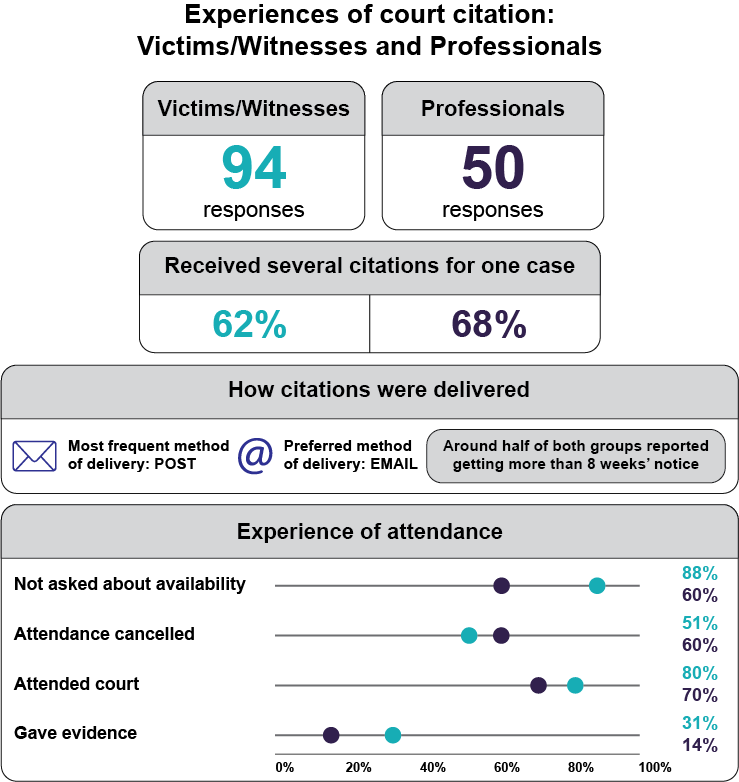
- Of our public survey respondents, 59%[37] were dissatisfied or very dissatisfied with their experience of being cited; 23% were neither satisfied nor dissatisfied and only 18% of respondents were satisfied with their citation experience. These statistics mirror what we heard in interviews from those who interact with witnesses – that citation processes require significant improvement.
“Nothing appeared to have moved on substantively this century. The reliance upon communication by mail is quaint at best.”
Public survey respondent
- Respondents to our public survey advised that, while post had been the most frequent method by which they had been cited, email would be their preferred option. Respondents also consistently told us that delivery of citation by police officers was their least preferred method to receive a citation.
“Police (although) pleasant appearing at your house can feel intimidating if not frightening and embarrassing.”
Public survey respondent
- Almost two-thirds of respondents advised that they received several citations for the same case. This was echoed in our case review, with each witness being cited on average 2.25 times. One sheriff and jury case had 19 witnesses and six separate sets of citations issued. Repeated adjournments or ‘churn’ has been a longstanding issue that agencies across the justice system have sought to address.
“I was cited to attend on multiple occasions (5 I think) yet only asked to give evidence on my final visit. When not called, there was no real cohesive explanation as to why you were not called … I never understood why Police Officers had to hand deliver a citation to me - it is the 21st century! An email or text would be far more efficient and less costly of already overstretched Police Officers time.”
Public survey respondent
- Of the witnesses, 78% reported that they had not been asked to provide availability prior to being cited. This was supported by our wider inspection, where we found the processes for checking availability of witnesses to be inadequate or non-existent. For further discussion of this issue, which builds failure and delay into the justice system, see paragraph 248.
“No consideration is given to witness availability despite unavailable dates being submitted.”
Public survey respondent
- Trials can be cancelled for multiple reasons[38] and just over half the respondents to our public survey advised their citation was cancelled at some point. Of those respondents who did attend court, only a third gave evidence. In our case review, only 17% of witnesses instructed to be cited ultimately gave evidence. Many respondents to our survey were understandably upset about having to attend court and not give evidence. While it is out of scope of this inspection, it is apparent that more must be done to communicate to witnesses why trials do not proceed. Many of the survey respondents were unhappy with a lack of updates on processes that occurred when they were at court. It is the responsibility of SCTS staff to update witnesses while at court. On many occasions the reason a trial does not proceed will be beyond the control of COPFS and it is important – for the sake of transparency – that witnesses are informed why they are being sent away and if they will be required at a future date.
- The following picture shows the survey break down by type of witnesses:
- Citation is only one process in the wider justice system, and understandably many witnesses advised us of issues that concerned or upset them that went beyond citation. While the volume of citations means that a tailored citation approach for every witness is impractical, our survey highlighted that there are questions about whether COPFS is adopting a trauma-informed approach. The main themes of the impact on witnesses taken from the public survey are:
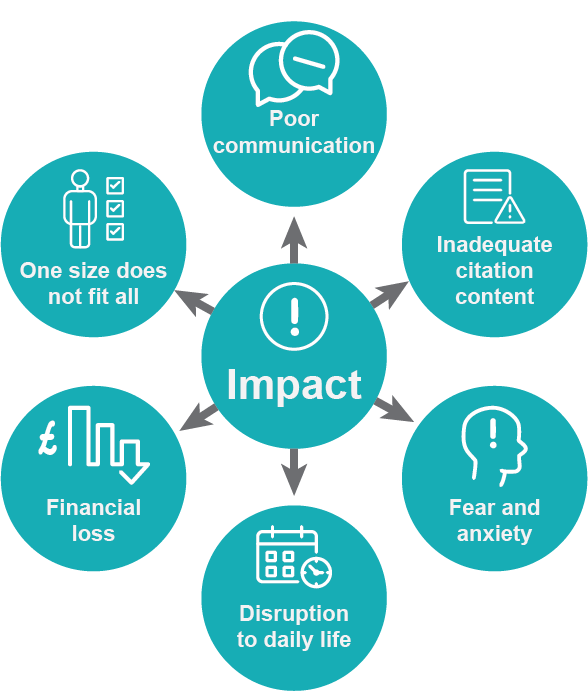
- Fear and anxiety – while court attendance is beyond the remit of this inspection, many respondents took the opportunity to explain how potential interactions in the court building caused them fear. In designing citation processes it is imperative that COPFS work with their justice partners to ensure that witnesses are prepared to give evidence in the best and safest way possible. In the context of citations, information is key, so that witnesses know what to expect. This aligns with the safety principle of trauma-informed practice.
“There aren't a lot of places to wait around and you run the risk of also sitting waiting in close proximity to the accused in your case.”
Public survey respondent
- Poor communication – many of our respondents were upset about the length of time COPFS took to respond to communication from witnesses. Response times to witnesses seeking excusal from attendance at court is a particular area of concern and is discussed further at paragraph 389. Other areas of weakness identified in our survey include inadequate communication on the day of trial and communication being too late in the process – such as being cited with a few days’ notice. Such poor communication often impinges upon the collaboration and trust principles of trauma-informed practice.
“The whole process is poorly explained and it's hard to get information about citation. Communication with Procurator Fiscal Service could be improved. They don't respond to emails and don't answer the phone.”
“My experience led me to clearly conclude that nobody in the system could [not] care less about victim experience. I was to give evidence about a highly traumatic offence. Took time off work for nothing, and nobody even had the decency to call me until after my mother emailed the court complaining I had not been told. Witnesses being told of a guilty plea should happen immediately.”
Public survey respondents
- Disruption to daily life – of the respondents to our public survey, 54% reported that they missed work or education,[39] 22% cancelled plans such as holiday or appointments[40] and 18% had to find childcare,[41] which again added to stress and anxiety. Some felt no consideration was given to travel time if they lived far from the court they had to attend, and some reported having to make their own accommodation arrangements. While citation of witnesses is necessary, it is questionable whether the justice system is doing enough to implement trauma-informed principles of choice and empowerment for witnesses regarding remote evidence and considered court scheduling.
“The court case was to be held over three days, whereas I was initially told it was one day. I thereafter had to make emergency childcare arrangements which caused me upset.”
“I have to travel 150 miles to Court, so I required to book travel and accommodation. Ultimately, the case was adjourned on several occasions, each time a day or so before the hearing. Planning travel is challenging and reclaiming costs was expected to be an issue as hearing did not take place.”
“It’s always short notice and after our surgeries are booked: then we have to get locums or reorganise surgeries, it’s frustrating for us and our patients!”
Public survey respondents
- One size does not fit all – we heard from respondents that the trial process, including citation, can cause additional issues for certain groups in society, such as witnesses with learning disabilities and those with medical conditions. From several of the replies we received to the survey, it is evident that some respondents found the citation content difficult to understand. This also raises concerns that the citation process will be particularly difficult to navigate for non-English speakers, or those with limited English. We also learned that there were particular challenges in the citation process for witnesses who work away from their home or work shifts/evenings.
- There are potential additional support measures in place to provide some victims and witnesses with more information and care, including links to support agencies. This is done through referral to the COPFS’s Victim Information and Advice (VIA); however, many witnesses do not fall within the referral categories. We heard from some COPFS staff that those witnesses who are referred tend to receive a better standard of service. In previous inspections, IPS has raised concern over the capacity for summary VIA staff to carry out their function.[42]
“Got my parent to contact as confusing and didn’t want to go.”
“Didn’t tell me what would be asked – just said if vulnerable get in touch – what does that mean? Do you not read my dob when issuing it? When I did get in touch and said I was worried just said I still had to go and answer questions – I didn't want to stand in court and face the man as know he was local.”
Public survey respondents
- Inadequate citation content – many respondents felt their citation lacked what they considered to be essential information. This was particularly the case with professional witnesses, for example, doctors who could not reasonably be expected to know about an incident without further information. Some felt the citation was not user friendly and had too much jargon. Several respondents felt there would be benefit in enclosing information on how to navigate the court process and what happens if the accused pleads guilty or the case is cancelled. This is discussed in more detail at paragraph 276, but it is evident from the response to our survey that citation content is an area in which COPFS could improve.
“The citation was full of too much jargon that someone who doesn't work for law related jobs wouldn't understand. There should be a booklet with the citation explaining next steps and FAQs.”
Public survey respondent
- Financial loss – we noted that the financial impact of citation was a recurring issue. Some witnesses who replied to our survey reported being left out of pocket because of the citation/court process. Having to pay for childcare was a recurring problem. Civilian witnesses can apply for reimbursement of certain categories of costs as expenses, but the rate of these may not cover the actual cost incurred. As a minimum, there should not be a financial cost or loss to a witness who is giving evidence in court.
- Our understanding of the impact of the citations process upon police and forensic scientist witnesses is drawn both from the police survey, and from the interviews and focus groups. Of the police survey respondents, 67%[43] felt that the whole citation process is not at all effectively managed; 32% felt it to be moderately effectively managed; and just 1% felt that it is very effectively managed.
“I can’t think of anything that is working well. This is my experience as a practitioner and now as a manager.”
Police survey respondent
- While police officers have a legal duty to give evidence as part of their role, the survey and fieldwork indicates that the citation process in its current form often has negative impacts upon them, as it also does for forensic scientists for whom evidence giving is a critical part of their job. A number of different (though often related) impacts of the citation process upon the wellbeing, personal and professional welfare of police officers, staff and forensic scientists were revealed:
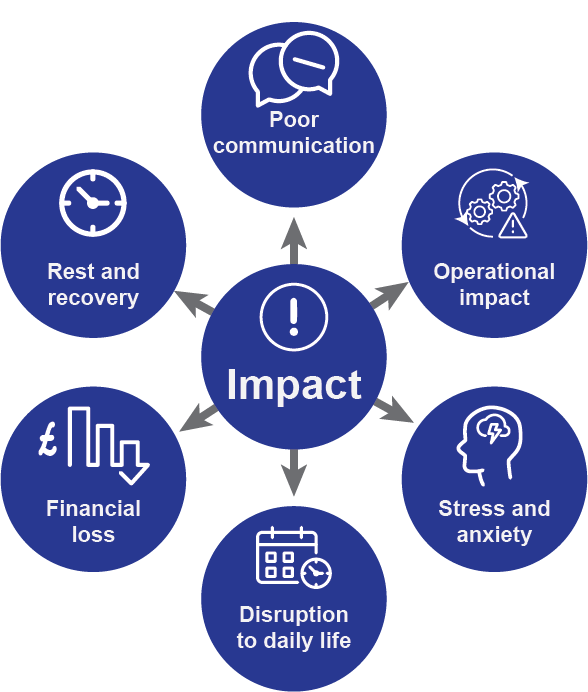
- Poor communication – many police officers and forensic scientists were frustrated by communication with COPFS. They felt that it was challenging to get responses, in particular to excusal requests, and to queries about whether cases were going ahead, causing uncertainty, sometimes forcing emergency arrangements or resulting in cancelled plans. Of the police survey respondents, 95% felt that they had not received a prompt response to their excusal request.
“Court excusals are never answered. As police officers we are expected to answer the PF within days however we don’t receive the same.”
“Mostly good communication when being cited. Poor communication when being countermanded/excused from court when excusals are submitted.”
“Have better, consistent channel of communication for Forensic Staff to be cited/countermanded to avoid time wasting.”
Police survey respondents
Impact on police and forensic scientist witnesses
Shift change |
Re-rostered rest days |
Cancelled annual leave |
Cancelled plans |
Childcare |
Financial loss |
Countermand |
|
Every time |
17% |
9% |
3% |
4% |
9% |
7% |
4% |
Most of the time |
50% |
49% |
15% |
17% |
23% |
16% |
36% |
Half of the time |
18% |
26% |
30% |
25% |
13% |
21% |
35% |
Rarely |
6% |
8% |
39% |
37% |
12% |
29% |
24% |
Never |
9% |
9% |
13% |
17% |
42% |
26% |
1% |
- Operational impact – in the focus groups and interviews, we heard about the operational impact of the citation process, including time taken to chase up excusals and being unable to attend training days unless considered ‘role critical’. When police officers attend court, there can be a knock-on effect upon their workload (and potentially that of their colleagues), but also upon the services they provide to victims and partners, which can, in turn, place further demand upon limited specialisms or resources.
- The main operational Police Scotland shift pattern comprises two dayshifts, two backshifts and two nightshifts, followed by four days off. Being cited to attend court often results in shift changes within this pattern, and it can be challenging for officers to adjust to these changes, particularly in relation to sleep and rest. As illustrated in the graph above, a total of 85% of police respondents experienced a shift change half the time or more.
“..knock on effect of last-minute change/reversion of shifts often meaning lack of sleep for nightshifts due to being countermanded at 1600 hrs that day.”
Police survey respondent
- Rest and recovery impacts – as above, being cited to attend court affects rest days, annual leave and changes in shift pattern. Court citations can often fall into the four days off, meaning that officers are interrupted during their rest period. Missing rest days between shifts was described as causing stress and burnout. Several officers described difficulties in maintaining a work/personal life balance. For example, one officer described working 12 days in a row as a result of rest days being cancelled for court attendance. When a rest day is cancelled, it can be challenging for it to be re-rostered and it can take place at a much later date, hence not providing the break from work. With reference to the graph above, a total of 84% of police respondents experienced re-rostered days half the time or more.
“Disruption of periods of rest – countermanded for some of the trial but told might not be required for another day with no rest day back or payment.”
“Increased stress due to insufficient rest between shifts.”
Police survey respondents
- The police survey also showed that it was common for annual leave to be cancelled due to court citations, with almost half of respondents (48%) having experienced this, as detailed in the graph above. Many felt unable to plan holidays because of not knowing whether they would have an excusal request granted.
- Disruption to daily life – across the police survey, interviews and focus groups, respondents advised that being cited as a witness affected their daily lives in many different ways. Family plans had to be cancelled or missed, including important life events such as funerals and birthdays. Almost half of the respondents (46%) said that they had had to cancel plans at least half the time or more, including medical appointments, as a result of being cited to attend court (see graph above).
- Respondents also described disruption to caring responsibilities and commitments. Arranging childcare to attend court was a particular issue when the court date was on a rest day or annual leave when childcare might not normally be scheduled. Almost half (46%) of police survey respondents needed to find childcare to attend court, as shown in the graph above. This is further described at paragraph 409.
“I care for my parents every Wednesday and have compressed and reduced my hours to accommodate this. I have had to find alternative care for my elderly parents and rearrange appointments for them.”
“I have missed children’s birthdays, and returned from holidays for trials that have never progressed.”
“Not excused for a family funeral.”
Police survey respondents
- Financial loss – police and forensic witnesses advised that they incurred financial loss in certain circumstances in order to attend court, such as through cancelled plans and holidays, and additional childcare costs. Of the police survey respondents, as shown in the graph above, almost half (45%) reported having experienced financial loss as a result of court citations.
- Stress and anxiety – many police and forensic witnesses described impacts upon their mental health (such as anxiety, stress and burnout) caused by the citation process. We were told that this resulted from different aspects of the process, such as from having to miss rest days or annual leave and receiving late countermands. Childcare was a particular cause of stress, with many reporting problems in arranging childcare on days where it was not normally required. Frustration was described due to the frequency with which citations do not result in court appearance or evidence giving, after personal arrangements have been put in place. This left some feeling undervalued and disempowered.
“Awaiting decisions of excusals while on annual leave, anticipation of result leading to anxiousness during leave period.”
“Increased stress due to insufficient rest between shifts. Cancelled dental or medical appointments (including counselling). Missed family events, stress due to very late countermands when a holiday has been booked and paid for months in advance, and I have had to make phone calls to receive updates.”
“I am autistic and find the constant cycle of citation, countermand, citation for the following day (which can last up to a week) extremely draining.”
Police survey respondents
- From interviews, it was clear that COPFS staff are aware that problems with citations can cause delays at court and can lead to adjournments and churn in the system, acceptance of reduced pleas by the Crown and cases being discontinued by the prosecutor.
- SCTS data published November 2025 showed that, over the past five years, an average of 56%[44] of Crown adjournments were due to witnesses failing to attend court, or not being cited. In 2024/25, this figure was 58%, which represented approximately 3,862 trials. Care must be taken to remember that these statistics are a percentage of adjournments granted, due to Crown motions only.[45] In the year 2024/25, 16,810 cases were adjourned on the day of the trial. Witnesses not attending or not being cited account for 23% of the total.
- From SCTS data, it is not possible to know what percentage of witnesses failed to attend because they were not successfully cited, or were cited but failed to attend. COPFS does not record this information in a manner that allows for analysis. During our case review we found difficulty determining why a case had been adjourned due to poor recording of proceedings by procurator fiscal deputes. While prosecutors face significant time pressures at court, it is important that there is an accurate record of which witnesses attended, which gave evidence, and why cases are adjourned. This is discussed further at paragraph 467.
- While we cannot say how often trials were adjourned because a witness did not receive a citation, it is reasonable to conclude that failures in the citation process are having a significant financial impact on the justice system, with thousands of trials being adjourned annually. While COPFS cannot be responsible for the actions of witnesses who choose not to attend when cited, the organisation does not appear to know the scale of the problem or what can be done to reduce it.
- COPFS targets for citations should be aimed at ensuring efficiency of business and providing quality service to witnesses. However, we found that existing targets were often inconsistent across different corporate documents; many are currently not tracked or measured, and some are unachievable. COPFS should identify appropriate and realistic targets to improve efficiency and effectiveness of citation. Such targets must be capable of monitoring, and be monitored with clear responsibility for action identified when targets are not met.
- There are targets and timelines for citations by COPFS (and service of these by Police Scotland) set out in ‘Protocol for witness citation targets’ in summary trials:[46]
- COPFS will issue postal citations and initial personal citations within 7 days of the pleading diet[47]
- COPFS will print out the target date on each citation issued for personal citation
- The police will serve the initial personal citations and return the executions to COPFS no later than 10 working days before the intermediate diet
- The police will serve personal citations where postal citation has failed and return the executions to COPFS no later than 3 working days before the intermediate diet
- Where no intermediate diet has been set, the police will serve the personal citations and return the executions to COPFS no later than 10 working days before the trial diet.
- As far as we could establish during our inspection, COPFS and Police Scotland do not monitor compliance with these targets. It is also not clear who has the responsibility to monitor or ensure compliance. Without an efficient analysis of performance by both organisations there is limited value in such targets being set and published.
- With a focus now on SCM and the replacement of intermediate diets with earlier case management hearings, the ‘Protocol for witness citation targets’ should be revisited and updated to take account of this and other changes in process.
- Although COPFS staff now have guidance on how sheriff and jury citations should be issued, we could find no target aimed at ensuring prompt issue of those citations. And, while summary cases account for the vast majority of citations, it is logical that there should be similar targets for issue and delivery of citations in solemn cases.
- There are targets set by COPFS to respond to excusal requests and countermands of witnesses when a trial is no longer proceeding and these are discussed later in this report.
- We could find no specific organisational targets for witness citations within Police Scotland, either at a national or local divisional level. While Police Scotland has guidance for the service of legal documents, which describes prioritisation of legal documents to be served, as well as guidance for police officers and police staff who have been cited to attend court, we could not find any targets related to either of these processes.
- It is important for any organisation to monitor performance processes through targets and data to ensure efficiency, compliance, effectiveness, manage risk and ensure customer satisfaction. Comprehensive data about the citation of witness process is not readily available and any data can be difficult to extract from the COPFS case management systems. Despite recent work on performance management about the citation process, as described below, there is still room for improvement.
- COPFS business managers receive some data on the citation process in the form of daily management reports. These cover:
- a list of cases where the autocite has not been triggered by the system. This is where:
- the trial is within 14 days of the date citations were due to be issued
- there is a trial within 20 weeks of the date citations were due to be issued and no witnesses have been marked for citing
- any cases where witnesses have not been marked for citing.
These lists allow managers to take remedial action in such cases. The COPFS system will continue to generate the daily lists until the witnesses are cited or the case closed.
- In 2024, COPFS began to monitor the numbers of personal citations issued in both summary, and sheriff and jury cases, after senior officers in Police Scotland raised concerns over the number of personal citations police officers were instructed to serve and the impact this was having on operational policing. Both organisations worked together to identify ways in which personal citations could be reduced. COPFS increased the length of the time civilian witnesses had to return the reply form for postal citations from 21 to 28 days for summary cases, and from 7 to 28 days for sheriff and jury cases, before a personal citation was issued to police officers to serve. The aim was for more witnesses to return their postal reply form before personal citations were issued for police service.
- In September 2025,[48] 2,064 sheriff and jury and 10,822 summary first citations were issued. Of these first citations, data showed:
- in sheriff and jury cases, personal citations after failed postal citations decreased from 18% in December 2024 to 12% by April 2025 – but increased again to 19% in September 2025
- in summary cases, personal citations after failed postal citations decreased from 30% in December 2024 to 20% in September 2025.
These figures indicate that extending the period for postal citation from 21 to 28 days has resulted in a general increase in the number of summary civilian witnesses reply forms being received by COPFS and fewer personal citations being issued to the police to serve in sheriff court proceedings.
- Monitoring this data highlighted the number of cases where personal service of citations rather than postal was used. This revealed that some offices were not following COPFS business rules. Staff were reminded of the business rules and following this:
- in sheriff and jury cases, personal service (excluding default) as set out at paragraph 5 above[49] decreased from a high of 58% in January 2025 to 40% in September 2025
- in summary cases, personal service (excluding default) decreased from a high of 49% in January 2025 to 38% in September 2025.
This shows the value in monitoring performance data for citations, and managers being aware of compliance or training issues. If staff do not follow the correct business rules this can have an operational impact on Police Scotland, with more personal citations being issued for service, rather than postal citation.
- Currently, data on the different type of citations issued in summary, and sheriff and jury cases is only shared among a few senior business managers in COPFS. There is a need for such data to be shared more widely by COPFS through a structured framework of governance, to identify trends and any divergence from the business rules on citation.
- The September 2025 data reveals that – although successful postal citation has increased – there is still a high rate of witnesses who do not return reply forms to COPFS in response to their postal citation. This increases the number of personal citations issued to police officers to serve:
- in sheriff and jury cases, 61% of postal citations failed
- in summary cases, 45% of postal citations failed.
These figures support the need to make it easier, quicker and more accessible for witnesses to respond to COPFS, rather than posting a paper reply form. One obvious option would be to enable witnesses to respond to COPFS by digital means instead, which is explored later in this report.
- Overall, there was little evidence of a performance management culture within Police Scotland regarding witness citations, with minimal oversight and accountability of day-to-day operations. As with COPFS, there were no clear mechanisms for monitoring or following up on citations approaching key dates, and no routine scrutiny regarding citation volumes, outstanding citations, timescales, or staff workloads. The approach was mainly reactive, with issues only addressed once they became problematic. Officers and staff responsible for administering citations described an overwhelmed, fragile system with no resilience.
- Our divisional fieldwork in Police Scotland revealed similar limited evidence of performance management culture regarding witness citations, and none driven from a national level. Where performance management information was collected in divisions, it was often recorded in very basic ways and there was no identifiable consistency of approach. This information was sometimes used to determine staff resources in the delivery of citations, but it was not sought centrally.
- We found that there was no systematic approach by Police Scotland to gathering or analysing performance data, further highlighting the absence of a structured framework for oversight in this area. We found no indication that citation-related performance information is routinely reported to the SPA. Without accurate collection of meaningful performance data, it is not possible to effectively evidence or assess whether organisational commitments, continuous improvement efforts, and strategic objectives are being met for the citation process.
- COPFS and Police Scotland are in the process of developing a joint performance dashboard – a visual digital aid that will collate key performance measures from both organisations in a single view. There will be a number of measures on the joint dashboard, including the number of citations issued. Over time, this dashboard could be expanded to incorporate additional targets such as those relating to excusal requests. This would allow both organisations to identify areas of good practice and strong performance, and areas for improvement.
Recommendation 1
COPFS and Police Scotland should:
(a) review the targets in the ‘Protocol for witness citation targets’ to take account of the business rules on automatic citing and removal of intermediate diets in summary case management cases. Compliance with these targets should be monitored and performance data analysed; and
(b) ensure all citation performance data is measurable and is collected, analysed and reported through governance structures to monitor performance across both organisations.
- It is important for any organisation to know how much a process costs to properly consider its efficiency and provide data for strategic planning and budgeting. COPFS cannot currently accurately determine the full costs relating to the witness citation process.
- Most civilian witness citations are issued by second-class Royal Mail in the first instance. Postage costs are calculated on volume of ‘bundled items.’ Each bundle can include different types of documents including citations, so it is not possible to isolate the postage costs for citations. Some police stations can receive personal citations from COPFS via DX[50] but, again, we found there was no certain way to identify witness costs relating to this method. In addition, costs associated with locally printing witness citations cannot be quantified as such ‘on-demand citations’ are not monitored.
- As previously explained, civilian witnesses are entitled to reclaim certain expenses from COPFS when they attend court to give evidence.[51] Witness expenses for COPFS amount to approximately £1.25 million annually, with sheriff courts (summary, and sheriff and jury) accounting for around £1 million per annum.[52] The text reminder service discussed at paragraph 378 adds an additional annual cost of approximately £11,000.
- COPFS should identify a method of identifying overall costs associated with the citation process to help with monitoring and budgeting. If the citation process were to become more digitalised, knowing current costs would enable COPFS to carry out a cost benefit analysis to assess the value of such a change.
- We requested the financial data that Police Scotland or the SPA holds for costs relating to citations. We found that Police Scotland is currently unable to determine the exact cost associated with administering and delivering witness citations, or that of officers’ attendance at court to provide evidence. Police Scotland collects some but not all citation data; we were unable to establish the reason for this. Quantifying the actual cost would enable a more evidence-based basis for service redesign.
- Police Scotland was only able to provide approximate figures[53] drawn from the LDD for the number of citations received and served. In the year from October 2023 to October 2024, Police Scotland estimated[54] that they had approximately 154,000 witness citations to serve.
- Police Scotland used information gathered from its own interviews and focus groups to estimate the average time to serve a citation. This noted a huge variation in delivery time due to factors including rural versus urban locations, number of delivery attempts and whether the citation was being delivered by a dedicated citations server or response officer. It projected that the resource requirement for the above volume of citations ranged between 173,000 and 280,000 hours, equating to the annual workload of a very wide-ranging 98 to 164 full-time officers (approximately). Police Scotland acknowledges that these are subjective estimates, and that it does not collect data that would enable it to evidence this more accurately. Nonetheless, it gives a rough indication of the amount of resource and cost that Police Scotland expends upon the process of serving citations.
- We also requested data relating to the financial costs of officers attending court as witnesses, and costs relating to this, such as the requirement to bring officers in to cover shifts to enable court attendance. Police Scotland does not gather comprehensive data to quantify the number of officers cited, attend court and ultimately give evidence, despite its current IT system (SCoPE) having the ability to do so. Gathering this data would enable it to better calculate the costs incurred and provide a more accurate view of the resource impact of officers attending court.
- We found that, currently, the only occasion when Police Scotland gathers data on police witness court attendance on SCoPE is when overtime is incurred. This could be used further to capture information relating to all citations.
- Police Scotland reported that, during the 2024-25 financial year, £2,663,643 was spent on police overtime for officers attending the sheriff court. Of this, £455,244 was for overtime incurred in relation to solemn cases, and £2,208,399 was in relation to summary cases. Data relating to 1st April to 31st August 2025 showed that 79.42% of court overtime related to the sheriff court and cost £822,926.
- In the year to date (as at September 2025), we were advised that, in 75.6% of cases in which overtime was claimed, police witnesses did not give evidence; evidence was given by police officers in 14.4% of overtime for court claims; and it was not recorded whether evidence was given or not in 10.0% of claims. This figure of evidence given is higher than the preceding five years, where evidence was recorded as being given in between 9% and 12.1% of cases where officers claimed overtime for attending court. However, no accurate data was provided on how many officers overall gave evidence, which is a significant gap in management information.
- There is an additional potential cost to Police Scotland when police officers are cited to give evidence. If a police witness’s shift has to change for them to attend court, it is sometimes necessary to bring in other officers to ensure the minimum number of officers are available to cover a particular shift. Having a one-day citation to court can result in an officer being unavailable for two nightshifts. Officers brought in to provide this backfill are paid overtime. In the 2024/2025 financial year, £90,766 was spent to enable police witness court attendance through backfill cost. The data is not broken down by the type of court (so may include High Court and Justice of the Peace) or shift.
- We noticed that there were very marked variations of overtime costs relating to shift cover across different police divisions. It was suggested to us that these variations are unreliable. We were advised in several interviews with police officers that backfill costs to enable police witnesses to attend court were not always recorded as such. This may indicate differences in awareness or understanding of how to appropriately claim and record such overtime and that better communication, business governance or training may be needed. In our fieldwork with police officers, the backfill costs were often described as the ‘hidden costs’ of court attendance as they are not captured within the main court overtime cost.
Recommendation 2
COPFS and Police Scotland should develop a clear and consistent method of identifying all costs associated with the citation process and police officer court attendance.