
Related Downloads
Additional
Key findings
1 Policing has effective strategic leadership. Leaders across policing are working well together, supported by open and constructive relationships.
2 The current strategic outcomes, shaped by stakeholder engagement, are broad. Police Scotland’s 2030 Vision has sharpened focus, and the upcoming 2026 review of statutory plans offers a timely opportunity to improve strategic alignment and clarify overall priorities.
3 Police Scotland is now focused on delivering the next phase of reform to achieve its vision for policing of safer communities, less crime, supported victims and a thriving workforce.
4 Governance arrangements are effective, but scrutiny could be improved through better coordination of business across SPA committees.
5 In response to the significant concerns raised on institutional discrimination and racism, policing has committed to addressing inequalities. Significant work is ongoing to embed equalities across its activities.
6 Policing has set ambitious targets to become more environmentally sustainable, but these are not within Police Scotland’s core strategies. It is likely that CO2e emission targets will not be achieved.
Vision
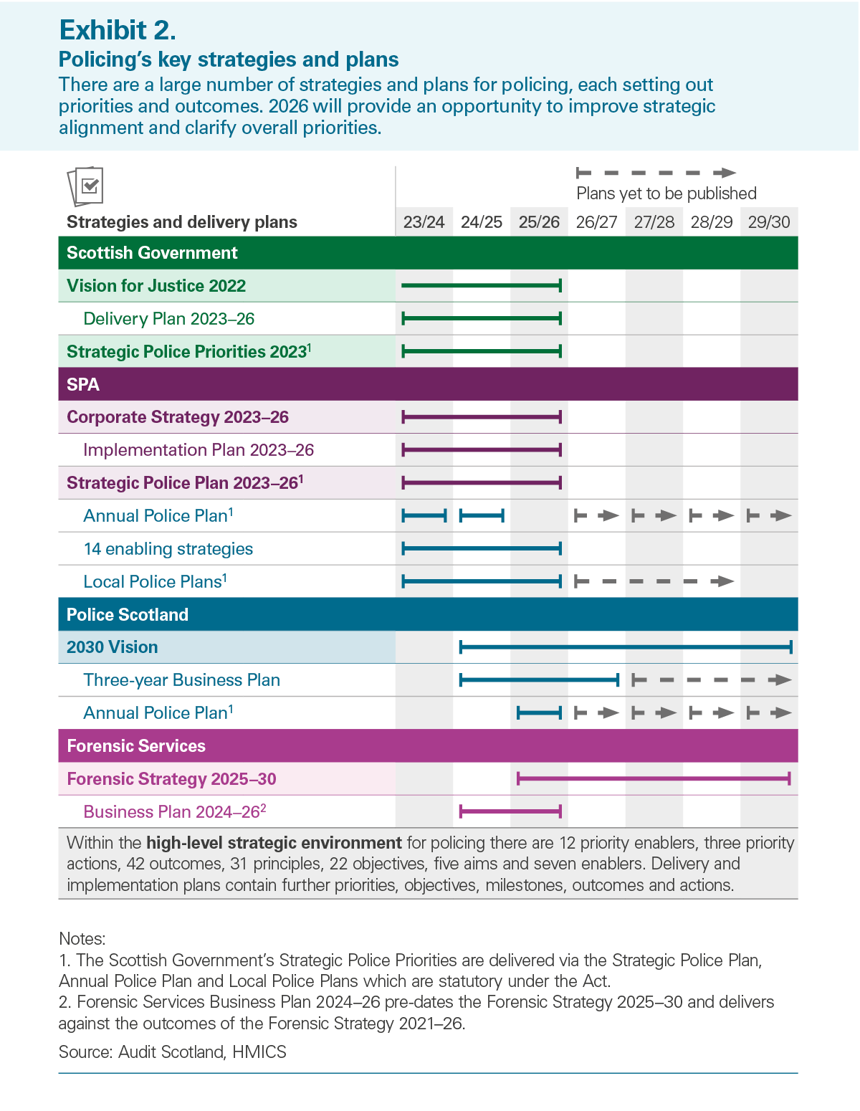
11. Policing operates within a statutory planning framework as set ou t in the Act. Policing’s strategic direction is set out in the Strategic Police Priorities and the statutory Strategic Police Plan (Exhibit 2, page 16). The Strategic Police Plan 2023–26 is a joint strategy between SPA and Police Scotland. It is broad and priorities and outcomes are not well defined. This makes it difficult to see how the strategic intent has been translated into specific, actionable objectives or measurable goals across policing (Recommendation 1).
12. Police Scotland’s 2030 Vision has clarified its strategic priorities but has shifted focus away from the Strategic Police Plan (Recommendation 1).
- The 2030 Vision and Three-Year Business Plan (2024) set out clear priorities for how Police Scotland intends to meet future policing challenges and its focus for the next phase of reform.
- While the 2030 Vision aligns with the broad objectives of the statutory Strategic Police Plan, the 2025/26 Annual Police Plan and performance reporting now focus on the 2030 Vision rather than delivery of and progress against the Strategic Police Plan. The status of strategies that support delivery of the current Strategic Police Plan is now unclear.
- In 2026, the Strategic Police Plan and Local Police Plans are due for review, alongside Police Scotland publishing its final business plan for the 2030 Vision (Exhibit 2). If Scottish ministers refresh the Strategic Police Priorities after the Scottish Parliament election in 2026, there will be a requirement for policing to review the statutory Strategic and Local Police Plans again.
13. Structured engagement with stakeholders and the workforce helped shape policing’s vision and priorities, securing support for the strategic direction. However the impact of public involvement was limited.
- Policing uses a range of structured engagement methods to actively gather and incorporate feedback from key stakeholders and local partners. This has helped refine strategic language, sharpen areas of focus, and reinforce commitments to partnership working.
- Individual bodies effectively involved their workforces when setting their own strategic priorities and outcomes. Workforce involvement in the development of the overarching Strategic Police Plan was limited. Despite this, the SPA is not planning to change its approach for the upcoming review.
Exhibit 2.
- While the impact of public involvement in shaping policing’s core strategies and vision was limited, Police Scotland does make effective use of rolling surveys and direct engagement with the public to inform local policing responses and operational decisions (Case study 3, page 37).
14. Strategic leadership is effective across policing, and senior leaders have established open and constructive working relationships.
15. There were a number of changes in SPA leadership and Board in 2025 and early 2026 (Exhibit 1). Our fieldwork found that good succession planning and induction was in place to manage the transitions.
16. In 2024, an annual workforce survey was reintroduced across policing. Results from Police Scotland and Forensic Services highlight the need for leadership to improve staff engagement (eg, how it listens and acts on feedback and how it communicates change).
- Police Scotland’s leadership team is taking action to improve its visibility and better communicate what the 2030 Vision means for officers and staff.
- Forensic Services established a short-life working group to address those areas identified for improvement.
- Results from the 2025 workforce survey show a two percentage point overall improvement from 2024 in engagement in Police Scotland, with improvements in all areas surveyed. Overall senior management scores improved for both Police Scotland and Forensic Services, in particular around communication.
- Policing has committed to acting on the results to drive improvement and undertaking an annual workforce survey to listen to workforce in future years.
17. Police Scotland has restructured its senior leadership portfolios several times in the last few years, most recently in March 2025, to streamline governance, clarify roles and responsibilities and ensure alignment with operational and organisational priorities. While the full impact of these changes is still emerging, early indications are positive including more collaborative cross-portfolio working towards clear priorities. As policing has now moved into phase two of reform, the current structure should be kept under review so the long-term effectiveness of its strategic portfolios can be assessed.
- Between 2016 and 2024, change and digital, finance, estates, human resources and procurement were overseen by a deputy chief officer (DCO), a senior police staff role. In 2024, the DCO post was removed from Police Scotland’s senior leadership structure, and its responsibilities redistributed across three deputy chief constable (DCC) portfolios.
- In March 2025, a further restructure re-shaped the existing DCC portfolios; introducing a DCC portfolio focused on transformation; consolidating all operational policing under a single DCC portfolio, and grouping enabling services and all matters related to professional standards into another distinct DCC portfolio.
18. Governance arrangements are effective. The SPA Board demonstrates good oversight of the key challenges facing policing and there is a good level of challenge and scrutiny at committee meetings.
19. We observed that the current scrutiny arrangements can sometimes result in duplication of reports or isolated discussions leading to inefficiencies which may impact on effective decision-making (Recommendation 3).
- The 2024 HMICS strategic review found scope for the SPA to ‘consider more overt, improved and systematic coordination across its committees to support scrutiny’.
- Our observation of the SPA committees continued to identify some duplication of information provided and issues discussed across the committees.
- The SPA Forensic Services Committee sits as a standalone meeting. However, given the significant amount of change ongoing across policing, there is a risk that this siloed approach could lead to information being considered, and decisions being made in isolation without consideration of wider strategic priorities across policing.
20. Police Scotland has acknowledged it needs to address serious equalities issues. Policing has set out clear commitments to do so in strategic plans and significant work is ongoing to embed equalities across its activities.
- In recent years, reviews, audits and inspections have found serious equalities concerns. In 2023, the then Chief Constable acknowledged that Police Scotland was institutionally discriminatory and racist.
- The current Chief Constable has set out in her 2030 Vision the commitment for Police Scotland to become an anti-racist, anti-discriminatory organisation.
- Police Scotland is coordinating all its work and improvement activities to address equalities concerns via the Policing Together programme and strategy (2022). Since spring 2023 this has been led by an assistant chief constable.
- Police Scotland is also responding to an internal audit (2024) which found that policing does not have effective arrangements in equality and human rights impact assessments.
- Police Scotland and Forensic Services workforce surveys highlighted areas for improvement, however our fieldwork revealed a positive cultural shift towards tackling equalities issues.
- The SPA recently (2024) undertook a Best Value deep dive into equalities leading to improved compliance for equalities in its self-assessment.
21. An assessment of Policing Together and progress against the strategy will be undertaken by HMICS as part of its planned scrutiny for 2026–28.
22. Policing has set clear environmental targets. However, Police Scotland does not set out environmental priorities or outcomes in its core strategic plans and recent progress is slower than expected.
- The SPA and Forensic Services have both set out specific sustainability outcomes in their core strategies and identified areas for improvement in their Best Value self-assessment (Appendix 2).
- Police Scotland has many interrelated environmental strategies and plans but its core strategic documents – the 2030 Vision, Three-Year Business Plan and Annual Policing Plan – make limited reference to environmental sustainability or goals. A 2024 internal survey revealed awareness of sustainability initiatives among senior leaders was low.
- Recent reports to the SPA Board indicated that significant progress has been made, however it is ‘highly likely’ that policing’s 35 per cent target to reduce CO2e emissions by end of March 2026 will be missed. The wider public sector is also facing challenges in reducing emissions.