
Related Downloads
Additional
Key findings
1 Financial management is strong with services delivered within annual budgets over recent years. Progress has been made in medium-term financial planning, and a new plan is in development. A financially sustainable policing model for the future needs to be set out.
2 Strategic workforce planning remains underdeveloped, and progress is slow. Policing now needs to put forward its case for the next stage of police reform, focussed on workforce modernisation. This includes improved management of the existing pressures on workforce.
3 Lots of improvement activity is taking place however, transformation programmes have not been effectively managed or delivered at pace. Police Scotland has failed to realise or demonstrate intended business benefits to the level expected. Work is in progress to address weaknesses in strategic oversight and coordination, but it is too early to assess the impact. There has been progress made with digital services and plans show what is needed to make estates fit for purpose. These all require effective management and significant investment.
Exhibit 3.
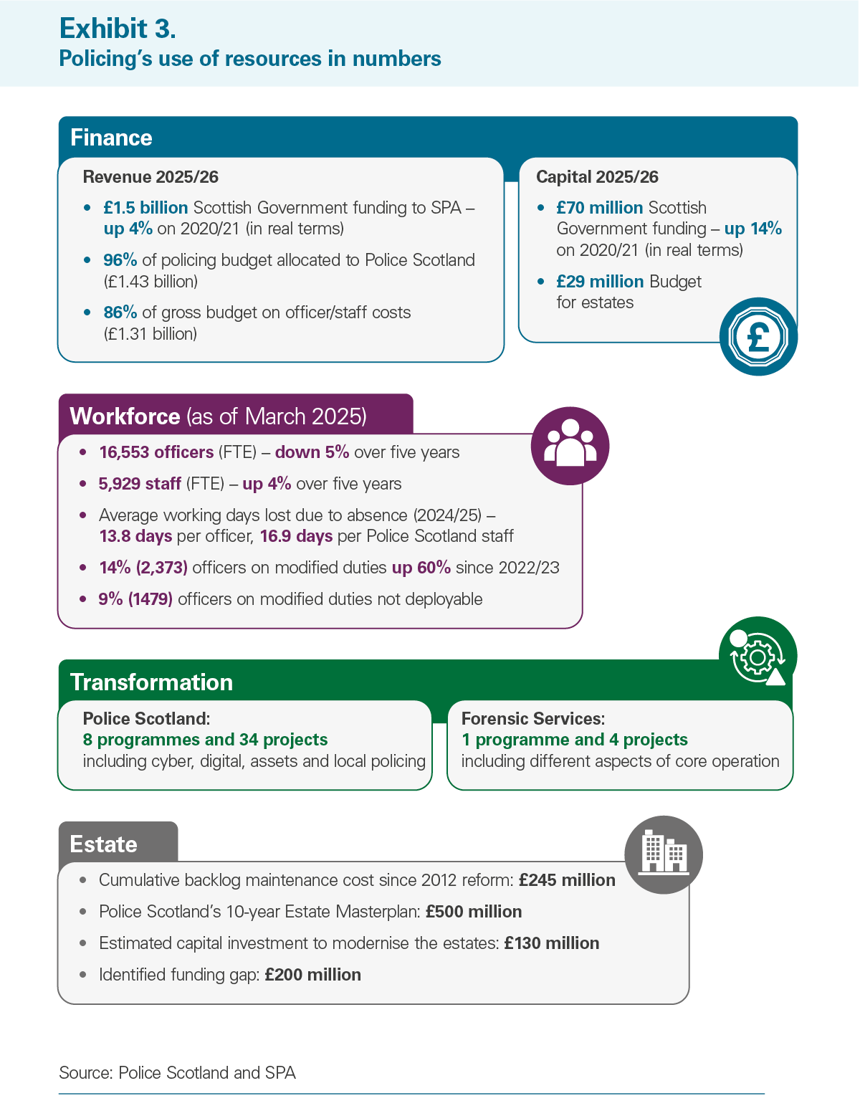
23. Financial management is strong, with balanced budgets being delivered since 2021/22. This is achieved through careful monitoring of costs throughout the year including active management of workforce numbers.
24. Progress has been made in MTFP. However, policing is still to demonstrate a financially sustainable model for the future (Recommendation 4).
- Policing’s annual funding settlements and late funding allocations in year makes financial planning focused on priorities challenging.
- Policing lost the ability to maintain reserves and to borrow as a result of the shift from local to central government after reform. This poses particular challenges in managing the multi-year capital programme. The capital budget is over-committed each year to allow flexibility to respond to potential slippage and incurs significant late year spending, which is regularly reported as an ongoing risk to the SPA Resources Committee. Effective monitoring of the timing and the cost of the projects to make the best use of the capital budget is required.
- The current policing MTFP 2022/23–2026/27 (MTFP, 2021) is linked to the previous 2020 Strategic Police Plan. As such, there is no clear link to the current strategic priorities and outcomes.
- While no MTFP update has been published since 2021, financial scenarios are developed as part of the annual budget cycle.
- Policing plans to finalise its next MTFP in the first quarter of 2026/27. It aims to support the prioritisation and allocation of financial resources to ensure effective service delivery aligned with strategic outcomes.
25. ‘People are supported’ is one of the strategic outcomes set out in the Strategic Police Plan. Police Scotland has a clear and ambitious strategic intent to build a thriving workforce, which forms one of the four pillars of the 2030 Vision.
- The next stage of reform aims to enhance police officer presence in communities and invest in the workforce to enable a coordinated approach to health, safety and wellbeing and an improved offer on training and development.
- To ensure it has the capacity to deliver on its vision for policing, Police Scotland is focused on workforce modernisation. As part of this, it aims to review staff and officer roles and deploy staff investigators and other non-warranted roles to release officers back to front-line duties.
26. Police Scotland’s current Strategic Workforce Plan (2023) is not sufficiently developed or implemented at pace to meet its strategic intent (Recommendation 5). Audit Scotland, HMICS and the external auditor have previously reported that workforce planning is underdeveloped.
- The plan does not set out what the future workforce should look like to deliver its strategic priorities and outcomes.
- It is not clear the impact of actions undertaken to date and how effective the delivery approaches have been. The milestones have been realigned, and progress has been more limited than originally expected.
- The plan is not aligned to MTFP. As such, the current financial and workforce plans do not support meaningful discussions within policing on budgets or with Scottish Government on funding.
- Police Scotland intends to present updated financial implications of the workforce plan to deliver the 2030 Vision in the first quarter of 2026/27. Following this, it plans to roll out more evidence-based workforce performance reporting.
27. In October 2025, Forensic Services published its first Strategic Workforce Plan, developed in collaboration with Skills for Justice. The plan provides a solid foundation to support its strategic outcomes but further work is needed to align it with policing’s MTFP.
- The plan sets out what the future workforce could look like to deliver its strategic priorities and outcomes. It includes scenario planning and demand forecasting, which support projections as to the size and skillsets of the workforce required over the next five years but an alignment is still to be made to policing’s MTFP.
28. Police Scotland highlighted the Scottish Government’s focus on police officer numbers and no compulsory redundancy policy as a limitation to workforce planning but these should not stop policing putting forward its case for ensuring an effective workforce for the future.
- The Scottish Government has not formally set a police officer target number since 2016/17, however it requests and publishes statistics on the number of police officers each quarter which it states provides ‘a snapshot of police strength’. Policing uses an officer establishment number in building up its cost base for the budget process (16,500 FTE for 2025/26). There is no evidence to support this being the number required to deliver effective policing for the future.
- As part of its 2026/27 pre-budget scrutiny submission to the Scottish Parliament’s Criminal Justice Committee, Police Scotland set out the need for around 850 additional officers and 350 additional police staff over the next two years to strengthen community policing and address emerging risks.
- The Scottish Government has a no compulsory redundancy policy, which also applies to police staff. Policing highlighted that it has been impacting its ability to effectively plan and re-shape its workforce.
29. Police Scotland recognises more could be done to manage the current pressures on the workforce effectively, maximise capacity and utilise the resources available. It must speed up delivery of its Modified Duties Improvement Plan, as the current and increasing number of officers on modified duties is not sustainable (Recommendation 5).
- Staff associations have highlighted various pressures the workforce is under, which have an impact on wellbeing. In addition to maintaining day-to-day policing, officers are routinely deployed for large events and traditionally non-policing responses such as mental health and distress incidents (Case study 2, page 31).
- Police Scotland notes that mental health issues remain the most common cause of long-term absence for officers and staff. In 2024/25, absence cost £80 million for Police Scotland and absence levels remain higher than pre-Covid levels (Exhibit 3, page 21).
- The increasing number of officers on modified duties (accounting for 14 per cent of the total officers) creates a resourcing pressure and is not sustainable.
- Police Scotland has not made enough progress in managing the growing number of officers on modified duties, which was first identified as an issue in 2021. Many are placed in roles that don’t require warranted powers or specialist police skills, which is affecting front-line service delivery and could harm staff wellbeing.
- In August 2025, Police Scotland set out its Modified Duties Improvement Plan. It recognises it must balance the need to maximise front-line capacity, to support service delivery and staff wellbeing, while also ensuring its approach to reasonable adjustments complies with the Equality Act 2010 and other legislation and case law.
30. Lots of transformation activity is taking place (Case study 1, page 30), however Police Scotland has not effectively managed its transformation portfolio in the past. Policing recognises this and positive steps have been taken to address weaknesses, but it is too early to assess the impact of these recent changes and have confidence policing will deliver the transformation required at pace (Recommendation 6).
- Transformation programmes have lacked effective governance and prioritisation. There has been a lack of strategic oversight and coordination. Policing has failed to realise or demonstrate intended business benefits to the level expected.
- As part of Police Scotland portfolio restructure (paragraph 17) a single deputy chief constable now manages the transformation portfolio (including digital), a director of transformation has been re-introduced, and the governance arrangements are streamlined to strengthen oversight of transformation activity.
- Work is in progress to improve prioritisation of the projects and better tracking and reporting on the benefits and impact of change during 2025/26.
31. Forensic Services has its own transformation programme. It highlighted that the reliance on Police Scotland providing part of corporate support services limits its ability to effectively use its resources and deliver its strategic priorities and outcomes (Recommendation 6).
32. Progress has been made in addressing many of the digital and data challenges following reform. However, funding digital transformation remains challenging.
- Progress made includes the introduction of a single national operating system which unified the fragmented legacy systems, investment in cybersecurity and resilience, implementation of digital evidence sharing capability, and roll-out of body worn cameras (Case study 1, page 30).
- Until recently, digital was not well integrated with other elements of strategic planning and transformation. Police Scotland’s leadership restructure is a positive step towards its ambition of moving from ‘doing digital to being digital’.
33. Policing has set out its long-term estate strategy. They have reduced the number of buildings and have increased the number of co-locations . To ensure deliverability, the implementation will require effective prioritisation and project management as well as significant investment (Recommendation 6).
- Police Scotland recognises its current estate is unsustainable The maintenance cost has accumulated with a large portion of the portfolio nearing the end of its useful economic life and operational use.
- The ten-year Estates Masterplan (2024) aims to modernise the policing estate to meet the needs of the future in line with the 2030 Vision. It sets out the organisational objective and the longer-term intention for the estate. Police Scotland is now working on a prioritisation and implementation plan.
- Police Scotland estimates that around £500 million will be required to deliver the masterplan, with a £200 million funding gap still to be addressed.
- A chief estates officer has recently been appointed to take forward the masterplan under the strategic direction of DCC Professionalism and Enabling Services.