
Related Downloads
Additional
Key findings
1 While lots of improvement activity is taking place and significant amounts of performance information is published, there is no clear reporting against strategic outcomes over time. As a result, policing cannot clearly demonstrate continuous improvement against those outcomes.
2 There is no integrated approach to Best Value self-assessment across policing. The individual bodies are at different stages in how they use the results to drive improvement.
3 Policing is self-aware and recognises where it needs to improve. olicing must coordinate and share organisational learning and best practice to effectively prioritise the use of its resources, deliver change and continuous improvement at pace.
41. Policing has performance frameworks and extensive reporting in place to support public scrutiny. However, it does not clearly demonstrate progress towards achievement of its strategic outcomes. As such, the rate and scale of improvement cannot be effectively assessed (Recommendation 2).
- Public performance reporting provides a lot of information (supported by good practice examples). However, the volume of material produced can have an impact on the effective scrutiny of strategic priorities and outcomes.
- Success measures for policing’s strategic outcomes are limited and are not Specific, Measurable, Achievable, Relevant and Time-bound (SMART).
- Reporting lacks a focus on outcomes and does not always provide a balanced picture, does not always highlight underperforming areas or barriers identified and its actions to address those.
- Forensics Services – The 2025/26 performance framework sets out key performance indicators with relevant targets and who it benchmarks with. Quarterly performance reports include a balanced scorecard which shows progress on key activities by strategic outcome area. However, it has not been updated to reflect the current Forensic Services Strategy 2025-30 developed in May 2025.
- Police Scotland – The 2025/26 Performance and Accountability Framework, endorsed in September 2025, improves on the previous version. It introduced strategic indicators to monitor progress against outcomes and Police Scotland plans to develop a balanced scorecard to reflect those indicators. However, it still lacks clarity on how it will support Police Scotland to progress against strategic outcomes and the impact of policing activities. Performance measures still have no targets or baselines.
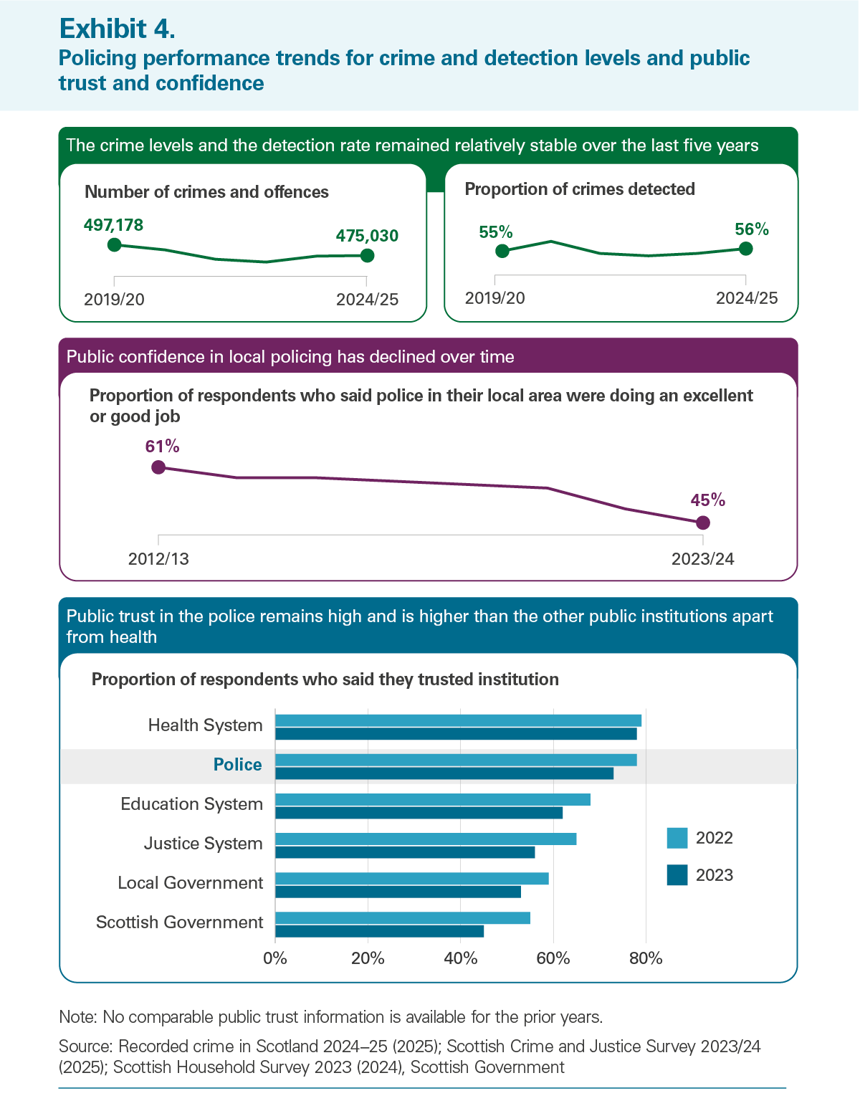
42. Performance information for crime and detection rates, public trust and public confidence is shown in Exhibit 4 (page 35). The nature of threat, harm and risk has been changing and becoming more complex, from communities into homes and online.
43. Policing is using performance data to support improvement:
- Police Scotland is proactively using data to better understand public confidence and to inform their improvement actions and operationa l responses (Case study 3, page 37).
- The SPA and Police Scotland are using benchmarking information such as the total crime levels compared to the other UK forces, but it is not yet routinely included in performance reporting nor clear how it supports improvement. They are looking at how they can use this more effectively in Police Scotland’s performance reporting.
44. While lots of improvement activity is taking place, there is no co-ordinated approach to best value self-assessment across policing (Appendix 2, page 40) and the individual bodies are at different stages (Recommendation 7).
- The SPA has a well-established (since 2021) approach to assessing itself against the Best Value characteristics. Results from its 2025
Exhibit 4.
self-assessment indicate a high level of compliance. Actions to be undertaken are incorporated into its annual business plan which ensures oversight of improvements.
- Forensic Services followed a similar approach to the SPA and completed its first self-assessment in 2025. Results showed good compliance. It is unclear how it is following-up the areas for improvement.
- Police Scotland undertook its first review of activities against Best Value themes in 2025. It took a different approach to the other two bodies and chose not to rate compliance against each theme. There are a number of areas for improvement identified as part of the self-assessment, but it is not clear how the areas for improvement will be addressed and tracked. A lot of useful information was gathered as part of the review, such as staff views, that could be used further to help identify how improvements could be made.
- The areas of improvement identified through the three Best Value self-assessments are consistent with what we have identified in this report.
45. A 2019 Scottish Government-commissioned evaluation of how policing in Scotland met the aims of police reform found evidence that progress against the three aims was uneven. While progress was made in reducing duplication and providing greater access to specialist expertise, the benefits to community and local policing were less clear.
46. Police Scotland has set a clear vision for what it wants to achieve in the next phase of reform. This includes strengthening policing in communities to meet the current and future demands. Progress with this should contribute to one of the aims of the original reform.
47. Policing had struggled to set and achieve a balanced budget since its inception. Since the last Auditor General section 22 report (2020) there have been continuous improvements in leadership, financial management and governance (paragraph 23). This provided assurance to the Scottish Government, leading to reform funding being baselined into revenue funding from 2023/24.
48. However, progress has been slow in demonstrating effective transformation, improvements in front-line policing, medium-term financial and workforce planning and performance management.
49. Policing reports that since 2012/13, police reform has delivered an estimated £290 million of annual efficiency savings, compared to the previous structure of policing. This historical reporting is valid but effective reporting of the benefits of current reform and transformation activity is now key to meeting the Best Value expectation of demonstrating continuous improvement. A baseline of cost and performance information needs to be set to measure progress against.
50. There are a significant number (around 250) of open recommendations from a range of inspection and audits bodies. In 2025, Police Scotland strengthened arrangements to better prioritise higher risk recommendations and introduced divisional dashboards to increase accountability and scrutiny at this level.
51. Policing is self-aware and recognises where it needs to improve. Policing now needs to work together to embed the principles of Best Value in all it does and to make the most of organisational learning and professional development of the workforce to drive continuous improvement.
Case study 3. Public confidence in local policing
The SPA has highlighted that Police Scotland is facing continuing challenges around building and maintaining public confidence in local policing. Police Scotland’s 2030 Vision is renewing focus on local and community policing to understand and improve public confidence.
While public trust in the police as a whole remains high (Exhibit 4, page 35), the level of public confidence in local policing has declined:
- The Scottish Crime and Justice Survey 2023/24 found 45 per cent adults said police in their local area were doing an ‘excellent’ or ‘good’ job – a decrease from 61 per cent in 2012/13.
Public confidence in local policing can fluctuate due to factors not linked to performance; however, confidence does impact if and how members of the public engage with police.
Those living in areas of deprivation have been shown to have lower confidence in the police. Policing worked with partners and communities on the Community Confidence Action Research project (2021–24) to understand and improve confidence levels in communities experiencing deprivation. The research and various survey results found police visibility and connectedness, and wider responses to anti-social behaviour key drivers of local confidence – more so than policing major events or international issues.
Since reform, greater emphasis has been placed on the development of a national force with specialist capabilities such as public protection rather than community policing. As part of delivering the next phase of reform, Police Scotland’s refreshed Policing Together programme (2024) includes a Communities pillar, and in its 2030 Vision, focus is on community policing with the ambition of increasing confidence levels within communities and with partners:
- The new Enhanced Community Policing Model outlines how community policing, active investigation and resolution hubs and incidence response can effectively work together to increase capacity, efficiency and better prioritisation to build public confidence. A pilot project is under way in Forth Valley Division and there are plans for the national roll-out of this model by 2027/28.
- Police Scotland is routinely using data and public surveys to identify ways to enhance confidence in local policing. Police Scotland reports data insights quarterly to Strategic Leadership Board for discussion, as well as to regional delivery boards and directly to local policing divisions. It feeds intelligence into its Policing Together strategy. Divisions are using these insights to tailor local communications and target visibility and availability of local police officers to where there are concerns.
- Thirty new deployable community advisors are providing Police Scotland with greater representation of minority communities and supporting decision-making to mitigate potential community tensions.
The roll-out of the community policing model is in initial stages. In the current Performance and Accountability Framework (paragraph 41) Police Scotland is using its Your Police survey to measure confidence in local policing and gauge performance against the Supported Victims pillar of the 2030 Vision.
Source: Police Scotland, Audit Scotland, HMICS